


This is an op-ed by Dennis Sammut, contributed to commonspace.eu
The 1st European Games open in Baku on 12 June 2015. It is an occasion for celebration for the six thousand athletes participating and for those who enjoy sports in its different forms. This event has however divided Azerbaijani society, as well as international public opinion. Some have questioned the wisdom of spending billions of dollars on sports in a country that still lacks many necessities in the fields of health and education. Others point to the arrests of dozens of human rights activists and journalists in the run up to the games. The Azerbaijani government on its part says that this criticism is orchestrated by enemies of Azerbaijan, and is based on double standards. It dismisses any claims of repression saying that all those arrested have broken the law in one form or the other.
These different views represent the very stark contradictions of contemporary Azerbaijan - on the one hand a country that has modernised and made tremendous progress in a very short time, on the other hand a country whose institutions often appear untouched by change, and continue to be managed in Brezhnev era style, some by people who were appointed during the Brezhnev era. The contradictions are everywhere - from the quality of life of the people, some enjoying prosperous living, others hardly having access to decent education and health care - down to the way that Azerbaijan communicates with the outside world, with sleek public relations firms and Soviet style propagandists dishing out daily contradictory messages to their heart's content.
Baku in 2015 is therefore a tale of two cities, and no one should dismiss either lightly or categorically because there is truth in both.
Fariz Ismailizade, a respected academic at Azerbaijan's Diplomatic Academy wrote on his facebook page on the eve of the Games,
"Today is the last day of preparations for the 1st European Games. Tomorrow will be the grand opening. Seeing so much colour, passion, energy, youthfulness in this city, I am absolutely convinced that it will be the best day in the thousands years long history of Baku and this nation. And some can say whatever they want about the purpose of these games. But the matter of the fact is that this nation, torn with war, poverty, desperation and occupation only 2 decades ago, has managed to transform itself to the levels which developed nations didn't achieve in such a short period of time and pulled together such a world class event with its own resources and this once again proves that this nation and this country does deserve an independent statehood and is capable to governing its own future. Congratulations, Azerbaijan !!!! Feeling very proud".
Emin Milli, an Azerbaijani dissident and former political prisoner who now manages an independent media outlet, Meidan TV, from exile in Berlin, wrote,
"As Azerbaijan prepares to roll out the red carpet to European athletes, a number of journalists and activists are languishing in jails."
Elmira Khadijova, the mother of one of those prisoners, journalist Khadija Ismailova, told Meidan TV,
"Personally, I will not watch these games. I am over 70 years old. Instead, I want to see Azerbaijan's open-minded, free thinking individuals released from the prison."
The success of critics to capture the attention of world public opinion has alarmed the Government of Azerbaijan. Many close to the Azerbaijani leadership have now convinced themselves that there is a conspiracy against their country, and an attempt by western countries to force regime change in Azerbaijan. This is dismissed as sheer fantasy by politicians and diplomats dealing with the country in western capitals. Indeed many countries genuinely want Azerbaijan to succeed both politically and economically, and have constantly advised the government and its opponents to compromise and dialogue, rather than confront each other. There is however increased frustration in the international community at the actions of the Azerbaijani government. The decision to close down the Baku office of the OSCE, a few days before the start of the Baku Games, was greeted with astonishment and cited as yet another example of how Azerbaijan shoots itself in the foot.
There is some reason to believe that Baku's paranoia is being fed by a third country, whose interest it is to see Azerbaijan isolated. The government of Azerbaijan must not fall into this trap.
As long as Azerbaijan remains a part of the international community and the family of European nations, including through its membership of the Council of Europe and the OSCE and its partnership with the European Union, all of which demand from their members high standards in respect to human rights and good governance, it must expect rigorous scrutiny of its record in these fields. This is not interference in sovereignty but a process of solidarity between countries who share common values.
However those criticising Azerbaijan also need to be more targeted and focused in their criticism. Sheer outright condemnations are not useful for anybody.
For the reasons that Fariz Ismailizade mentioned, the Baku Games, with all their controversy, are an important moment for Azerbaijan, and one can only wish that they are successful - an occasion to celebrate unity in sports, as well as the European character and achievements of the modern Azerbaijani Republic.
Beyond the fun and games there are however more important issues. Once these games end the Azerbaijan leadership must take stock of the situation and take some hard decisions. In many ways the Baku 2015 Games have become a defining moment for Azerbaijan, not for what actually will happen during the time of the games, but for what will happen immediately after.
source: Dennis Sammut contributed this op-ed for commonspace.eu. Dennis Sammut is the Director of LINKS (Dialogue, Analysis and Research).
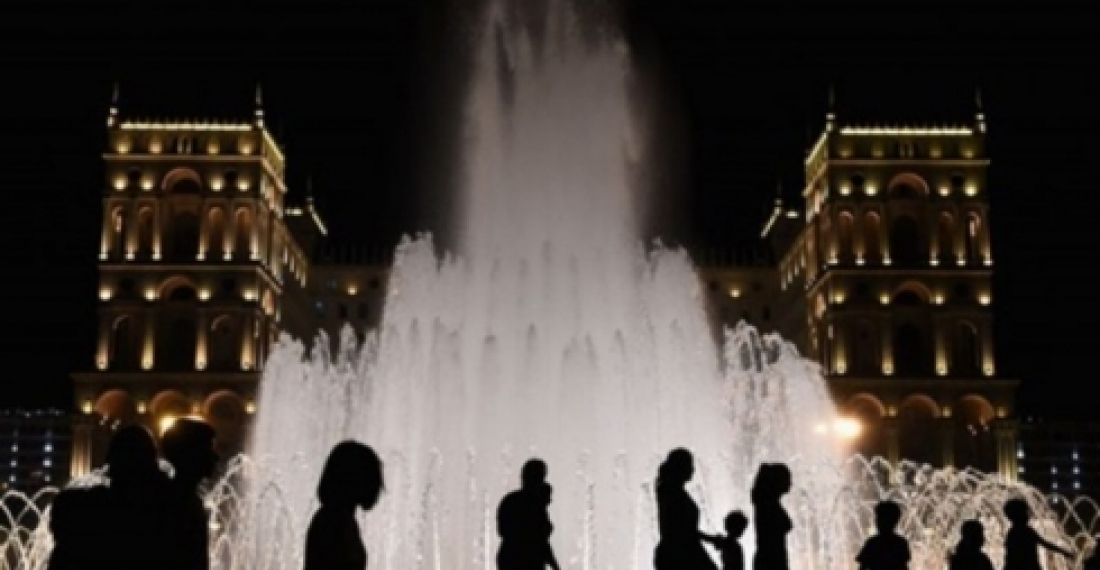
photo: Soviet era style Government Building in the centre of Baku, illuminated ahead of the Baku 2015 games (picture courtesy of baku 2015).



