


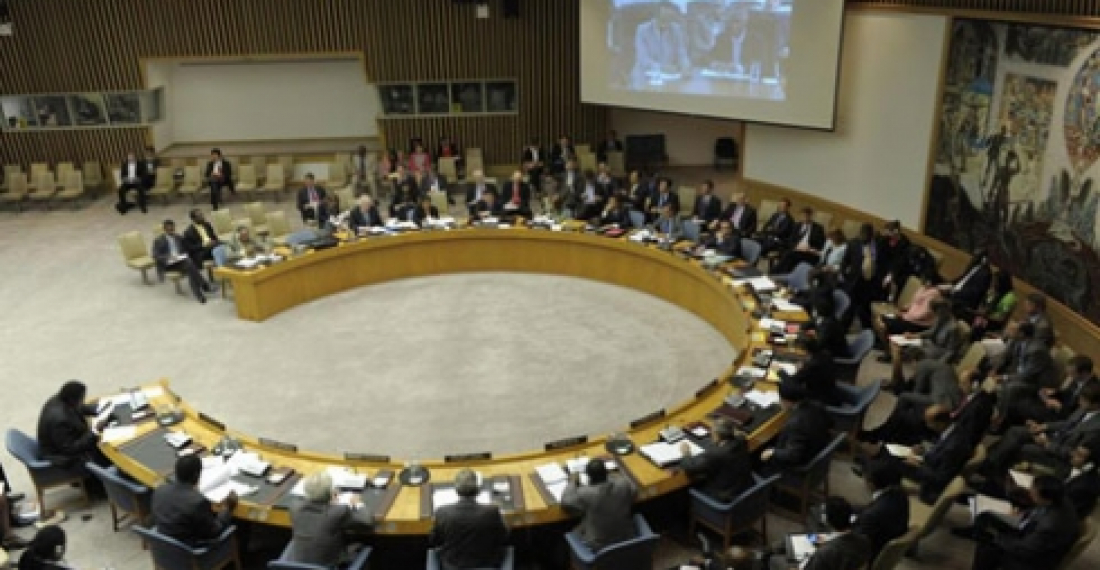
Azerbaijan's bid for a seat on the UN Security Council still undecided

Guatemala, Morocco, Pakistan and Togo will serve as non-permanent members of the 15-member Security Council in 2012-13 after winning their seats during elections held on Friday (21 October) at the United Nations Headquarters in New York. But a fifth vacant seat, which is allocated to an Eastern European country, remains unfilled after no country passed the necessary threshold during nine rounds of voting.

UN Member States voted in the General Assembly by secret ballot for five non-permanent seats divided by geographical grouping – three from Africa and the Asia-Pacific region, one from Eastern Europe, and one from Latin America and the Caribbean. To win election, a country must receive a two-thirds majority of those countries present and voting, regardless of whether or not they are the only candidate in their region. Voting continues until the threshold is reached for the required number of seats.

In the Eastern European category, after nine rounds of voting, no country had met the two-thirds majority threshold.  In the ninth round of balloting, Azerbaijan obtained 113 votes and Slovenia received 77 votes. A new vote will now take place on Monday.

Azerbaijan has been intensively lobbying for the Security Council seat for more then one year, and has secured the support of influential international organisations such as the Organisation of the Islamic Conference (OIC), The Arab League and the Non-Alligned Movemement. Azerbaijan Foreign Minister Elmar Mammadyarov was present in New York during today's vote.

Today’s elections were held to replace the departing members of Bosnia and Herzegovina, Brazil, Gabon, Lebanon and Nigeria.

The new members will join Colombia, Germany, India, Portugal and South Africa, whose terms end on 31 December 2012, and the five permanent Council members, which each wield the power of veto – China, France, Russia, the United Kingdom and the United States.

source: commonspace.eu

photo: The UN Security Council in Session (picture courtesy of the UN News Service)

Related articles

Editor's choice
News
European leaders set out their plan for Ukraine

European leaders set out their plan for Ukraine

The leaders of Germany, Denmark, Finland, France, Italy, Netherlands, Norway, Poland, Sweden, and United Kingdom, together with the President of the European Council, and the President of the European Commission, o  Monday (15 December) issued a statement, outlining their plan for Ukraine. In their statement, Chancellor Merz, Prime Minister Frederiksen, President Stubb, President Macron, Prime Minister Meloni, Prime Minister Schoof, Prime Minister Støre, Prime Minister Tusk, Prime Minister Kristersson, Prime Minister Starmer, as well as President Costa and President von der Leyen spoke about "Peace for Ukraine". The Leaders welcomed significant progress on President Trump’s efforts to secure a just and lasting peace in Ukraine. They also welcomed the close work between President Zelenskyy’s and President Trump’s teams as well as European teams over the recent days and weeks. They agreed to work together with President Trump and President Zelenskyy to get to a lasting peace which preserves Ukrainian sovereignty and European security. Leaders appreciated the strong convergence between the United States, Ukraine and Europe. Leaders agreed that ensuring the security, sovereignty, and prosperity of Ukraine was integral for wider Euro-Atlantic security. They were clear that Ukraine and its people deserved a prosperous, independent, and sovereign future, free from fear of future Russian aggression. Both the US and European leaders committed to work together to provide robust security guarantees and economic recovery support measures for Ukraine in the context of an agreement on ending the war. This would include commitments to: Provide sustained and significant support to Ukraine to build its armed forces, which should remain at a peacetime level of 800,000 to be able to deter conflict and defend Ukraine’s territory. A European-led ‘multinational force Ukraine’ made up from contributions from willing nations within the framework of the Coalition of the Willing and supported by the US. It will assist in the regeneration of Ukraine’s forces, in securing Ukraine’s skies, and in supporting safer seas, including through operating inside Ukraine. (Click the image to read the statement in full).

Popular


