On 5 November, the Yasamal District Court in Baku notified the editors of the “Azadliq” (“Freedom”) newspaper that the publication’s bank accounts would be frozen. This decision was related to a court verdict against “Azadliq” in a libel suit brought by businessman Anar Mammadov, the son of Azerbaijani transport minister Ziya Mammadov.
Mr Mammadov had filed a complaint against the opposition “Azadliq” and “Yeni Musavat” newspapers for an article printed in July 2010, which reported that Mr Mammadov had paid one million manat (approximately 1m Euros) during the Gabala Music Festival in order to have a bear slaughtered for a barbecue. In January 2012, the Yasamal District Court had ordered the newspaper to pay a fine of 4,200 manat, a decision that was later upheld by the Baku Court of Appeal.
According to the newspaper’s first deputy editor, Rahim Hajili, “Azadliq” had been notified a week earlier that it was due to pay the fine but had filed a judicial complaint against the decision. In such case, Mr Hajili noted in comments to the “Caucasian Knot” news website, the court order should be suspended. “The illegal seizure of the paper’s bank accounts paralyzes its activities, which actually entails criminal liability for obstructing the legitimate activities of journalists," Mr Hajili told the “Caucasian Knot”, adding that in his view the court decisions had a political background. “Seizure of the accounts is one more step toward the elimination of opposition papers.”
“Azadliq”, ideologically close to the opposition Popular Front Party of Azerbaijan and critical to the current government, has been published since December 1989. With a print-run of 9,000, and a readership estimated to be rather higher due to the sharing of copies, it is one the best-selling papers in the country. In recent years, however, “Azadliq” has repeatedly faced problems. In March and April 2011, two of its journalists, Seymour Khaziyev and Ramin Deco, were abducted one shortly after the other, threatened and subjected to physical and psychological pressure in order to abandon critical reporting, according to information released by press freedom watchdog Reporters Without Borders. Due to changes in the newspaper distribution network in Azerbaijan, “Azadliq” and other publications also have increasing difficulties to reach their audience. The GASID distribution company, which serves mainly independent and opposition-leaning newspapers, has had many of its own newsstands shut down, while other kiosks either do not carry newspapers at all or do so only in insufficient numbers.
“Azadliq” currently faces also fines from other court cases brought against it in the past year. Apart from the complaint of Mr Mammadov, these include claims brought by the head of the Baku Metro system, member of parliament Novruzali Aslanov, and the head of the “Bina” Shopping Centre in Baku. The cumulated amount of fines imposed on the paper totals more than 65,000 manat. At the same time, the GASID distribution company owes “Azadliq” approximately 35,000 manats in unpaid revenues. This in turn leads to the paper’s arrears with the state publishing house, which regularly threatens to cease printing of “Azadliq”, Rahim Hajili told the “Caucasian Knot.”
In comments on the libel case brought by Mr Mammadov against “Azadliq”, Ali Hasanov, Head of Department on Social Political Issues of the Presidential Administration, said the Azerbaijani authorities could not “restrict the rights of citizens to protect their honour and dignity in the courts, as well as the rights of courts to consider and take decisions on these matters.” Mr Hasanov noted that it was up to the media to comply with professional ethics and uphold the rights of citizens, contact.az and “Caucasian Knot” report.
But Ali Kerimli, leader of the Popular Front Party of Azerbaijan, said in the framework of a public hearing organised by the Institute for Reporter Freedom and Safety (IRFS) in Baku on 13 November, that “everyone knows that the courts in Azerbaijan are dependent on the executive branch.” Therefore, Mr Kerimli stated, the courts took verdicts against “Azadliq” according to political orders. This should be seen as part of the preparations for “not free presidential elections in October 2013” in Azerbaijan. “If "Azadlig" will be shut down, an important channel to inform the public about violations of human rights will be eliminated. The day after, almost no one will write anymore about the arbitrariness of public officials,” Mr Kerimli cautioned the participants of the public hearing, as reported by the “Caucasian Knot”.
The Intelligentsia Forum of Azerbaijan, a public organisation uniting prominent scientists, writers and journalists, describes the court order against “Azadliq” not only an incident of pressure on the newspaper itself but on “democracy and democracy initiatives as well as fundamental freedom” more generally. In a public appeal, the Forum emphasises that over the past years, “Azadliq” “journalists have been arrested, beaten, insulted and forced into emigration. The newspaper has been removed from its office and placed into premises unfavourable for work. It continually faces unjust court decisions for bigger fines.” The appeal ends by calling on the Azerbaijani authorities to cease all steps directed toward the suppression of the paper and to remove all claims against it.
On the international level, a similar statement has been released by Reporters Without Borders. The watchdog organisation has labelled the court order on the seizure of the “Azadliq” bank accounts an “illegal decision” in a “decisive phase in moves over the past few months to suffocate” the paper.“ Exorbitant fines and a deliberate attempt to squeeze its circulation have put the newspaper in a precarious position, further exacerbated by its bank account being frozen. The paper’s survival is under greater threat than ever, which is precisely the intention of the courts.” Reporters Without Borders, in the statement published on its website, say the Azerbaijani authorities “must finally decriminalize defamation and guarantee independent journalists and media organizations a fair hearing.”
source: Report prepared by Marion Kipiani for commonspace.eu
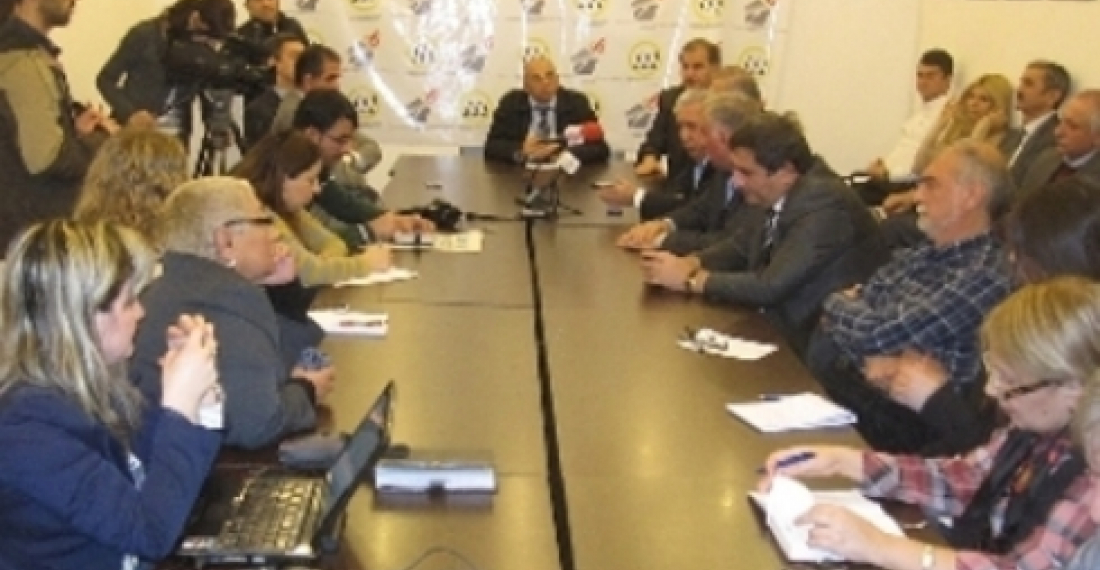
photo: Representatives of Azadliq newspaper making an appeal for support to stop the newspaper from closing down (picture courtesy of www.azadliq.az.)