


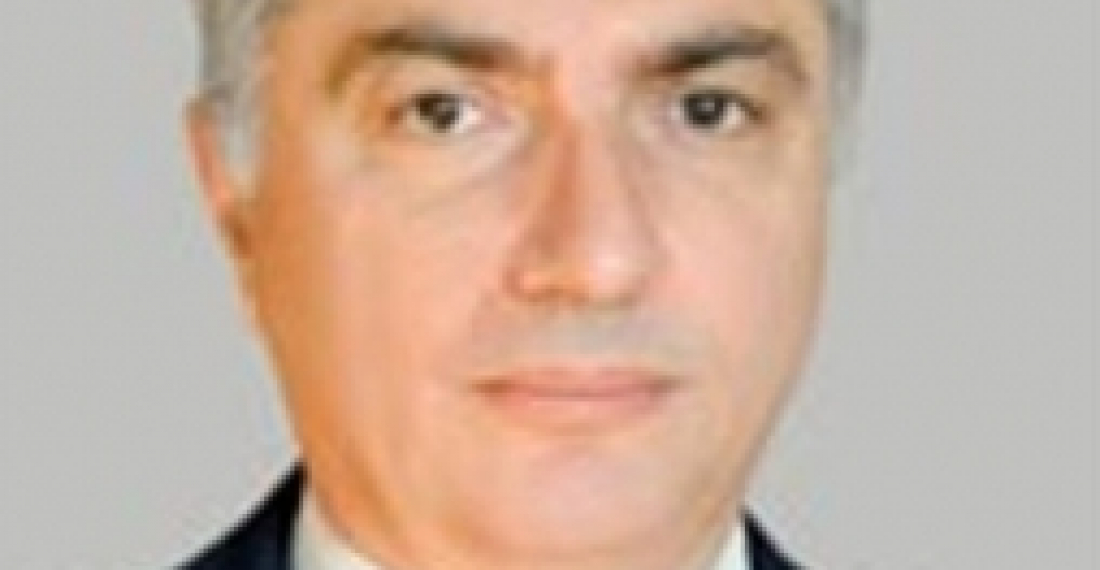
The leader of the Democratic Party of Armenia Aram Gasparovich Sargsyan has warned that Azerbaijan may take advantage of the Iranian crisis and attack Karabakh.
The Armenian politician reflected on the situation in a comment to the Armenian opposition newspaper Aravot in its issue of 13 January 2012. Aram G Sargsyan said "The tension is increasing day by day, nobody wants to make concessions, and if the EU countries really make a decision on 30 January to prevent the export of Iranian oil, it is very likely that Iran will take the corresponding steps, about which it has already declared. It is very difficult to make any predictions. In 2008, when the Georgian-Ossetian conflict broke out, Azerbaijan tried to take advantage of the situation and attacked Karabakh. I discovered this programme at that time and made a public speech in Stepanakert. There was no denial of the fact from Azerbaijan's side. The same can happen in this case, when the situation around Iran unfolds."
Sargsyan was a former presidential advisor and a member of the Armenian parliament from 2003 to 2007.
A report published in December 2010 by the British organisation LINKS summarised the views of the Democratic Party of Armenia on the Karabakh conflict and conflict resolution process. (Read the full report with the views of forty six Armenian and Azerbaijani Political Parties).
The report summarised the views of the Democratic Party of Armenia based on an interview with its Chairman Aram G Sargsyan held in Yerevan on 16 June 2010, and is reproduced here:
■ Position on Nagorno-Karabakh and its future
The party considers an exact position difficult to outline, however it maintains that the fundamental principles of conflict resolution are that it should be peaceful and based on mutual concession. The principle of mutual concession should apply primarily to the status of Nagorno-Karabakh, a status which it considers has been reached in a highly legal way according to the internal legislation of the Soviet Union and under international law. The party considers the establishment of the Nagorno-Karabakh Republic and its statehood as very much in line with international norms.
As the party has attentively followed the process for many years, it has issued over this time numerous speeches and declarations regarding the matter. The party established a committee in defense of Nagorno-Karabakh in 1996 that included around 25 political parties and NGOs, which contributed to the process by making resolutions and declarations for the settlement of the conflict.
The party has been actively organizing and participating in meetings in Moscow with political parties from Nagorno-Karabakh, Azerbaijan and Armenia. This was part of a joint Russian-American project established by the US State Department and Russian Ministry of Foreign Affairs. As a result of six years of these meetings the party has issued a comprehensive package of solutions to the conflict, named the 'Framework Agreement', which was presented to all parties of the conflict. This met with limited success as although the first group of representatives from Azerbaijan which participated agreed to the package, the second group (during the process Azerbaijan decided to send a new group to the negotiations) did not.
Regarding the hostilities of 1989-94 many of the party members participated in the war, but not any of the senior leadership, which contributed to the process in non-combat roles. The Chairman of the party was for example an adviser to the Armenian president from 1998-1999 and therefore involved in the conflict at a strategic policy level. Regarding veteran organizations the party has no official relationships, but does enjoy good private relations with them.
The party also has friendly relations with the authorities in Nagorno-Karabakh as well as with many of the NGOs in the territory, maintaining both official and unofficial relations with them. Senior members of the party have on several occasions held meetings with the government officials from Nagorno-Karabakh, with the exception of the Prime Minister.
■ Position on the peace process and international involvement
The party considers the work of the Minsk Group as a necessity and regards the efforts put forward by it as priceless. The party credits the group with having very much contributed to the process by maintaining the cease-fire between the parties. The DPA however objects strongly to what is considers the Minsk Group working beyond its remit, seeking to resolve the whole matter comprehensively rather than working to its mandate of only resolving the conflict. The party considers them two very specific and different issues, one a problem with Nagorno-Karabakh in a wider regional perspective and the other a problem between Nagorno-Karabakh and Azerbaijan. The party also believes the conflict a product of unresolved issues, something it criticizes the Minsk Group for not discussing as the core reasons for the conflict. The DPA believes that the issue must be discussed in international legal terms and not only within a political framework.
The party considers a political solution impossible, since the Azeris regard the region as theirs, while Armenia and Nagorno-Karabakh fundamentally disagree with them, and therefore an impartial jury is required to decide on a legally binding decision regarding Nagorno-Karabakh. The party believes that there are only six possible solutions to the conflict (1) Legal, (2) Political, (3) Economic integration, (4) War, (5) Preservation of the status quo, and (6) Possible union of the states in South Caucasus, including the unrecognized regions, to begin an integration process with the European Union.
The party is unsupportive of the Madrid principles and calls for their abandonment, as it believes that they can never be realized. The party considers the principles unrealistic as on a daily basis Azerbaijan is making military statements claiming that they are going to start a war to regain the territories of Nagorno-Karabakh and its surrounding areas.
The party is also skeptical of the possibility of peacekeepers which would alter the balance of power in an already problematic region. Iran for example has very difficult relations with both the EU and the US and would never agree to the presence of peace keepers (including NATO troops) in the region. The DPA also objects to the Madrid principles as it considers them as biased, assuming that only the Armenian side should make concessions, with the withdraw of their troops from Nagorno-Karabakh and its surrounding regions. The party considers the status of Nagorno-Karabakh as the primary issue and does not agree with the principle that it should be considered secondary, and has called on the prime minister of Nagorno-Karabakh to withdraw his initial agreement to the principles.
Regarding the role of international actors, the party maintains that the co-chairs within the Minsk Group are the most appropriate for the job and fully adequate, as all the international bodies are presented through France, Russia and the US. Turkey, however, cannot participate in any capacity, as they are considered the defenders of Azerbaijan. The DPA believes that when Turkey closed its borders with Armenia this was a sign of aggression according to international law, something however the international community does not criticizes Turkey for, and highlights the irony that whilst Turkey is criticizing Israel for blockading Gaza, they are doing just the same to Armenia.
■ On people to people contacts and civil society activity
The party believes that confidence building measures are very important for finding a final and comprehensive solution and insuring that trust can emerge between the parties before the final settlement. The party is involved in such work, arranging on an annual basis an international conference in Yerevan which Azeris are invited to with security guarantees, unfortunately however they do not always participate. The party believes that the people of Armenia are very friendly towards Azeris, but unfortunately this cannot be said for Armenians travelling to Azerbaijan.
Regarding free movement the party maintains it is already contributing to this, and is ready to receive and invite Azeris to Armenia. However the party believes that the reluctance of Azeris to visit Armenia is due to the fact that they are demoralized and consider themselves a defeated nation, and cannot accept the fact that the Nagorno-Karabakh people can sustain a statehood and national life independent of Azerbaijan. The party however advocates that the borders between Armenia and Azerbaijan should be reopened and that the border regions should be renovated, something which is in both nation's interest. However, for this to happen President Aliyev must cease from repeating or making any aggressive military statements.
■ Other information
The DPA contested the parliamentary elections in 1995, 1999 and 2003 and claims to have 3750 members of which around 75% are men and 25% are women. It currently has no members of parliament.
source: commonspace.eu
photo: Aram G Sargsyan, Chairman of the Democratic Party of Armenia (archive photo)



