


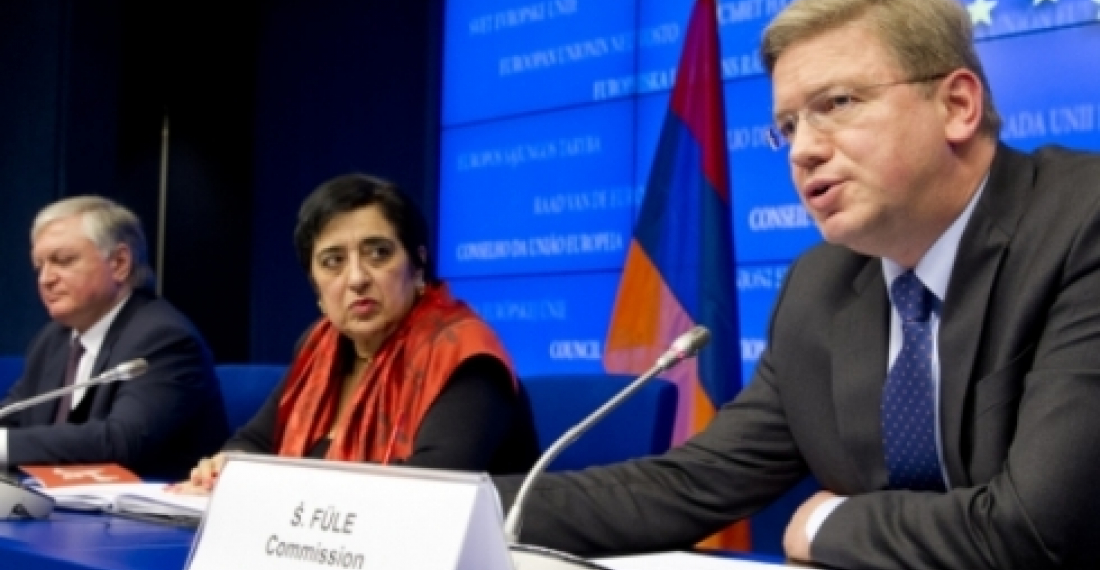
The Cooperation Council between the European Union (EU) and the Republic of Armenia held its thirteenth meeting on Monday 17 December 2012. The EU was represented by Dr. Erato Kozakou-Marcoullis, Minister of Foreign Affairs of the Republic of Cyprus, acting as Chair of the Cooperation Council on behalf of the High Representative of the Union for Foreign Affairs and Security Policy, Catherine Ashton, and Štefan Füle, Commissioner of Enlargement and European Neighbourhood Policy. The Armenian delegation was led by Mr. Edward Nalbandian, Minister of Foreign Affairs of the Republic of Armenia.
This meeting took place in a very intensive year for bilateral relations, including visits to Armenia by the President of the European Council, Mr. Herman Van Rompuy, President of the European Commission, Mr José Manuel Barroso, and Commissioner Füle, and a visit by the President of Armenia, Mr. Serzh Sargsyan, to Brussels earlier this year.
Using the same language as had been stated earlier in the day during the meeting of the EU-Azerbaijan Co-operation Council, a statement from the European Union said that "The Cooperation Council reviewed progress on the settlement of the Nagorno Karabakh conflict. The EU reaffirmed that the status quo is unacceptable and that the solution of this conflict remained a top priority. Both sides reiterated their support to efforts deployed by the OSCE Minsk Group. The Cooperation Council reviewed progress on the settlement of the Nagorno Karabakh conflict. The EU confirmed its complementary role in support of confidence building measures. The EU also expressed concern on incidents at the frontlines. The EU urged both sides to maintain stability on the ground and to refrain from aggressive, belligerent statements and actions that would increase tension."
The Cooperation Council underlined the need to remain focused on implementation of reforms, in parallel to the negotiations of the Association Agreement, including the Deep and Comprehensive Free Trade Area. The sides agreed to start soon the negotiations of an Association Agenda, intended to replace the ENP Action Plan and to prepare for the future implementation of the Association Agreement.
The European Union encouraged Armenia to conduct fair and transparent presidential elections in February 2013, addressing OSCE/ODIHR recommendations presented following the May 2012 parliamentary elections.
EU Commissioner for Enlargement and European Neighbourhood Policy, Commissioner Stefan Fule stated at the meeting"
"I said already in September in Yerevan that we managed to move our agenda to a higher level. And this Council only confirms that Armenia and the EU get closer to each other in concrete ways:
There are already some specific achievements - a short while ago we have signed the Visa Facilitation Agreement and protocol concerning Armenia's participation in EU programmes. For people this is a visible and tangible result of our close partnership.
But there is more on our ambitious agenda. The negotiations of the Association Agreement, including the Deep and Comprehensive Free Trade Area, have progressed well. For a successful outcome which allows EU-Armenia relations to reach their full potential, we will need sustained reform efforts next year.
We welcome progress made by Armenia in the conduct of May parliamentary elections. At the same time, we trust that Armenia will address the remaining OSCE/ODIHR recommendations in the context of presidential elections in February next year. This is a crucial issue for a relation based on common values.
We welcome Armenia's efforts in the area of good governance and human rights. Important challenges remain, including ensuring independence of the judiciary and pursuing systemic anti-corruption measures.
The goals and ambitions are clearly defined. Now it is about how to turn them into reality. Armenia can of course count on EU's support. We hope to be able to make a very positive assessment of the strengthening of our relationship during the Eastern Partnership summit in Vilnius next year."
The signature ceremony for two agreements took place before the Cooperation Council. The first was the Visa Facilitation Agreement, which together with Readmission Agreement (to be signed at a later stage and enter into force simultaneously) will be a first step to creating conditions for secure and well managed mobility, including a visa-free regime in due course. The second was a Protocol to the EU-Armenia Partnership and Cooperation Agreement: this protocol concerns participation by Armenia in EU programmes, and will create a legal basis for the Armenian institutions to benefit from closer contacts with its EU counterparts.
Commonspace.eu political editor said in a comment: "Relations between Armenia and the European Union have moved at a much faster pace than it would have been possible to imagine even five years. Both sides have shown a desire to set these relations on a high qualitative level as soon as possible. The EU has welcomed the speed with which Armenia has implemented some changes that were necessary for this process to move ahead. The fact that the Parliamentary Elections in May 2012 were deemed to have been considerably better than previous ones, and the existance now of a pluralistic parliament has helped this process. There however remains a constructive amibiguity on a number of issues in the relationship, and the process remains fragile. Contradictory signals from Armenia on issues related to human rights and the democratic process create some scepticism in European circles. On its part Armenia is wary of the strategic relationship developing between the EU and Azerbaijan in the energy sector, and fears this may cloud the EU position on that issue. It is important that the two sides are aware of these concerns and that they take steps to address them. The signing of the visa facilitation agreement was an important signal that the two sides are serious in wanting to take the relationship forward."
source: commonspace.eu with the Press and Information Service of the European Union
photo: Armenian Foreign Minister Edward Nalbandian with the Foreign Minister of Cyprus Dr. Erato Kozakou-Marcoullis and EU Commissioner Stefan Fule at the 13 Armenia-EU Co-operation Council Meeting in Brussels on 17 December 2012. (picture courtesy of the Cypriot Presidency of the EU.)



