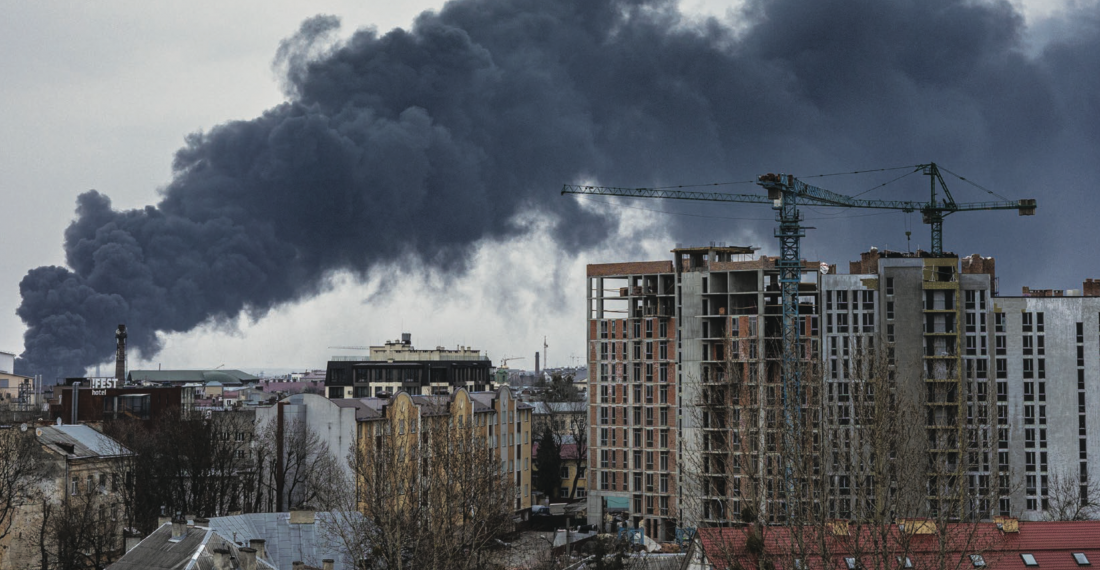
Russia’s invasion of Ukraine in February 2022 shattered Europe’s security architecture, with far-reaching and unpredictable implications for conflicts in neighbouring regions where Russia plays a role. This discussion paper, just published by Conciliation Resources, focuses on the impacts of war in Ukraine on the peace processes of the South Caucasus, a region fractured by protracted conflicts dating back to the 1990s.
Russia’s invasion of Ukraine in February 2022 shattered Europe’s security architecture, with far-reaching and unpredictable implications for conflicts in neighbouring regions where Russia plays a role. This discussion paper focuses on the impacts of war in Ukraine on the peace processes of the South Caucasus, a region fractured by protracted conflicts dating back to the 1990s.
A first impact is the precipitous decline in Moscow’s capacity to maintain its already challenged position as the primary security actor in the South Caucasus. After Turkish support helped Azerbaijan to overturn the status quo in the Karabakh conflict in 2020, Russia appeared to reassert itself by brokering an end to that conflict which assured Russian interests. War in Ukraine, however, has in its first year substantially depleted both Russia’s material capacities as a military power and, as importantly, its reputation as a security patron to states and communities in the South Caucasus, and Eurasia at large.
A second impact is the acceleration of the already evident decline of multilateral institutions in the South Caucasus. While the Geneva International Discussions convening Abkhaz, Ossetian, Georgian, Russian and United States representatives have continued despite successive postponed meetings, the Minsk Group of the Organization for Security and Co-operation in Europe (OSCE) responsible for mediating between Armenia and Azerbaijan has effectively disintegrated. In its place rival Armenian-Azerbaijani negotiations tracks mediated by Russia and the European Union (EU) have appeared.
A third impact is a renewed securitisation of the South Caucasus, reflecting declining belief in both Russian security guarantees and capacity to deter violence. Repeated escalations in Armenian-populated parts of Karabakh after February 2022, in which Azerbaijani forces advanced beyond previously agreed lines of contact, exposed the fragility of the Russian peacekeeping mission in the territory. In September cross-border strikes on Armenia exposed the ineffectiveness of the Russian-led Collective Security Treaty Organization (CSTO), which has consistently declined to support member-state Armenia.
Diminished perceptions of Russia as a security actor and the decline, and in some cases collapse, of multilateral mediation infrastructure have left a dangerous security vacuum in the South Caucasus. Three dynamics have emerged that seek to fill this vacuum.
The first dynamic is the EU’s evolution into direct mediation and, temporarily at least, security monitoring roles in the Armenian-Azerbaijani context. EU mediation began before Russia’s invasion but has accelerated since then and at the time of writing is directed towards supporting the signing of an inter-state agreement between Armenia and Azerbaijan. This agreement will reportedly not, however, encompass issues relating to the situation in Armenian-populated Karabakh.
The second dynamic is the proposal of new regional formats, such as the ‘3+3’ platform aimed at bringing Russia, Iran, Turkey, Armenia, Azerbaijan and Georgia into a regional grouping exclusive of Euro-Atlantic actors. This project faces numerous obstacles, from the absent or troubled relations among several of the group’s prospective members, to the increased costs of co-operation with Russia and Iran as a result of war in Ukraine, to the South Caucasus states’ continued desire – albeit at different scales and intensities– for partnership with Euro-Atlantic actors.
The third dynamic is a fragile trend towards increased bilateral relations among some of the region’s states. Turkey and Armenia initiated a new effort to normalise their relations in January 2022, yet Russia’s invasion has recast Turkey’s regional and global role in ways that diminish the value to Ankara of normalising ties with Yerevan. Armenia and Azerbaijan have also multiplied the number of negotiations tracks and have set precedents of unmediated meetings among their top diplomats. New bilateral dynamics between Armenia and Azerbaijan are nevertheless extremely vulnerable, above all to renewed violence in Karabakh or across the Armenia-Azerbaijan state border.
For advocates of peace in the South Caucasus, Russia’s invasion of Ukraine has had mixed effects. On the one hand, the invasion has disrupted the international ecology of conflict resolution for the long term, with Moscow seeking to displace it with a ‘regionalised’ world order in which great powers dominate ‘their’ neighbourhoods – by force when necessary. Coming soon after the widespread discrediting of peacebuilding that accompanied the second Karabakh war in 2020, and combined with new operational challenges related to the sanctions regime and its impacts especially on communities in contested territories, South Caucasian horizons for peace initiatives may seem bleak.
Yet the invasion has also sharpened perceptions of the risks to fractured regions such as the South Caucasus of a normless international order dominated by great powers to the detriment of local agency. After the 2020 Karabakh war, regional connectivity emerged as a key focus for potential peacebuilding in the South Caucasus; the connectivity agenda has been powerfully reinforced by Russia’s actions in Ukraine. At the same time, the invasion has vividly demonstrated the risks of historicised irredentism, militarisation and securitised identity narratives in the service of power. For the South Caucasus these considerations point to the urgency of practical and cultural work to reconnect a fractured region and construct identities that can co-exist within it.
For Euro-Atlantic policy actors, this report identifies three interlinked perspectives that can usefully inform strategy for the South Caucasus. First, policies in the region should not be framed as part of a larger ‘Russia policy’, nor should developments in the South Caucasus be read exclusively through the prism of Russian-Western rivalry. Second, Euro-Atlantic actors need to remain keenly aware of the impacts of sanctions, and other measures designed to inflict damage on the Russian economy, on the ‘in-between’ states and entities with extensive ties with Russia. Western policy also needs to extend a general exemption from the Russian sanctions regime to peacebuilding alongside humanitarian activity. Third, European actors in particular need to invest in the articulation of a longterm vision for the South Caucasus. This vision may not offer immediate answers to the region’s current challenges, but it can set core parameters enabling a more strategic and less reactive approach to developments in the region over the longer term.
You can read or download the full version of the report in PDF format here