


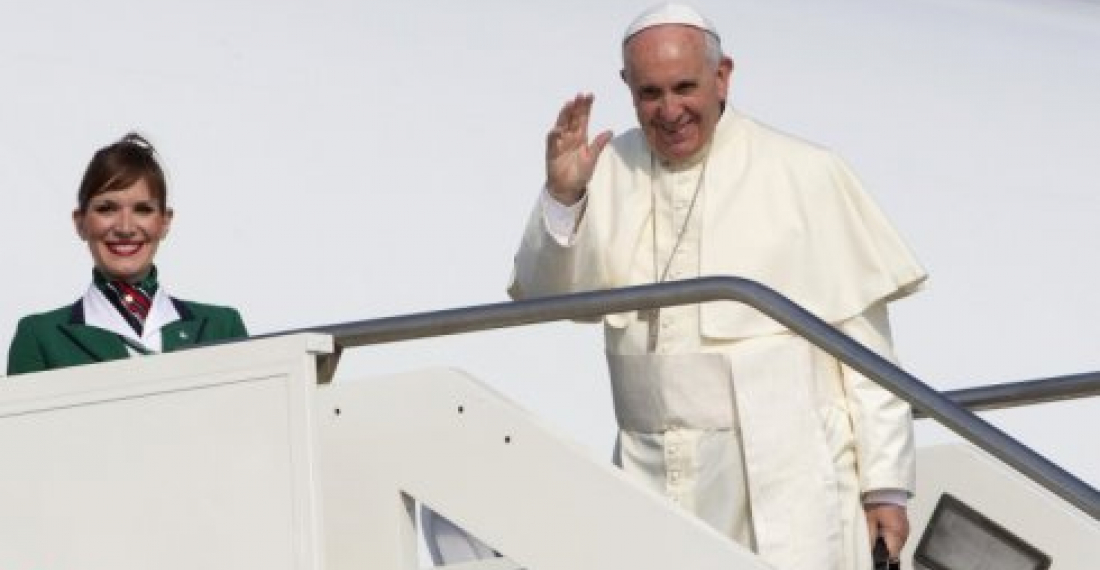
This short briefing note was prepared by the editorial team of Caucasus Concise. There will be a live blog covering the visit of Pope Francis to Georgia and Azerbaijan on commonspace.eu starting on 29 September at 1200 GMT
The Vatican this week released the programme of the visit of Pope Francis to Georgia in Azerbaijan. The Pope will arrive in Tbilisi on 30 September and will stay until 2 October when he flies to Baku before returning to Rome that same evening. This will be the Pope's second trip to the South Caucasus this year. In June he visited Armenia.
 Papal visits to Catholic communities throughout the world have become a common occurrence since the days of Pope Paul VI, which saw the head of the Roman church leaving the walls of the Vatican and travelling across continents. Later Popes however turned papal visits into missions with a wider agenda, promoting peace, social issues and values, and importantly inter-Christian and inter-religious dialogues.As the absolute ruler of the Vatican State, the Pope also travels as a head of state, a convenient double hatting in some countries where the Catholic Church is not considered to be so important.
Georgia's Catholic community is small, and in Azerbaijan it is miniscule. Yet both countries in very different ways represent societies and views that the Catholic church and its leader want to interact with.
The visit to Georgia at the invitation of President Giorgi Marghvelashvili is also wholeheartedly supported by the Georgian Orthodox Church. Its leader, the Catholicos Patriarch of all Georgians Ilya II is not only a much respected national symbol in Georgia, but also one of the giants of the world orthodoxy. Although of advanced age Ilya II remains a towering figure among international religious leaders. Pope Francis has taken a very personal interest in the advance of ecumenism and dialogue between the Christian churches.  When Ilya II was younger and in better health he travelled extensively and the Georgian Church became more in dialogue with other Christian churches. This process has stopped, and some say may even have reversed in recent years since the Patriarch travels rarely these days. The visit of Pope Francis will therefore be a good opportunity to renew links and also to open up a new dialogue between the Churches.
There have been some isolated incidents of orthodox clergy protesting against the Pope's visit to Georgia. When the visit was announced in Aprila fringe group, the "Orthodox Parents Union"came out against the visit. As reported by Tabula.ge the leader of the group, Father Davit Isakadze,said that the Pope is worse than the devil and the President who invited him is a comedian. However, since then any criticism of the visit has been muted, and reduced to a few whispers on social media, and the wishes of the Patriarch to host the leader of the Catholic Church in Tbilisi seems to be respected.
Georgia is a country that politically wishes to integrate fully in the European and Euro-Atlantic community. For many Georgians however the Church and its Patriarch are a source of great pride. Some anti-western forces, with a little nudging from Moscow, have tried to depict the west as being in some kind of conflict with the Orthodox Church because of some differences on social issues. The visit of Pope Francis, with its emphasis on what is common between the Churches will help dispel these rumours.
The Pope will visit Tbilisi only days before Georgians vote in parliamentary elections. That the visit can take place at all so close to the elections is a good example of how far Georgia has gone to becoming a normal European country. Nonetheless the possibility of some kind of provocation cannot be excluded and the Georgian government will be on taking all precautions to ensure the visit is conducted successfully.
 From Georgia the Pope goes to Azerbaijan at the invitation of President Ilham Aliev. Azerbaijan is a secular republic but its population is overwhelmingly Shia Muslim. The visit will provide the Pope an opportunity to interact with Shia Islam in ways not so easily possible elsewhere. Azerbaijan is also a big promoter of the dialogue of civilisations. For the Azerbaijani government the papal visit fits well within this direction of work.
The Pope will only stay in Azerbaijan for around twelve hours. There are some sensitivities related to the Papal visit in Baku too. The Pope has developed a reputation of having particularly close relations with Armenians. This comes from the time that he was Cardinal-Archbishop of Buenos Aires where there is a large Armenian community. The Pope's visit to Armenia in June was hailed a huge success by both the Vatican and the Armenian authorities (see more on the Pope's visit to Armenia in the live blog that followed the papal visit on commonspace.eu in June here). The Pope has also used the term genocide to describe the killing of Armenians by Ottoman Turks in the early 20th century - a sensitive point for Azerbaijan, even if not so much as in Turkey.
Baku however will roll out the red carpet anyway, because its tolerance of religious freedom is something that it projects very widely.
Under Pope Francis the Catholic Church is changing fast. The Pope sees himself as a modern person and he wants to engage with global issues as a temporal, as well as a spiritual leader. The Caucasus with its complexities and challenges offer plenty of opportunities for Papal diplomacy and charm to play itself out.
This short briefing note was prepared by the editorial team of Caucasus Concise. There will a live blog covering the visit of Pope Francis to Georgia and Azerbaijan on commonspace.eu starting on 30 September at 0700 GMT



