The European Union has some difficult decisions ahead as tensions between EU member state Greece, and EU Candidate country Türkiye, in the Aegean Sea, escalate. This dispute is not only about economic and maritime resources, but also has deep historical roots. Noman Ahmed and Maximiliaan van Lange analyse the background to the current stand-off.
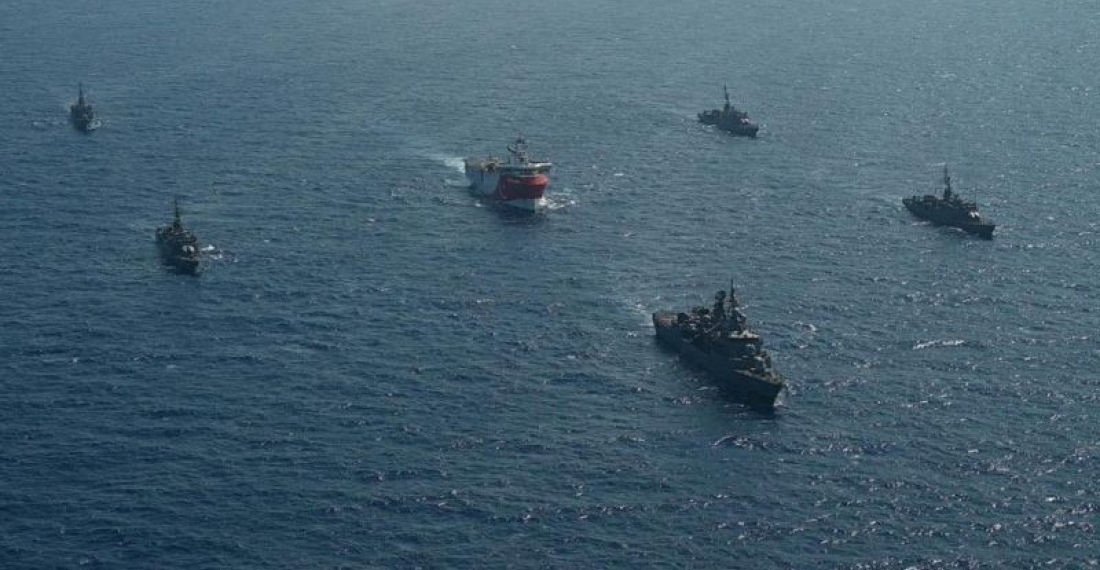
Recently, the Turkish Government's research vessel "Oruç Reis" began exploratory surveying south of the Greek Island of Kastellorizo. The drilling led to a dangerous confrontation between the Turkish and Greek navies, as warships sailed through the narrow strait that separates the Island from the Turkish mainland. In a recent incident between a Turkish navy ship and a Greek frigate, the Turkish ship got damaged, and this almost led to a confrontation between the Turkish and Greek navies.
Since then, the Turks have been on their guard because the Greek coastguard has recently intercepted a Turkish recreational boat. Subsequently, Turkish recreational boats have stayed away from Kastellorizo. Both countries remain on high alert. On the diplomatic front, Greece and Türkiye accused each other of escalation and NATO-sponsored talks to defuse the tensions appear stalled. The location of Kastellorizo can tell us much about the dispute, and why the strait is the site for the developing tensions. And it is not only about oil and gas.
Kastellorizo's isolated location, two kilometres from the Turkish mainland and 580 kilometres from the Greek mainland, gives the island a vital role in the geopolitical balance of power. Kastellorizo is the latest fault line of the long-running geopolitical conflict between Türkiye and Greece, currently centred around the exploitation of gas fields in the eastern Mediterranean. For Türkiye, access to energy resources is an essential objective of its ambitious foreign policy. Egypt, Israel, the Republic of Cyprus and Greece are other regional players who plan to extract gas and compete for European markets via pipelines that run across the same geographical region.
Economic and maritime resources are not the only considerations in Turkish and Greek minds. Both countries have long aimed at limiting each other's geopolitical advancement. Historical claims, national pride, and a long list of perceived unresolved grievances have long weighed down on the relationship between the two neighbours.
In the 18th century, several tensions emerged on the periphery of the Ottoman Empire, leading, among other things, to the Greek War of Independence in the early 19th century. Tensions were exacerbated due to the support of the newly independent Greek state for Russia, and for other parts of the Ottoman Empire that wanted to secede. Tensions continued until the last days of the Empire. When the Greek-Turkish War ended in 1922, the new-born state of Türkiye had to hastily accept the Treaty of Lausanne which drew the modern borders between Greece and Türkiye. Kastellorizo, despite being closer to Turkish shores, became part of Greece. Needless to say, the Turks were not entirely happy about the treaty but in light of the challenges facing their new state, they accepted the maritime borders, and other provisions stipulated by the Treaty in return for international recognition, but with lingering grudges and reservations.
The discovery of oil and gas reserves in the East Mediterranean in the past decade has raised the stakes and ignited a new wave of tensions. However at the heart of the current dispute are also core issues of national pride and security, maritime borders, and for Türkiye, the feeling of loss that the current Turkish government appears determined to rectify.
The Treaty of Lausanne is not the only legal regime that impacts the present crisis. International law clearly defines maritime borders and Exclusive Economic Zones (EEZ). Since the Eastern Mediterranean is a compact area with almost ten littoral countries, maritime borders can be subject to multiple interpretations. The Greek interpretation boxes Türkiye in and hinders its ambitions to become a regional energy hub. To break the containment, Türkiye claims its own version of maritime borders, as in the agreement it reached with the Libyan Government in Tripoli in December 2019. Furthermore, it has been reinforcing those claims by sending research ships to conduct exploration, accompanied by naval vessels.
Signing cooperation deals is another method of laying claim to the EEZs. The EEZ claimed by the EastMed Gas Forum (Egypt, the Republic of Cyprus, Israel, and Greece) essentially contradicts the EEZ claimed in the Memorandum of Understanding between Libya and Türkiye, with the latter ignoring the presence of small Greek islands including Kastellorizo. Türkiye, in fact, does not recognize the UN Convention on the Law of the Sea which had created the concept of EEZs. Turkish action threatens the EastMed project and thus, gas is not expected to reach Europe anytime soon and the EU will have to keep using Russian gas until the dispute in the East Mediterranean is resolved.
The situation in the eastern Mediterranean risks breaking into a regional conflict in which global powers such as Russia and NATO can be embroiled. France sent warships to the disputed waters around Kastellorizo last week in a show of support for Greece. Egypt and Israel are also supporting Greece in the conflict, but the United States does not want war in the area and will not encourage either side into conflict. The US has recently completed joint naval exercises with Türkiye, and views it as a key regional ally despite outstanding issues in US-Türkiye relations. Russia is also facing something of a quandary. Greece and Cyprus have traditionally shared a Christian Orthodox heritage tradition, and have a long history of good relations. But Russia has also in the last years been courting Türkiye which it sees as an important ally against US-EU pressure.
A political solution seems a long way off, considering that tensions remain very high. Greece and Türkiye are making maximalist demands, and are under significant pressure from their domestic audiences in their own countries not to budge. A solution is only possible if all the countries in the region are willing to gather around a table and prepare to offer a concession. Alas, talks are complicated by the fact that Türkiye has poor relations with many of those countries, and President Recep Tayyip Erdogan is on a mission to assert Turkish power in the eastern Mediterranean, under the banner of national dignity and restoration of lost rights.
Source: Noman Ahmed is a Research Associate on Europe's Neighbourhood South at LINKS Europe; Maximiliaan van Lange is a Research Associate on Safety, Security and Transparency in the EU and beyond at LINKS Europe.
Photo: The Turkish research vessel "Oruc Reis", escorted by Turkish navy ships, conducts exploration in disputed Aegean waters (archive picture)
The views expressed in opinion pieces and commentaries do not necessarily reflect the position of commonspace.eu or its partners