


Analysis: The European Parliament approves by a huge majority visa liberalisation for Georgia. Why was this decision so important for Georgia?

This analysis was prepared by the staff of commonspace.eu. Some parts of this analysis were first published on a live blog carried on the website on 2 February 2017.

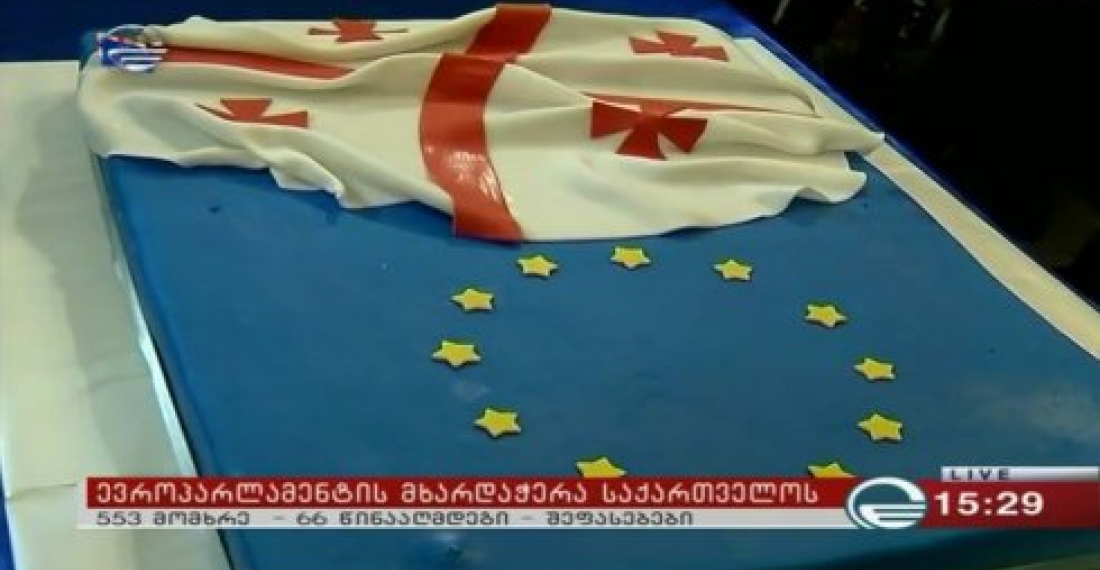
The European Parliament on Thursday (2 February) adopted by a huge majority a proposal to grant Georgians visa free travel to EU Schengen countries. The report presented by rapporteur Mariya Gabriel was adopted with 553 votes in favour, 66 against, and 28 abstentions. The measure is expected to become operative by the end of March, after it goes through a number of legal formalities within the EU institutions.

For Georgians, Europe is not simply an economic project, nor just a political alliance: it is a national vocation embedded in the sense of identity of the Georgian nation. Georgia has engaged with the EU for twenty-five years with missionary zeal, summarised simply but powerfully by Georgia's late statesman Zurab Zhvania in his first address to the Parliamentary Assembly of the Council of Europe - "I am Georgian and therefore I am European". There were on the way many ups and downs, but eventually Georgia became an Associate member of the EU through the Association Agreement signed in 2014, and which came into force last summer. Visa free travel is not a part of that agreement, but is a crucial add on that would make the hundreds of pages of association agreement tangibly relevant to the entire Georgian nation. The visa liberalisation measure has therefore assumed an importance for Georgians, and for Georgia's relations with the EU, that is far greater than would be the case with other countries.

Today's vote in the European parliament is the climax of years of complex negotiations. Relations between Georgia and the European Union go back to the early 1990s when Georgia regained its independence after the collapse of the USSR. The European Union was one of the first international organisations to engage with Georgia - initially offering emergency humanitarian aid to alleviate the suffering of massive poverty and displacement caused by the collapse of the Soviet Union and the conflicts that raged on its territory. The European Union opened a delegation in Georgia way back in 1994, and soon after Georgia and the EU signed a Partnership and Co-operation Agreement.

Discussions on lifting the visa requirement for Georgians wanting to travel to Europe have been going on for several years. The Georgian government hoped that it could conclude the discussions in 2016, and put huge efforts into implementing the reforms that were asked from it by the EU as a condition for this measure. Things however got delayed as a result of external factors - including the European Union's difficulties in tackling a huge refugee and migration crisis that saw millions trying to enter the EU from countries in Africa and the Middle East. At a time when the emphasis was on tightening border controls, relaxing the entry requirements for millions of people, through relaxation of visa rules, was not a popular measure with the electorates in many countries and several EU governments wanted safeguards in place. In essence this is the reason for the delay. Not surprisingly the delays have caused huge frustrations  among the Georgian public. But two factors remained constant, and helped to ensure that Georgia and the EU stayed the course: the first is support in Georgia for European and Euro-Atlantic integration has remained solidly positive. This support reflects itself also in the position of most political parties, including the governing Georgian Dream party and the two wings of the opposition UNM, which have recently separated. The second factor is that despite everything else going on in the world, support for Georgia within the European Union - the institutions, the member states, the parliament, and wider public opinion, remained high, and remained solid. Today's vote was the ultimate proof of that.

In technical terms the approved measure is a draft law giving Georgian citizens the right to travel to the EU without a visa. Biometric passport holders will be able to enter the Schengen area for 90 days within any 180-day period for a holiday, business or any other purpose, except working.

Negotiators from the European Parliament and Council (representing the 28 member states) negotiators struck a deal on the legislation last December. The visa waiver will enter into force on the same date as the visa suspension mechanism, which allows EU member states to temporarily reintroduce visa requirements for reasons of public security.

The decision is a huge success for Prime Minister Giorgi Kvirikashvili and his team. Kvirikashvili spoke wisely when he addressed members of the government shortly before the vote was taken.

'I would like to thank to all MEPs that will take part in today's voting as this day is of historic importance for Georgia. I would also like to thank to all public servants that have contributed to the great success. I would like to express my gratitude to the parliament of Georgia and to all those that have participated in this process that resulted in a big success for Georgia,' the PM has remarked.  According to him, today's decision will confirm concrete results of being close to the EU.  The prime minister called on Georgians "to show great responsibility and obey the laws of those countries that they will visit as a result of this measure".

In effect, for Georgia this decision is a small step on a much longer journey. EU and NATO membership remain high on the agenda of the Georgian government, although there is also a realistic assessment that now may not be the time to push these forward. But with Georgians travelling freely in Europe that objective is now certainly one step closer.

This analysis was prepared by the staff of commonspace.eu. Some parts of this analysis were first published on a live blog carried on the website on 2 February 2017.

Photo: The Georgian Parliament celebrated the decision of the European Parliament to grant Georgians visa free travel with a huge cake with the Georgian and EU flags (picture screen grab from Imedi TV)
 

Related articles

Editor's choice
News
Council of Europe launches new International Claims Commission for Ukraine

Council of Europe launches new International Claims Commission for Ukraine

Thirty-four countries and the European Union have signed a new convention establishing an International Claims Commission for Ukraine at a diplomatic conference co-hosted by the 46-nation Council of Europe and the Netherlands in the Hague. The diplomatic conference was attended by leaders and high-level representatives from over 50 states, including the President of Ukraine, Volodymyr Zelenskyy, the President of the Republic of Moldova, Maia Sandu, and the Prime Minister of the Netherlands, Dick Schoof.  “Today marks a major step forward in ensuring accountability for Ukraine. The International Claims Commission represents justice and hope for tens of thousands of victims—our determination that those who have suffered will not be forgotten. I call for quick ratifications so we can get the commission rapidly up and running for the people of Ukraine,” said Council of Europe Secretary General Alain Berset. Ukrainian President Volodymyr Zelenskyy said: “We expect that every mechanism for compensation from the Register of Damage and Claims Commission to the actual payments – will start working and receive strong and sufficient international support, so that people can truly feel that any kind of damage caused by the war can be compensated. This war, and Russia’s responsibility for it, MUST become a clear example – so that others learn not to choose aggression.” “Accountability is about creating the conditions for peace that endures. And therefore, accountability is a condition of security – today and for the future. But accountability is not only about Ukraine. And it is not only about one aggressor and one victim. Accountability is about Europe. About every country in Europe. It is about whether Europe, as a whole, is willing to defend its peace,” said Maia Sandu, President of the Republic of Moldova, which currently holds the Presidency of the Council of Europe’s Committee of Ministers. The Prime Minister of the Netherlands, Dick Schoof, said: “Every day Russia is deliberately bombarding homes, destroying businesses and damaging infrastructure in Ukraine. Russia must compensate Ukraine for the damage caused. That is why we have launched the International Claims Commission for Ukraine and we are honoured to host it.” The International Claims Commission will be the second part of a comprehensive compensation mechanism related to Russia’s war of aggression, building on the existing Register of Damage for Ukraine. The claims commission will be established within the framework of the Council of Europe and will also be open to other countries. The Register of Damage for Ukraine, created in 2023, collects and records compensation claims submitted by individuals, organisations and public bodies in Ukraine. Forty-four states and the European Union have so far joined the Register, which has already received 86,000 claims. The International Claims Commission will review, assess and decide upon claims submitted to the Register of Damage for Ukraine and determine the amount of compensation, if any, which is due in each case. The convention establishing the commission will enter into force once it has been ratified by 25 signatories, as long as sufficient funds have been secured to support its initial work.

Popular

Editor's choice
News
Council of Europe launches new International Claims Commission for Ukraine

Council of Europe launches new International Claims Commission for Ukraine

Thirty-four countries and the European Union have signed a new convention establishing an International Claims Commission for Ukraine at a diplomatic conference co-hosted by the 46-nation Council of Europe and the Netherlands in the Hague. The diplomatic conference was attended by leaders and high-level representatives from over 50 states, including the President of Ukraine, Volodymyr Zelenskyy, the President of the Republic of Moldova, Maia Sandu, and the Prime Minister of the Netherlands, Dick Schoof.  “Today marks a major step forward in ensuring accountability for Ukraine. The International Claims Commission represents justice and hope for tens of thousands of victims—our determination that those who have suffered will not be forgotten. I call for quick ratifications so we can get the commission rapidly up and running for the people of Ukraine,” said Council of Europe Secretary General Alain Berset. Ukrainian President Volodymyr Zelenskyy said: “We expect that every mechanism for compensation from the Register of Damage and Claims Commission to the actual payments – will start working and receive strong and sufficient international support, so that people can truly feel that any kind of damage caused by the war can be compensated. This war, and Russia’s responsibility for it, MUST become a clear example – so that others learn not to choose aggression.” “Accountability is about creating the conditions for peace that endures. And therefore, accountability is a condition of security – today and for the future. But accountability is not only about Ukraine. And it is not only about one aggressor and one victim. Accountability is about Europe. About every country in Europe. It is about whether Europe, as a whole, is willing to defend its peace,” said Maia Sandu, President of the Republic of Moldova, which currently holds the Presidency of the Council of Europe’s Committee of Ministers. The Prime Minister of the Netherlands, Dick Schoof, said: “Every day Russia is deliberately bombarding homes, destroying businesses and damaging infrastructure in Ukraine. Russia must compensate Ukraine for the damage caused. That is why we have launched the International Claims Commission for Ukraine and we are honoured to host it.” The International Claims Commission will be the second part of a comprehensive compensation mechanism related to Russia’s war of aggression, building on the existing Register of Damage for Ukraine. The claims commission will be established within the framework of the Council of Europe and will also be open to other countries. The Register of Damage for Ukraine, created in 2023, collects and records compensation claims submitted by individuals, organisations and public bodies in Ukraine. Forty-four states and the European Union have so far joined the Register, which has already received 86,000 claims. The International Claims Commission will review, assess and decide upon claims submitted to the Register of Damage for Ukraine and determine the amount of compensation, if any, which is due in each case. The convention establishing the commission will enter into force once it has been ratified by 25 signatories, as long as sufficient funds have been secured to support its initial work.

