|
Turks remain firmly in favour of EU membership despite recent snubs. Sixty-nine percent of Turks support Turkey's European Union membership, although relations with the EU are stagnant, and Turks regard relations with the EU as the country's most important foreign policy issue, according to a recent survey. Turkish attitudes towards foreign policy and foreign policy issues are becoming more complex as the European asspirations of the majority of Turks have to be reconciled with equally strong attitudes involving Turkey's role as a Muslim power. The survey “Foreign Policy Perceptions in Turkey,” conducted on Dec. 6-14 last year by KA Research and the Turkish Economic and Social Studies Foundation (TESEV) with 1,000 respondents, found that the most supportive region for the country's EU membership is southeast Anatolia with 91 percent of those polled, followed by east Anatolia with 87 percent. The lowest support for the country's EU membership comes from central Anatolia with 58 percent. “Support for Turkey's EU membership in these regions can be explained by looking at political and economic factors. These two regions will gain from increased welfare and they will significantly benefit from Turkey's democratic transformation on the path to EU membership,” the report said. Reporting on the launch of the survey, the Turkish daily newspaper Today's Zaman quoted TESEV Director Can Paker saying that “It is noteworthy that EU membership is still considered one of the most important foreign policy issues, even though it is not on the agenda during the election process in Turkey,” Paker added that since Turkey is on the brink of creating a new constitution, it is important to stress the EU criteria and the EU membership of Turkey, 60 percent of whose trade is with European states. When asked why they want Turkey to be a member of the EU, 22 percent of the respondents said “easing visa restrictions,” 21 percent said “economic benefits,” 13 percent said “for democracy,” 8 percent answered “job opportunities, decrease in unemployment” and 7 percent said “increased living standards.” Of the 26 percent of the respondents who did not support Turkey's EU membership, the most common reason given was that Turkey was strong enough on its own, with 21 percent, while 10 percent of the respondents stressed the differences between the moral and cultural values of Turkey and the EU, 8 percent said that the EU did not want Turkey and 6 percent of the respondents stated they did not want Turkey to become an EU member because Turkey is a Muslim country. Financial crises faced by the EU states have not gone unnoticed, as 6 percent of the respondents said that the EU is failing. When asked when they thought Turkey would become a member of the EU, 49 percent of the respondents said that Turkey would become a member of the EU within the next five to 20 years, while “never” was the most popular answer with 30 percent. On the other hand, there are some optimists -- 16 percent -- who think that Turkey will accede to the EU within the next five years. According to 20 percent of the respondents, Turkey will become a member within the next five to ten years. In the survey, when asked to list the biggest obstacle to Turkey's EU membership, the most common answer given by the respondents was xenophobia/Islamophobia, with 22 percent. Other answers included the unwillingness of the EU countries with 7 percent, Turkey's population with 4 percent and terror, also 4 percent. Only 3 percent of the respondents stated that the biggest obstacle to Turkey's membership was the Cyprus issue. “These responses are consistent with the view that the EU is making it harder for Turkey to become a member for religious and cultural reasons, a sentiment that is becoming increasingly widespread in Turkey,” stated the report, written by TESEV's Mensur Akgün, Sabiha Senyücel Gündoğar, Aybars Görgülü and Erdem Aydın. The researchers also indicated that the Turkish public embraces peaceful solutions, which are stressed in Turkish foreign policy, as 75 percent of the respondents support Turkey's efforts for mediation in the Palestinian-Israeli conflict, 50 percent support rapprochement with Armenia and 58 percent support sending peace forces to Lebanon. Of the respondents, 52 percent also indicate satisfaction -- versus 31 percent dissatisfaction -- with the way foreign policy decisions are made. Twenty-five percent of the respondents also regard the prime minister, and another 25 percent the Ministry of Foreign Affairs, as the most important actor in foreign policy making, while only 5 percent think that Parliament is most important, while 2 percent say that the army is most important.
|

Source: commonspace.eu editorial team with additional reporting from Today's Zaman
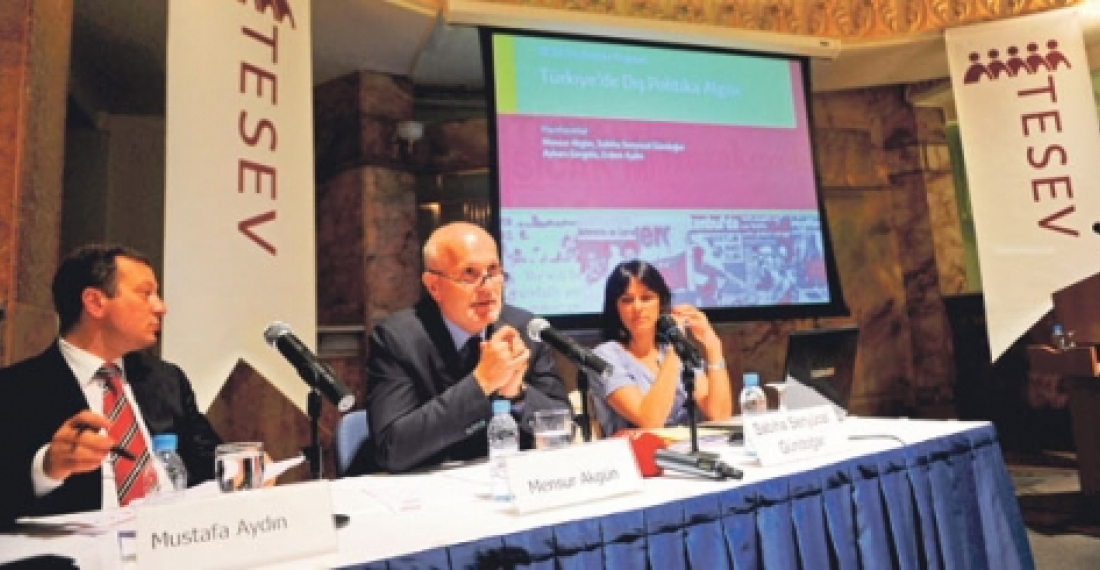
Photo: TESEV officials at a press conference launching the survey on 3 June. Photo courtesy of Todays' Zaman