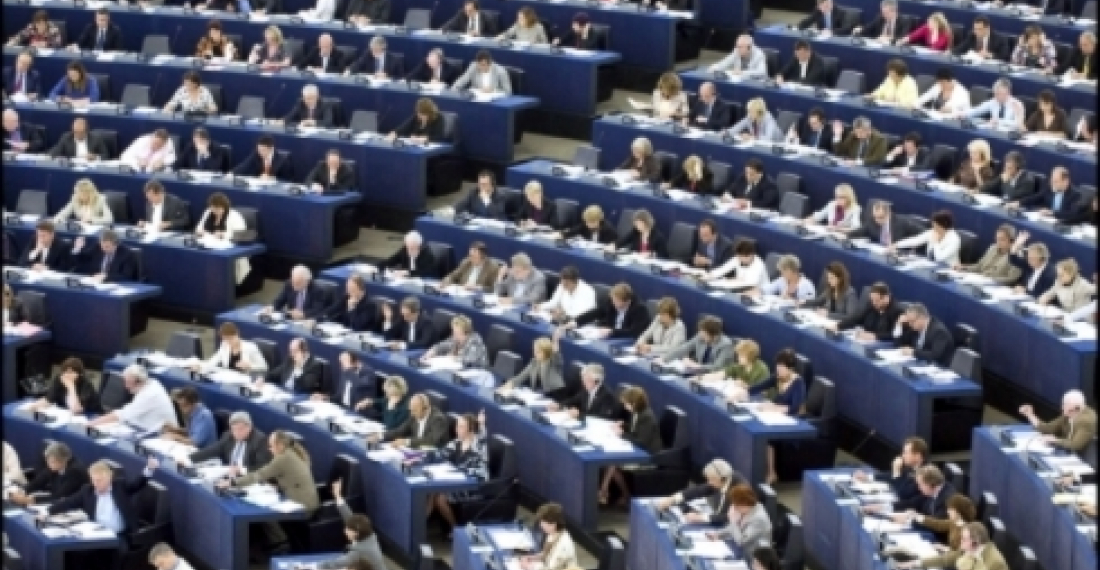
The European Parliament on Wednesday adopted a wide-ranging resolution on relations with Europe's neighbours, including the Eastern Partnership countries. With something for everybody to like, and something for everybody to dislike, the resolution reflects European opinion, but only if read in full.
The full text of the European Parliament Resolution (in english) is available here
Referring to the Eastern Partnership in general the resolution
"Recommends that the Union should: (a) strengthen the application of the more-for-more principle and stimulate it by positive competition and cooperation among partner countries, expressing necessary support to EaP states facing pressure from third countries when implementing the acquis communautaire; (b) apply a two-track approach, by making demands of EaP governments whilst being open, generous and engaging towards the citizens of partner countries; (c) encourage those citizens to advance the values the EU is based upon - namely democracy, the rule of law and respect for human rights and fundamental freedoms - through their commitment to promote them, thus making them the main source of normative power transformation; (d) design a long-march strategy to promote European values encompassing internal change and the aspirations of these societies for freedom and prosperity; (e) decentralise the EaP by engaging with, and offering its ownership to, public actors on both sides through horizontal partnerships and twinning, accompanied by increased mobility, people-to-people contacts, visa facilitation and the prospect of a visa-free system, in which case the neighbours-first approach should apply; and (f) initial or sign the Association Agreements and aim for their prompt entry into force, initially on a provisional basis and then in full, before the end of the current term of the European Parliament and the European Commission, provided that the necessary conditions and requirements have been met; (g) refrain from using force or threats to use force in resolving disputes in the region, underlining that the only possible way to settle conflicts in the region is through negotiations within the internationally accepted formats, based on the principles of international law;
Recalls its position that the occupation by one country of the Eastern Partnership of the territory of another violates the fundamental principles and objectives of the Eastern Partnership and that the conclusion of the EU Association Agreements with Armenia and Azerbaijan should be linked to progress towards the resolution of the Nagorno-Karabakh conflict, in accordance with UN Security Council resolutions 822, 853, 874 and 884 of 1993 and the Organisation for Security and Cooperation in Europe (OSCE) Minsk Group Basic Principles, enshrined in the L'Aquila joint statement of 10 July 2009;
Deplores the fact that as the Vilnius Eastern Partnership Summit approaches, different types of pressure are escalating on Eastern Partnership countries; regards this pressure as unacceptable and calls on Russia to abstain from proceedings which are in clear violation of the Helsinki principles; strongly underlines that the free choices of the Eastern Partnership countries should not make them bear consequences such as trade measures, visa policy, the restricted mobility of workers, interference in frozen conflicts, and others; calls on the Commission and the European External Action Service (EEAS) to deal with the deplorable developments beyond a purely trade dimension, thereby acting and defending the Union's partners by sending a strong message of support for all Eastern Partnership countries in their European aspirations and choices; underlines however, that Association Agreements (AAs) and Deep and Comprehensive Free Trade Agreements (DCFTAs) are a blueprint for reforms that are beneficial for all;
Remains committed to further developing the Euronest Parliamentary Assembly as an important forum for multilateral interparliamentary cooperation with the Eastern Partnership countries; deplores the proposed cuts in the ENP budget lines for the 2014-2020 multiannual financial framework, as these budget lines aim at a closer support for actions and projects related to democracy-building, the rule of law and the promotion of human rights;
Stresses that lifting visa requirements would be a significant gesture towards the peoples of Eastern Partnership countries and would genuinely help them to move closer to EU Member States;
Considers the publication of the Eastern Partnership Roadmap 2012-2013 to be a first step towards developing better monitoring tools; calls on the Commission and the EEAS to further develop appropriate follow-up mechanisms capable of assessing the performance and achievements of the ENP countries and to set clear and measurable objectives;
Recommends that the Eastern Partnership countries: (a) rebalance and redouble their efforts towards the fulfilment of political, legal and economic criteria; (b) enshrine in their societies fundamental values of democracy, the rule of law, human rights and gender equality, and the fight against corruption; (c) further boost societal change, reform processes and the systemic upgrading of public standards and administration, considering European integration as a long-term strategic choice and not merely an economic and administrative endeavour; (d) close the gap between rhetoric and practical action; (e) pay greater attention to the multilateral structure of the Eastern Partnership and to learning through best practices; (f) apply to regional conflicts the spirit and lessons derived from the historical experience of European integration and enhance regional, political and economic cooperation among themselves, since bilateral issues must be resolved peacefully and good neighbourly relations and regional cooperation are fundamental elements of the Eastern Partnership; (g) involve citizens and engage public actors in horizontal partnerships and in twinning with counterparts from the Union, as well as engaging with civil societies and the younger generation as a factor for change; (h) refrain from using force or threats to use force in resolving disputes in the region, underlining that the only possible way to settle conflicts in the region is through negotiations within the internationally accepted formats, based on the principles of international law;
22. Is concerned by Russian actions designed to deter partner countries from political and economic association with the EU; reaffirms the sovereign right of each state to choose political and trade alliances; believes, furthermore, that progressive integration of partner countries with the EU is fully consistent with their pursuit of cordial relations with Russia; rejects the perception of a zero-sum game as a paradigm for the EU's and Russia's relations with partner countries;
23. Reaffirms the need to strive for the regional stability and security that are necessary to achieve the goals of the Eastern Partnership, also in the context of further integration with the EU; urges further efforts to progress towards the resolution of the territorial conflicts in Georgia, Azerbaijan, Armenia and Moldova; recalls in this respect its position that the conclusion of the association agreements between the EU and Armenia and Azerbaijan should be linked to progress towards the resolution of the Nagorno-Karabakh conflict, in accordance with UN Security Council resolutions 822, 853, 874 and 884 of 1993 and the OSCE Minsk Group Basic Principles enshrined in the L'Aquila joint statement of 10 July 2009;
Recalls that a commitment to the AAs and DCFTAs precludes any other simultaneous form of participation in a customs union;
Calls on the Member States and Eastern European partners to review their arms export policies in the region with a view to reaching agreements on the disarmament and demilitarisation of conflict areas; calls on Russia to respect the agreements in a constructive way, fully respecting the sovereignty of the countries of the region and refraining from any actions which would endanger regional stability;
Emphasises that the EU and Eastern European partners face common political challenges with regard to ensuring the reliable and safe supply of energy; recalls that energy security cooperation is clearly identified as a priority under the Eastern Partnership and the ENP for the period 2014-2020; expects the third Eastern Partnership Summit, to be held in Vilnius, to provide an impetus for enhanced cooperation in the energy field and to increase energy security on both sides;
Recalls that the Energy Community Treaty sets the basis for establishing a fully integrated regional energy market favouring growth, investment and a stable regulatory framework; recommends to this end extending the Energy Community Treaty beyond 2016, whilst adapting its decision-making to future challenges, including by setting up legal control mechanisms to deal with deficient acquis implementation as well as solidarity mechanisms; welcomes the application to join the Energy Community by Georgia, which would become the third Eastern Partnership country, after Ukraine and Moldova, to join; calls for further expansion of the Energy Community via the ENP in line with the objectives of the Energy Community on the basis of mutual interest; emphasises that regulatory integration should be in line with common investments in interconnection capacity and infrastructure as well as renewable energy, energy efficiency and new technologies; emphasises the key importance of the further diversification of supply and transit routes;
Calls for the insertion of an energy security clause in every agreement with the Eastern Partnership countries to guarantee full respect for EU internal energy market laws, as well as the inclusion of an Early Warning Mechanism in such agreements to guarantee an early evaluation of potential risks and problems relating to transit and supply of energy from third countries, as well as establishing a common framework for mutual assistance, solidarity and dispute settlement;
On Armenia, the resolution
Recognises the progress made in democratic standards and in the fulfilment of Association Agreement requirements, but acknowledges that persistent deficiencies in the area of democracy still remain to be addressed; recognises that further progress should be made in the areas of governance reforms, including law enforcement, judicial sectors, and the fight against corruption; regrets the latest move by the President of Armenia in committing to the customs union; reminds the Armenian authorities that such a policy is not compatible with the Association Agreement; hopes, in this regard, that Armenia will continue EU-related reforms, the implementation of which could lead to the country's economic prosperity and could help solve socio-economic and political problems which still persist within the country; calls for a pursuit of cooperation with the EU, to which the EU is open;
Welcomes the implementation of sound macroeconomic policies and structural reforms in Armenia and further progress towards meeting the objectives of the Action Plan;
On Azerbaijan the resolution
Regrets that an unclear vision and hesitation persist on the issue of Azerbaijan's pursuit of the Association Agreements; stresses the economic potential of EU-Azerbaijan relations, but is concerned by deficiencies in the fields of democracy, the rule of law and human rights in Azerbaijan; insists therefore that Azerbaijan show its commitment by stepping up its relevant standards, including freedom of speech and association and allowing the democratic opposition to enjoy their rights; insists that the release of political prisoners and an end to the harassment of political activists, human rights defenders and journalists are the necessary preconditions for any agreement on a strategic modernisation partnership with Azerbaijan;
Deplores the lack of respect for international standards shown in the run-up to the presidential elections which took place on 9 October 2013, including candidates being denied registration on procedural grounds, and calls for the immediate and unconditional release of the 14 Azerbaijani opposition politicians, journalists and human rights activists imprisoned during the past months, including Tofiq Yaqublu and Ilgar Mammadov(18);
Regrets the lack of vision and hesitation shown by the Union with regard to the AAs and DCFTA, as a consequence of failing to understand the strategic role of Azerbaijan in economic, geopolitical and cultural terms.
Source: Commonspace.eu; Resolution text European Parliament website.