


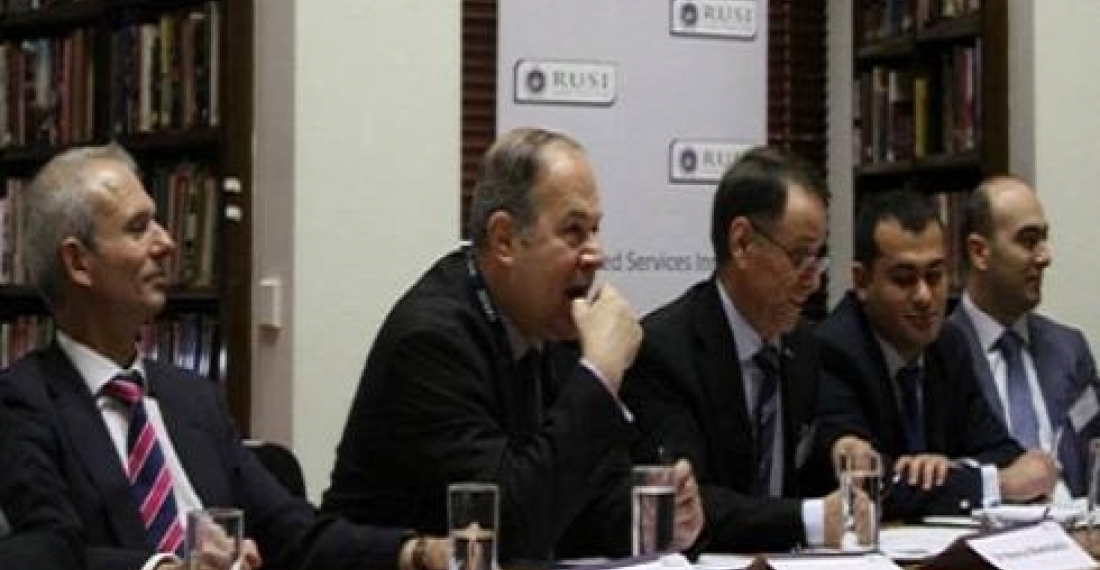
Senior Azerbaijani official lashes out at critics at London conference.

The Deputy Head of the Azerbaijani Presidential Administration, Novruz Mammedov,  was one of the keynote speakers at a conference organised at the Royal United Services Institute in London (RUSI) on Thursday, 4 July on "Shaping the Policy Agenda: British-Azerbaijani Relations in the context of Europe". Another keynote speaker was the British Minister for Europe, David Lidington. The conference was jointly organised by RUSI and the Strategic Studies Centre of Azerbaijan.

In his speech to the conference Novruz Mammedov criticised the west's attitude towards Azerbaijan, saying that it was hard to accept it as fair and well thought through. Mammedov gave a detailed exposition of Azerbaijan's achievements over the last twenty years, and addressed directly criticism being levelled at Azerbaijan over its democracy and human rights record.

According to the Azerbaijani web portal news.az,  in reference to a recent resolution of the European Parliament on Azerbaijan Mammedov said:

As for the reports of some organizations and governmental institutions alleging the violation of democracy and human rights in Azerbaijan, he noted that nothing is being said about the violation of all rights of more, that one million of refugees and IDPs. "Human rights and democracy are kept simply in the context of authorities and opposition", he said, "But, what about the rights of refugees and IDPs or do they not deserve the protection? The position voted in the European Parliament with the participation of 15-20 members is presented as the resolution of the Parliament with total number of 754 members" N.Mammadov continued that as a result, the right of absolute majority of members of the European Parliament is misused. "This contradicts the principles of democracy."

Mammedov also lashed out at criticism in the British media on Azerbaijan. According to news.az he stated that,

"The statistics show that the number of critical reports about Azerbaijan appeared in the British press within 3 months in relation to the criminal actions of two young Azerbaijanis that present themselves as bloggers is more than the general number of articles written about the Karabakh problem in last 20 years".

Speaking about European multiculturalism, Mammadov said that it has already started to decline. "However, Azerbaijan lives in the conditions of peace and tolerance of various religions", he said, "Azerbaijan has managed to build an ideal and tolerant society which can be exemplary for all world countries and even for Europe. This has been declared by the Pope John Paul II during his visit to Baku".

According to Mammadov, taking into account all these facts which should be taken into consideration - it is hard to accept the attitude of West to Azerbaijan as a fair, well thought and substantiated position from political, economic, cultural, religious, geopolitical and other points of view.

Mammadov stressed that choosing the path of close co-operation and integration with Europe since the first years of its independence, Azerbaijan has managed to implement large projects of strategic importance and become the political, economic, cultural, energy and transportation bridge between East and West by addressing all challenges and facing firmly strong pressure.

Mammedov concluded,

"However, we are aware, that as with all countries, Azerbaijan has some minor problems. We take it as normal to be criticized. Nevertheless, we think that the criticism should not be biased and unfair. A selective approach should not be applied to nations. Only a fair criticism can serve the co-operation and allow us to overcome various threats and challenges".  

source: commonspce.eu with news.az

photo: Novruz Mammedov addressing a conference at RUSI in London on 4 July 2013. Also in the picture on the left is the Minister for Europe, David Lidington (picture courtesy of the Centre for Strategic Studies -SAM, Baku.)
Related articles

Editor's choice
News
Council of Europe launches new International Claims Commission for Ukraine

Council of Europe launches new International Claims Commission for Ukraine

Thirty-four countries and the European Union have signed a new convention establishing an International Claims Commission for Ukraine at a diplomatic conference co-hosted by the 46-nation Council of Europe and the Netherlands in the Hague. The diplomatic conference was attended by leaders and high-level representatives from over 50 states, including the President of Ukraine, Volodymyr Zelenskyy, the President of the Republic of Moldova, Maia Sandu, and the Prime Minister of the Netherlands, Dick Schoof.  “Today marks a major step forward in ensuring accountability for Ukraine. The International Claims Commission represents justice and hope for tens of thousands of victims—our determination that those who have suffered will not be forgotten. I call for quick ratifications so we can get the commission rapidly up and running for the people of Ukraine,” said Council of Europe Secretary General Alain Berset. Ukrainian President Volodymyr Zelenskyy said: “We expect that every mechanism for compensation from the Register of Damage and Claims Commission to the actual payments – will start working and receive strong and sufficient international support, so that people can truly feel that any kind of damage caused by the war can be compensated. This war, and Russia’s responsibility for it, MUST become a clear example – so that others learn not to choose aggression.” “Accountability is about creating the conditions for peace that endures. And therefore, accountability is a condition of security – today and for the future. But accountability is not only about Ukraine. And it is not only about one aggressor and one victim. Accountability is about Europe. About every country in Europe. It is about whether Europe, as a whole, is willing to defend its peace,” said Maia Sandu, President of the Republic of Moldova, which currently holds the Presidency of the Council of Europe’s Committee of Ministers. The Prime Minister of the Netherlands, Dick Schoof, said: “Every day Russia is deliberately bombarding homes, destroying businesses and damaging infrastructure in Ukraine. Russia must compensate Ukraine for the damage caused. That is why we have launched the International Claims Commission for Ukraine and we are honoured to host it.” The International Claims Commission will be the second part of a comprehensive compensation mechanism related to Russia’s war of aggression, building on the existing Register of Damage for Ukraine. The claims commission will be established within the framework of the Council of Europe and will also be open to other countries. The Register of Damage for Ukraine, created in 2023, collects and records compensation claims submitted by individuals, organisations and public bodies in Ukraine. Forty-four states and the European Union have so far joined the Register, which has already received 86,000 claims. The International Claims Commission will review, assess and decide upon claims submitted to the Register of Damage for Ukraine and determine the amount of compensation, if any, which is due in each case. The convention establishing the commission will enter into force once it has been ratified by 25 signatories, as long as sufficient funds have been secured to support its initial work.

Popular

Editor's choice
News
Council of Europe launches new International Claims Commission for Ukraine

Council of Europe launches new International Claims Commission for Ukraine

Thirty-four countries and the European Union have signed a new convention establishing an International Claims Commission for Ukraine at a diplomatic conference co-hosted by the 46-nation Council of Europe and the Netherlands in the Hague. The diplomatic conference was attended by leaders and high-level representatives from over 50 states, including the President of Ukraine, Volodymyr Zelenskyy, the President of the Republic of Moldova, Maia Sandu, and the Prime Minister of the Netherlands, Dick Schoof.  “Today marks a major step forward in ensuring accountability for Ukraine. The International Claims Commission represents justice and hope for tens of thousands of victims—our determination that those who have suffered will not be forgotten. I call for quick ratifications so we can get the commission rapidly up and running for the people of Ukraine,” said Council of Europe Secretary General Alain Berset. Ukrainian President Volodymyr Zelenskyy said: “We expect that every mechanism for compensation from the Register of Damage and Claims Commission to the actual payments – will start working and receive strong and sufficient international support, so that people can truly feel that any kind of damage caused by the war can be compensated. This war, and Russia’s responsibility for it, MUST become a clear example – so that others learn not to choose aggression.” “Accountability is about creating the conditions for peace that endures. And therefore, accountability is a condition of security – today and for the future. But accountability is not only about Ukraine. And it is not only about one aggressor and one victim. Accountability is about Europe. About every country in Europe. It is about whether Europe, as a whole, is willing to defend its peace,” said Maia Sandu, President of the Republic of Moldova, which currently holds the Presidency of the Council of Europe’s Committee of Ministers. The Prime Minister of the Netherlands, Dick Schoof, said: “Every day Russia is deliberately bombarding homes, destroying businesses and damaging infrastructure in Ukraine. Russia must compensate Ukraine for the damage caused. That is why we have launched the International Claims Commission for Ukraine and we are honoured to host it.” The International Claims Commission will be the second part of a comprehensive compensation mechanism related to Russia’s war of aggression, building on the existing Register of Damage for Ukraine. The claims commission will be established within the framework of the Council of Europe and will also be open to other countries. The Register of Damage for Ukraine, created in 2023, collects and records compensation claims submitted by individuals, organisations and public bodies in Ukraine. Forty-four states and the European Union have so far joined the Register, which has already received 86,000 claims. The International Claims Commission will review, assess and decide upon claims submitted to the Register of Damage for Ukraine and determine the amount of compensation, if any, which is due in each case. The convention establishing the commission will enter into force once it has been ratified by 25 signatories, as long as sufficient funds have been secured to support its initial work.

