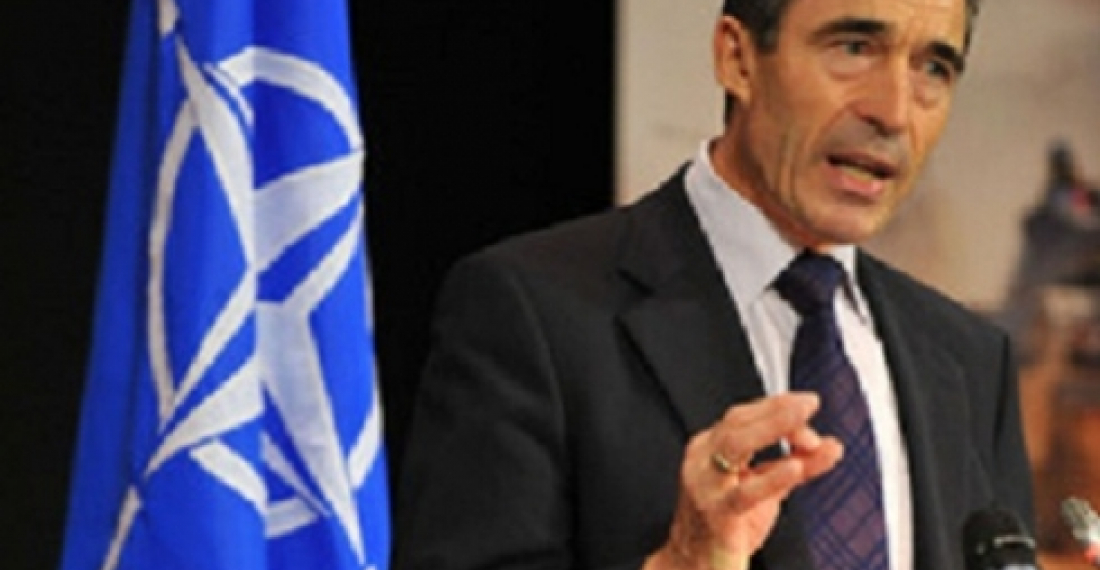
NATO Chief navigates stormy Caucasian waters.Anders Fogh Rassmusen visits region at a time of heightened tensions and political controversy.

The Secretary General of NATO, Anders Fogh Rassmusen has been in the South Caucasus over the last two days, making short visits to Armenia, Azerbaijan and Georgia.

The visit of the Head of NATO to the region sends a signal of continued committment by the Atlantic alliance to develop relations with the three republics, once part of the arch enemy - the USSR. All three countries have a relationship with NATO through the Partnership for Peace Programme, whilst Georgia is seeking full membership of the alliance.

The visit took place despite heightened tensions between Armenia and Azerbaijan and a few weeks before a hardly fought election campaign in Georgia.

Speaking at the Azerbaijani Diplomatic Academy in Baku this morning Rasmussen said:

"...... this region still faces great security challenges. Azerbaijan has a complicated neighbourhood. And the most pressing regional challenge remains finding a solution to the Nagorno-Karabakh conflict.

Two things are clear. First, that there is no military solution. And second, the only way forward is through dialogue, compromise, and cooperation.

As I said in Yerevan yesterday, NATO as an organisation is not involved directly in finding a solution to this conflict. Nor do we take sides. But we will continue to support the Minsk Process and efforts towards a peaceful settlement.

As I also said in Yerevan yesterday, I am deeply concerned by the Azerbaijani decision to pardon Ramil Safarov. The act he committed in 2004 was a crime which should not be glorified, as this damages trust and does not contribute to the peace process. There must be no return to conflict between Armenia and Azerbaijan. Tensions in this region must be reduced, and concrete steps must be taken to promote regional cooperation and reconciliation."

Rasmussen was greeted by demonstrators shouting "justice" when he arrived yesterday to speak at Yerevan State University. He later met with Armenian President Serzh Sargsyan. At a press conference afterwards Sargsyan reiterated the condemnation of the Armenian government of Hungary's decision to return Safarov to Azerbaijani jurisdiction.

Whilst neither Armenia nor Azerbaijan seek NATO membership both countries are keen to keep a good relationship with the alliance.

Meanwhile Azerbaijani media is reporting that Ramil Safarov is in an unknown location for his own safety.

source:commonspace.eu
Related articles

Editor's choice
News
Borrell tells the European Parliament that the situation in Afghanistan was critical, but the EU will remain engaged

Borrell tells the European Parliament that the situation in Afghanistan was critical, but the EU will remain engaged

Borrell underlined that the European Union will make every effort to support the peace process and to remain a committed partner to the Afghan people. "Of course, we will have to take into account the evolving situation, but disengagement is not an option.  We are clear on that: there is no alternative to a negotiated political settlement, through inclusive peace talks.
Editor's choice
News
Pope's visit to Türkiye and Lebanon has a strong ecumenical character, and places interreligious dialogue at its centre

Pope's visit to Türkiye and Lebanon has a strong ecumenical character, and places interreligious dialogue at its centre

Pope Leo XIV has begun the first overseas trip of his pontificate, a six-day visit to Türkiye and Lebanon, which started yesterday (27 November) and ends on Tuesday (2 December). According to Vatican Radio, the visit "carries a strong ecumenical character and places interreligious dialogue at its centre. It will also be a moment of closeness to Christian communities and local populations across the region".   During nearly a week in the region, Pope Leo XIV will meet civil and religious authorities, visit mosques and ancient churches, pray at Beirut’s port in memory of the victims of the 2020 explosion, and hold private meetings with Presidents Recep Tayyip Erdoğan and Joseph Aoun.   A highlight of the visit will be a visit to Nicaea, where the Pope will mark the anniversary of the Council of Nicaea. Christians of many traditions recognise the Council of Nicaea as a foundation of shared faith. One of the most anticipated moments will be the Pope’s encounter with Lebanese youth in Bkerké, at the Maronite Patriarchate, a meeting expected to carry strong messages of hope in the Jubilee Year. A central event will be the ecumenical celebration in İznik, where the Pope and Ecumenical Patriarch Bartholomew will walk together toward the ruins of the Basilica of St Neophytos. The prayer, held before icons of Christ and the Council, will conclude with the lighting of a candle—a symbolic gesture of unity. The journey will also highlight interreligious engagement.   Memorable moments are expected throughout the trip: a wreath at Atatürk’s mausoleum, prayer inside the Blue Mosque, Mass at Istanbul’s Volkswagen Arena, the planting of a cedar at the presidential palace in Beirut, and prayer at the tomb of St Charbel in Lebanon. The Vatican said that "Pope Leo XIV’s pilgrimage to Türkiye and Lebanon aims to offer a voice of peace, unity, and hope at the heart of the Middle East."

Popular

Editor's choice
News
Pope's visit to Türkiye and Lebanon has a strong ecumenical character, and places interreligious dialogue at its centre

Pope's visit to Türkiye and Lebanon has a strong ecumenical character, and places interreligious dialogue at its centre

Pope Leo XIV has begun the first overseas trip of his pontificate, a six-day visit to Türkiye and Lebanon, which started yesterday (27 November) and ends on Tuesday (2 December). According to Vatican Radio, the visit "carries a strong ecumenical character and places interreligious dialogue at its centre. It will also be a moment of closeness to Christian communities and local populations across the region".   During nearly a week in the region, Pope Leo XIV will meet civil and religious authorities, visit mosques and ancient churches, pray at Beirut’s port in memory of the victims of the 2020 explosion, and hold private meetings with Presidents Recep Tayyip Erdoğan and Joseph Aoun.   A highlight of the visit will be a visit to Nicaea, where the Pope will mark the anniversary of the Council of Nicaea. Christians of many traditions recognise the Council of Nicaea as a foundation of shared faith. One of the most anticipated moments will be the Pope’s encounter with Lebanese youth in Bkerké, at the Maronite Patriarchate, a meeting expected to carry strong messages of hope in the Jubilee Year. A central event will be the ecumenical celebration in İznik, where the Pope and Ecumenical Patriarch Bartholomew will walk together toward the ruins of the Basilica of St Neophytos. The prayer, held before icons of Christ and the Council, will conclude with the lighting of a candle—a symbolic gesture of unity. The journey will also highlight interreligious engagement.   Memorable moments are expected throughout the trip: a wreath at Atatürk’s mausoleum, prayer inside the Blue Mosque, Mass at Istanbul’s Volkswagen Arena, the planting of a cedar at the presidential palace in Beirut, and prayer at the tomb of St Charbel in Lebanon. The Vatican said that "Pope Leo XIV’s pilgrimage to Türkiye and Lebanon aims to offer a voice of peace, unity, and hope at the heart of the Middle East."