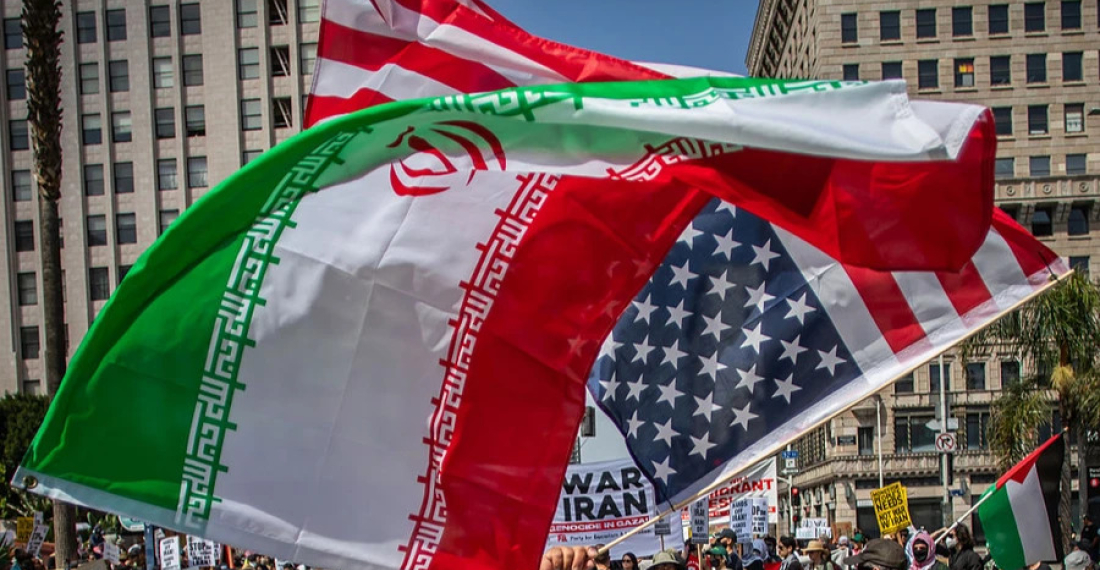
US President Donald Trump said on Monday (16 June) that a memorandum of understanding (MoU) with Iran has been "all signed" electronically, and the Strait of Hormuz will be “completely open” by Friday (19 June).
US officials said the agreement was signed by Trump, US Vice President JD Vance and main Iranian negotiator and Parliament Speaker Mohammad Bagher Ghalibaf. The details of MoU have yet to made fully public, but some details have been selectively leaked. The MoU, brokered in significant part by Pakistan and set to be formally signed in Switzerland on Friday, includes a cessation of hostilities in Lebanon, an end to Iranian restrictions on the Strait, a reduction of US military assets from the region, and some relief of sanctions and frozen Iranian assets. Iran's nuclear program (the original justification of the war) is deferred to be decided during the following 60-day period, though the memorandum secured Iran's reaffirmation of its commitment to the Non-Proliferation Treaty. The regional welcome was broad and immediate, with Saudi Arabia, the UAE, Kuwait, Qatar, Egypt, Lebanon, Jordan, and Türkiye all issuing statements of relief. Yet that relief was calibrated. Gulf capitals had spent three and a half months watching Washington threaten a partner over a waterway, contemplate occupying an island within artillery range of the Iranian mainland, and preside over what they privately called the worst global energy crisis in decades, all while urging restraint behind closed doors. In truth, the memorandum of understanding resolves the immediate crisis. Whether it resolves the deeper question of what kind of security guarantor Washington intends to be is another matter entirely, and the quiet work of building alternative architecture across the region suggests that Gulf capitals are not simply waiting around for the answer.
From brinkmanship to deal, the deeper reckoning for Gulf security has only just begun
Monday (8 June) marked one hundred days since the war began and more than sixty days since a ceasefire was announced on 8 April. However, neither milestone seemed to be the true bearer of a real resolution. Writing for Arab News, Dr. Abdel Aziz Aluwaisheg put this reality into stark terms: the IMF has revised its 2026 global growth forecasts from 3.4 percent to 2 percent if the closure continues, inflation is predicted to rise to 6 percent, and GCC economies that were projected to grow by more than 6 percent last October are now expected to shrink by more than 8 percent. Before the closure, around 13 million barrels of oil, 140 billion cubic meters of natural gas, and 20 percent of the world's fertilizer supply crossed the strait daily. Saudi Arabia is not the worst affected, as it maintains Red Sea export channels and land routes. Still, the kingdom truly thrives when the world economy grows, and ending the war is now as much about economic self-preservation as it is about principled diplomacy.
The question of what reopening looks like has become considerably more complicated. Ceasefire efforts have had substantial struggles following the downing of a US Army Apache helicopter by Iranian forces near the Strait, with CENTCOM launching retaliatory air strikes and Tehran striking multiple US military installations across Jordan, Kuwait, and Bahrain, including most notably the headquarters of the US Fifth Fleet. As this escalation continued, Trump posted that US forces would seek to occupy Kharg Island, the 22 square kilometer island through which 90-96 percent of Iran's crude oil exports pass. Writing for the Middle East Monitor, Dr. Jannus TH Siahaan argued the gamble made is increasingly likely to backfire. Iran is already operating under near emergency conditions following a naval blockade that had been imposed since 13 April, with more than twenty tankers stranded off the coasts of Kharg. Occupying the island, hence, would impose little additional economic pressure while inflaming Iranian nationalism. Kharg also lies only 21 miles from the Iranian mainland, placing every American position within range of Iranian artillery and short-range ballistic missiles. The World Bank warned that should fighting around Kharg further disrupt energy supplies, global economic growth could plunge to 1.3 percent.
With Hormuz remaining closed throughout the conflict, the threat of a second chokepoint had also been taken seriously. Writing for The New Arab, Ariya Farahmand documented that Iran and its allies had signalled intentions to activate the Bab al-Mandab, the Red Sea strait via which around 15 percent of global trade and 12 percent of seaborne oil passed in 2023. Saudi Arabia, which had grown dependent on Red Sea exports following the Hormuz closure, faced the prospect of economic siege had that threat materialised. The rerouting of the Gulf economy had already transformed the region's logistics landscape in ways that are predicted to outlast the conflict itself. Writing for Gulf International Forum, Robin Mills documented that Khor Fakkan went from handling 2,000 shipping containers a week before the war to roughly 50,000. New pipeline and rail projects were fast-tracked, though Yanbu and Muajjiz were already heavily burdened, and major infrastructure requires three to four years to complete. Qatar remained the most exposed throughout as its LNG industry, which can only export via specialised tankers loading at facilities on the Strait, left it with no viable alternative routes for the duration of the closure.
This briefing was first published Arabia Concise on 16 June 2026. It was prepared by Santiago Ferbel-Azcarate, with support from the commonspace.eu editorial team, drawing on reporting from Arab News (Riyadh), Middle East Monitor (London), The New Arab (London), and the Gulf International Forum (Washington D.C.).