


There appears to have been a shift in the calculus of the war, though it is not entirely clear whether it amounts to a turning point or merely a pause. Writing for Al Arabiya, political analyst Raghida Dergham observed that both Washington and Tehran appear to be buying time, studying strategic and tactical mistakes, repositioning militarily and politically, and seeking what she called “a warrior's pause”. Neither side emerged from the first round with a decisive outcome: Tehran's regime appears to remain intact, and Trump's objectives remain unmet. What is new, and what has been described as both intriguing and alarming, is that Trump briefly spoke of a US-Iranian partnership in generating revenue via the Strait of Hormuz before walking back on the idea due to pressure from European and Gulf allies. The remark, however fleeting, signals the unpredictability of the situation; a White House moving between maximum pressure and maximum uncertainty, with allies left to scrape for interpretation. Reminiscent of this fact, negotiations in Islamabad seem to have stalled, and Trump's decision to impose a blockade on Iran’s maritime trade has only further disrupted the landscape, even as Iran threatens to retaliate by targeting Gulf ports directly.
The structural damage to the Gulf’s economic foundations continues to deepen in ways that outlast individual strikes. Evidently, the war has blown apart the so-called “oil for security” bargain underpinning US-Gulf relations, which allowed Arab oil producers to get American protection as long as they kept energy markets stable. This bargain, according to Timothy Hopper, writing for the Middle East Monitor, is likely not to return. Bahrain is perhaps the starkest illustration of what this rupture looks like in practice. Entering the conflict already in a fiscal deficit, with high amounts of public debt and low foreign exchange reserves, the war has only continued to erode its export revenues and tourism simultaneously. Economists specializing in the region expect Bahrain to lean heavily on wealthier Gulf neighbours to fund its post war recovery, a dynamic that will quietly but meaningfully shape intra-GCC dependencies in the months ahead.
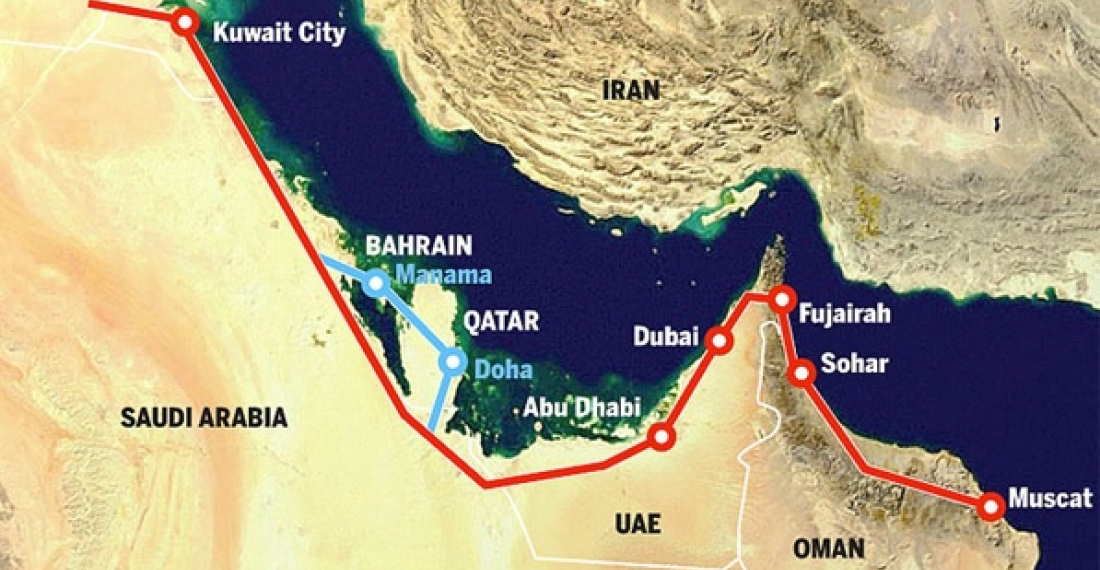
Against this backdrop, a question has been pushed to the forefront: What regional architecture might emerge from the rubble? Writing for the Carnegie Endowment for International Peace, Sam Worby and Andrew Leber outlined three broad scenarios for Gulf states after the Iran war, arguing that the closure of the Strait of Hormuz has validated longstanding investments in pipeline infrastructure capable of bypassing the strait, while also exposing their limits; pipelines benefiting only some of the Gulf states, and do nothing for imports of non-oil goods such as fertilizer. Their prescription is ambitious: accelerating the long-stalled GCC rail project to link existing networks across Oman, Saudi Arabia, and the UAE with the remaining Gulf monarchies, while deliberately leveraging the bloc’s different national strengths: the UAE’s edge in military technology, Oman's diplomatic positioning, Saudi Arabia’s strategic depth, and the trade-focussed hubs of Doha, Dubai, and Abu Dhabi, as complementary assets rather than competing ones. Whether the political will exists to pursue such integration under wartime conditions is another matter, but the analytical case has rarely appeared clearer.
Dubai, for its part, is pushing hard to maintain its image. The CEO of Dubai Economic Development Corporation was reported to have said that the damage to the emirate has been “very, very limited relative to what’s been hurled at us,” and pointed to the emirate's green corridor with Oman, a streamlined customs arrangement for air and road freight opened on 14 March that bypasses the Strait of Hormuz entirely, as evidence of Dubai’s adaptability. A one-billion dirham economic support package announced on 1 April offered businesses a three-month deferral on government fees. The corridor is a genuine contingency, but it is also a measure of how much the regional connectivity map has already been redrawn. Further north, Türkiye, Syria, and Jordan announced plans to revive the historic Hejaz Railway. The revival is expected to take four to five years and eventually connect with Saudi Arabia's rail network. It is both symbolic and strategic, a reminder that the war’s disruptions are accelerating infrastructure conversations that had been left aside for years.
The human costs of the conflict are spreading well beyond the Gulf. Writing for Arab News, Gabriele Malvisi and Anan Tello reported that Iran's closure of the Strait of Hormuz has already driven petrol prices in Sudan to 30,000 Sudanese pounds per gallon, up from 19,000 in February, with some analysts projecting further rises by midyear. For farmers in Al-Qadarif and Al-Jazirah, dependent on diesel to power irrigation pumps and move seeds to market, the planting window opening in June is approaching, with the arithmetic already becoming impossible. The Hormuz crisis has repeatedly exposed uncomfortable truths about global energy politics: that the energy infrastructure is acutely vulnerable to disruption at a handful of geographic chokepoints, and that in every such geopolitical catastrophe, some suffer while others profit from the chaos.
Ukraine has emerged, unexpectedly, as one of the war's more consequential new actors. Writing for Arab News, Luke Coffey noted that Zelensky has signed security agreements with Saudi Arabia, the UAE, and Qatar in recent weeks, offering Ukrainian expertise in countering Iranian drones and missiles, expertise accumulated through years of high-intensity warfare repelling Iranian-designed systems. No country in the world, Coffey argues, has more recent practical experience confronting Iranian aerial threats. It appears that Zelensky’s visit to Syria has only extended this logic further, with Kyiv positioning itself as a provider of military know-how across a theater long-dominated by Russia and increasingly shaped by Türkiye. It is a remarkable pivot for a country that, four years ago, was entirely dependent on outside military assistance. Saudi Arabia, meanwhile, is attempting something more challenging than military deterrence; it is trying to build an enduring diplomatic outcome and prevent the return of war, a goal that requires Iran to demonstrate its willingness through actions rather than words. The responsibility for rebuilding trust seems to fall primarily on Tehran. Whether Iran is in any position to meet that expectation or, let alone willing to, is the question on which the region's next chapter will turn. The Gulf has survived the war's first phase. Whether the order that emerges from it is one it can live with is far from settled.
Source: This briefing was first published in Arabia Concise on 21 April 2026. It was prepared by Santiago Ferbel-Azcarate, with support from the commonspace.eu editorial team, drawing on reporting from Al Arabiya (Riyadh), Middle East Monitor (London), the Carnegie Endowment for International Peace (Washington D.C.), and Arab News (Riyadh).



