Gulf countries seek new security framework as war exposes the limitations of US guarantees

There appears to have been a shift in the calculus of the war, though it is not entirely clear whether it amounts to a turning point or merely a pause. Writing for Al Arabiya, political analyst Raghida Dergham observed that both Washington and Tehran appear to be buying time, studying strategic and tactical mistakes, repositioning militarily and politically, and seeking what she called “a warrior's pause”. Neither side emerged from the first round with a decisive outcome: Tehran's regime appears to remain intact, and Trump's objectives remain unmet. What is new, and what has been described as both intriguing and alarming, is that Trump briefly spoke of a US-Iranian partnership in generating revenue via the Strait of Hormuz before walking back on the idea due to pressure from European and Gulf allies. The remark, however fleeting, signals the unpredictability of the situation; a White House moving between maximum pressure and maximum uncertainty, with allies left to scrape for interpretation. Reminiscent of this fact, negotiations in Islamabad seem to have stalled, and Trump's decision to impose a blockade on Iran’s maritime trade has only further disrupted the landscape, even as Iran threatens to retaliate by targeting Gulf ports directly.

The structural damage to the Gulf’s economic foundations continues to deepen in ways that outlast individual strikes. Evidently, the war has blown apart the so-called “oil for security” bargain underpinning US-Gulf relations, which allowed Arab oil producers to get American protection as long as they kept energy markets stable. This bargain, according to Timothy Hopper, writing for the Middle East Monitor, is likely not to return. Bahrain is perhaps the starkest illustration of what this rupture looks like in practice. Entering the conflict already in a fiscal deficit, with high amounts of public debt and low foreign exchange reserves, the war has only continued to erode its export revenues and tourism simultaneously. Economists specializing in the region expect Bahrain to lean heavily on wealthier Gulf neighbours to fund its post war recovery, a dynamic that will quietly but meaningfully shape intra-GCC dependencies in the months ahead.

Against this backdrop, a question has been pushed to the forefront: What regional architecture might emerge from the rubble? Writing for the Carnegie Endowment for International Peace, Sam Worby and Andrew Leber outlined three broad scenarios for Gulf states after the Iran war, arguing that the closure of the Strait of Hormuz has validated longstanding investments in pipeline infrastructure capable of bypassing the strait, while also exposing their limits; pipelines benefiting only some of the Gulf states, and do nothing for imports of non-oil goods such as fertilizer. Their prescription is ambitious: accelerating the long-stalled GCC rail project to link existing networks across Oman, Saudi Arabia, and the UAE with the remaining Gulf monarchies, while deliberately leveraging the bloc’s different national strengths: the UAE’s edge in military technology, Oman's diplomatic positioning, Saudi Arabia’s strategic depth, and the trade-focussed hubs of Doha, Dubai, and Abu Dhabi, as complementary assets rather than competing ones. Whether the political will exists to pursue such integration under wartime conditions is another matter, but the analytical case has rarely appeared clearer.

Dubai, for its part, is pushing hard to maintain its image. The CEO of Dubai Economic Development Corporation was reported to have said that the damage to the emirate has been “very, very limited relative to what’s been hurled at us,” and pointed to the emirate's green corridor with Oman, a streamlined customs arrangement for air and road freight opened on 14 March that bypasses the Strait of Hormuz entirely, as evidence of Dubai’s adaptability. A one-billion dirham economic support package announced on 1 April offered businesses a three-month deferral on government fees. The corridor is a genuine contingency, but it is also a measure of how much the regional connectivity map has already been redrawn. Further north, Türkiye, Syria, and Jordan announced plans to revive the historic Hejaz Railway. The revival is expected to take four to five years and eventually connect with Saudi Arabia's rail network. It is both symbolic and strategic, a reminder that the war’s disruptions are accelerating infrastructure conversations that had been left aside for years.

The human costs of the conflict are spreading well beyond the Gulf. Writing for Arab News, Gabriele Malvisi and Anan Tello reported that Iran's closure of the Strait of Hormuz has already driven petrol prices in Sudan to 30,000 Sudanese pounds per gallon, up from 19,000 in February, with some analysts projecting further rises by midyear. For farmers in Al-Qadarif and Al-Jazirah, dependent on diesel to power irrigation pumps and move seeds to market, the planting window opening in June is approaching, with the arithmetic already becoming impossible. The Hormuz crisis has repeatedly exposed uncomfortable truths about global energy politics: that the energy infrastructure is acutely vulnerable to disruption at a handful of geographic chokepoints, and that in every such geopolitical catastrophe, some suffer while others profit from the chaos.

Ukraine has emerged, unexpectedly, as one of the war's more consequential new actors. Writing for Arab News, Luke Coffey noted that Zelensky has signed security agreements with Saudi Arabia, the UAE, and Qatar in recent weeks, offering Ukrainian expertise in countering Iranian drones and missiles, expertise accumulated through years of high-intensity warfare repelling Iranian-designed systems. No country in the world, Coffey argues, has more recent practical experience confronting Iranian aerial threats. It appears that Zelensky’s visit to Syria has only extended this logic further, with Kyiv positioning itself as a provider of military know-how across a theater long-dominated by Russia and increasingly shaped by Türkiye. It is a remarkable pivot for a country that, four years ago, was entirely dependent on outside military assistance. Saudi Arabia, meanwhile, is attempting something more challenging than military deterrence; it is trying to build an enduring diplomatic outcome and prevent the return of war, a goal that requires Iran to demonstrate its willingness through actions rather than words. The responsibility for rebuilding trust seems to fall primarily on Tehran. Whether Iran is in any position to meet that expectation or, let alone willing to, is the question on which the region's next chapter will turn. The Gulf has survived the war's first phase. Whether the order that emerges from it is one it can live with is far from settled.

Source: This briefing was first published in Arabia Concise on 21 April 2026. It was prepared by Santiago Ferbel-Azcarate, with support from the commonspace.eu editorial team, drawing on reporting from Al Arabiya (Riyadh), Middle East Monitor (London), the Carnegie Endowment for International Peace (Washington D.C.), and Arab News (Riyadh). 

Latest

Editor's choice
Monday Commentary
Monday Commentary: PEACE IN OUR TIME?

Monday Commentary: PEACE IN OUR TIME?

Making peace between Armenia and Azerbaijan was never going to be simple, nor easy, nor quick. It is taking time, writes Dennis Sammut in this Monday Commentary. “There is a sense of realism coming from the leaders of the two countries – President Ilham Aliyev of Azerbaijan and prime minister Nikol Pashinyan of Armenia, that frankly, is necessary and welcome”, he writes. At a time when conflicts are raging all over the world – from Ukraine to the Gulf, from Africa to South Asia, the prospect that Armenia and Azerbaijan had finally, after decades of conflict that left thousands of dead and many more displaced, decided on embarking on a journey of peace was welcomed. Peace between Armenia and Azerbaijan can be top-down up to a point. Both leaders have spent political capital preparing for a peace deal. But both are aware that their people are not ready for peace yet. In fact, in Armenia, most of the elite are negative toward a peace deal with Azerbaijan. Pashinyan needs time to persuade his countryfolk. That is why 2031 is realistic. Ilham Aliyev runs a tighter shop, but he is also not immune to public opinion. Every time someone hits a landmine in Karabakh, which unfortunately happens often, peace comes into question. Which is why Aliyev chooses to sound hardline, more often than not. In pursuing the peace agenda, both Aliyev and Pashinyan need to proceed cautiously. But they are right in making peace the central issue in their agenda. It is the main issue, and the one that will define them in history. So forward, cautiously but resolutely! In pursuing the peace agenda, Aliyev and Pashinyan need to be supported clearly and unambiguously. There are too many people in Baku and Yerevan who are sitting on the sides, waiting. The international community is not doing enough. It is time to be counted. Otherwise, the spoilers will win, and the region will go back to its bad habits. (Click the image to read the full commentary).
Editor's choice
News
Ukraine Peace Talks Set to Expand as Russia and Europe Clash Over Post-war Security

Ukraine Peace Talks Set to Expand as Russia and Europe Clash Over Post-war Security

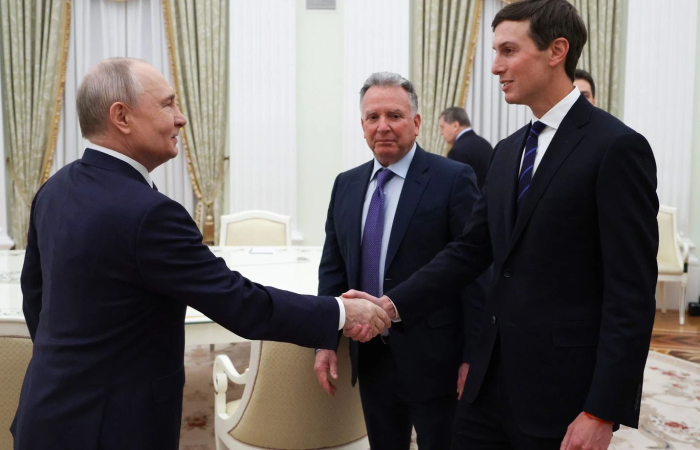
Ukraine and Russia could see European countries join the next round of peace negotiations, following talks between US special envoys Steve Witkoff and Jared Kushner and Russian President Vladimir Putin in Moscow on Thursday (November 12). However, conflicting positions over European military involvement, Ukraine’s territorial future and the continent’s security arrangements highlight the difficulties facing the diplomatic process. Speaking after the meeting, Witkoff said European participation would be an important development, describing the countries concerned as key partners. Kushner also indicated that Washington had noticed a shift in European attitudes and believed their involvement would not obstruct progress. In a statement published on X, he said the expanded discussions would address broader European security arrangements alongside territorial disputes between Russia and Ukraine. The US envoys subsequently travelled to Dublin, where they met Ukrainian President Volodymyr Zelenskyy during a European summit. Zelenskyy welcomed the possibility of European participation and expressed hope that the negotiations would include measures to reduce tensions and establish ceasefires. He also reiterated the importance of European representation in decisions concerning the continent’s security. Moscow, however, has offered a more cautious interpretation of the proposed expansion. Putin's aide, Yuri Ushakov, suggested that European countries should first reconsider their military assistance to Kyiv, arguing that their current actions demonstrated an unwillingness to pursue peace. Putin similarly called on Washington to work with its European allies to establish whether they genuinely wanted peace or continued confrontation with Russia. The Russian president also rejected the prospect of European peacekeeping troops being deployed to Ukraine following a potential agreement, describing such a presence as a continuation of the war. His position reflects wider disagreements over the future European security architecture, with Moscow seeking discussions on the continent's broader security arrangements, while European leaders insist that such negotiations cannot replace a settlement of the war. Simultaneously, Zelenskyy raised concerns about disruptions to Starshield, the US-made satellite communications service used by Ukrainian forces. He described Washington’s discussions with Moscow about Europe's future security as unusual and warned against decisions that could undermine Ukraine's sovereignty. Despite the diplomatic activity, fighting continued. Russian drone attacks killed two people in Ukraine's Sumy region and injured five in Rivne, while a separate attack in Russia's Belgorod region killed one person and injured four. Ukrainian agricultural company Kernel Holding also suspended operations at all its oilseed extraction facilities following repeated Russian attacks.

Popular

Editor's choice
Monday Commentary
Monday Commentary: European-Azerbaijan relations need an intensive and multifaceted dialogue that is frank and honest

Monday Commentary: European-Azerbaijan relations need an intensive and multifaceted dialogue that is frank and honest

Last week I visited Baku, Azerbaijan. My visit was relatively short, but very intensive, and had many meetings with stakeholders and colleagues. When I arrived in Baku first time in 1996,  Azerbaijan was a different country: weak, poor, and shaken by defeat in war. For thirty year the Karabakh issue dominated the agenda: the political agenda but also the popular mindset. Now, thirty years later, Azerbaijan has returned to Karabakh, and peace with Armenia is on the horizon. It is a new era for Armenia-Azerbaijan relations, for the South Caucasus, but also for Europe.  But we cannot be complacent: the Peace agreement has been initialed but not signed; borders remain closed; TRIPP is ambitious but remains an idea; and there are spoilers who want to turn the clock back. We must not allow them, and in this Europe and Azerbaijan must work together. Europe’ vanguard organization is the European Union – it is a free union of 27 member states; it is a strong global economic force, and increasingly a diplomatic and military force too. But it remains “work in progress” and can often appear dysfunctional. It often lacks collective and institutional memory. In its dealings with Azerbaijan the EU has made many mistakes – not least opening the delegation here late – in 2008. It sometimes appears condescending. Some utterances from the European Parliament and from some quarters in some member states are not understandable even for me. They irritate the Azerbaijanis, but serve no other purpose But Azerbaijan has also not handled relations with the EU well. It has failed to respond when the hand of friendship reached out; and it confused irritating actions, sometimes by well-meaning people; sometimes by outright spoilers, with strategic action. In short, EU-Azerbaijan relations have suffered from a lack of proper dialogue. This dialogue must be frank, honest and multi-faceted involving different segments of society on both sides.   Is Azerbaijan Europe? When Azerbaijan applied to join the Council of Europe in the 1990s, there were some who opposed, saying this was not Europe. I was one of the people who argued that Armenia and Azerbaijan may be on the periphery of the continent geographically, but were European in essence. Certainly their elites. During the discussion on 4 September in Baku, my friend Farhad Mammedov, mentioned that Azerbaijan is not interested in joining the EU, and was now close to the Central Asian countries in the 5 plus 1 format. Neither things mean that Azerbaijan is not Europe. There are several European countries that are not in the EU, and do not want to be, for example Norway and Switzerland. Iceland has recently voted to stay out of the EU. The UK was a member and left. Europe is bigger than the EU, and the holding of the European Political Community summit in Baku in 2027 proves that. Despite all the rhetoric, I never heard the president of Azerbaijan  saying that Azerbaijan is not Europe, nor have I heard any European president say it either. Not wanting to join the EU and forging close relations with neighbouring regions does not make Azerbaijan any less European. It is only logical that when Europeans talk to Azerbaijan they talk like family. The conversation is often frank. It must also be honest, and Europeans need always to remember this too. A frank, honest and multi-faceted dialogue A frank, honest and multifaceted dialogue will contribute to relations between Azerbaijan and the rest of Europe: it will avoid misperception, which unfortunately is very common on both sides; it will provide a forum where problems can be discussed and resolved, and it will increase mutual trust, so that together common problems can be addressed. (click image to read the full Monday Commentary)
Editor's choice
Monday Commentary
Monday Commentary: “The barren rocks of Aden” and “These lands of Yemen are so ruthless”

Monday Commentary: “The barren rocks of Aden” and “These lands of Yemen are so ruthless”

There are two early 20th-century tunes that mark foreign attempts to occupy and “pacify” Yemen. The Scottish tune “The barren rocks of Aden” marks the mobilisation of Highland soldiers, enlisted to be deployed to the Yemeni port of Aden, that in 1837 became the last colony to be incorporated into the British Empire. The tune talks of the harshness of the terrain, but is celebratory, It was even played as a farewell tune to Sir William Luce at the parade in Sharjah celebrating his end as “British Viceroy” in the Middle East in 1966. The second tune is an Anatolian lament. As Ilker Sezer reminded us this weekend, in his weekly feature on “Turkiye Today”, it “mourns the tragic fate of Ottoman soldiers dispatched to the harsh, remote deserts of Yemen during the fall of the empire, young men who marched away from their villages and never returned home. Most of their names, and numbers, were never recorded. Yet, their fate left a mark on the Turkish psyche.” Subsequent invaders have discovered that Yemen is a grave that cannot be overcome by the strength of modern technology, and that whilst Yemeni society is splintered and divided, building a reliable alliance with Yemeni factions is difficult. These are the harsh lessons facing Saudi Arabia, as the Kingdom faces its biggest challenge in its modern history. The leadership of the Kingdom now has to respond decisively. At stake is their very credibility. This is likely to be a long and messy conflict. Saudi military objectives need to be focused: to box in the Houthis rather than destroy them. This is likely to include: (a) regaining territory lost on the Red Sea coast; (b) control over Bab el Mandeb Strait; (c) some kind of cordon sanitaire on the Saudi-Yemeni border; and if things go well (d) the capture of Sanaa. All this would not eliminate the Houthi problem, but it will contain it. In the end the Saudis will have to continue managing Yemen with a mixture of carrot and stick. For the moment, the stick is likely, but the carrot cannot be forgotten either. (click the image to read the Monday Commentary in full)