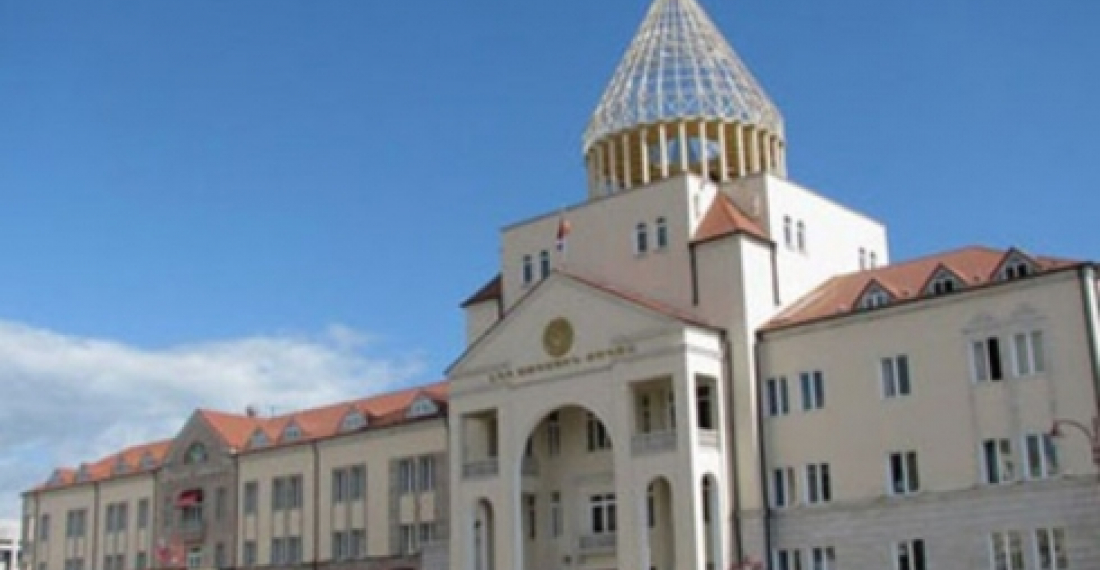
Chief of Staff of Armenian Army in Stepanakert. Colonel General Yuri Khachaturov met with the President of the self declared Nagorno-Karabaklh Republic, Bako Sahakian.

The Chief of Staff of the Armenian Army, Colonel General Yuri Khachaturov is in Stepanakert for meeting with the leadership of the self declared Nagorno-Karabakh Republic. on Monday morning he was received by the president, Bako Sahakian. NKR Defense Minister Movses Hakobyan, first deputy head of the General Staff of the Armenian Armed Forces Enrico Apryamov also participated in the meeting.

Commonspace.eu political editor said in a comment that there are often visits by senior officials of the Armenian Army to Nagorno-Karabakh. However these visits seem to have increased in the last months, and they are also being given more prominence by the media. This is partly because the leadership of the self declared Nagorno-Karabakh republic needs to show to its population that it is taking the deteriorating security situation on the front line seriously. It is also a sign that Armenian forces are increased in more intensive contingency planning. The visit of Khachaturov this week is likely also related to the imminent opening of Stepankert Airport, a move that has been rejected by Azerbaijan.

source; commonspace.eu
Related articles

Editor's choice
News
Millions attend Khamanei's funeral

Millions attend Khamanei's funeral

Large crowds of black-clad mourners have gathered outside Tehran's main mosque to pay their respects to Iran's former supreme leader on the first day of his funeral commemorations. Ayatollah Ali Khamenei's body is currently lying in state at the Grand Mosalla, ahead of his burial in his hometown of Mashhad next Thursday. Authorities expect 15-20 million people to attend the ceremonies across Iran and Iraq over the coming days, which take place more than four months after Khamenei was killed in US and Israeli strikes. Masses of supporters of the Islamic regime turned out on Saturday morning,  chanting slogans against the US and in support of revenge for the ayatollah's killing. "We came [to the funeral] because we promised the supreme leader we would stand by him to the very end," 37-year-old professor Reza told news agency AFP in the Grand Mosalla's courtyard. "For a long time, we shouted that we would sacrifice our lives for the leader, but it was he who sacrificed himself for us." Arash Rahimi, 40, told Reuters: "Everyone here has come to avenge the blood of their supreme leader. "As our leader has said, we have a blood feud with the United States. Our relations with the United States will never be good." Khamenei was killed during joint Israeli and US strikes on Iran in late February, in what quickly spiralled into a wider regional conflict. US President Donald Trump said Iran's government was "dying to settle" a peace deal to end the war after a preliminary agreement was struck between the two, adding on Friday: "We gave them [Iran] a week off for a funeral because we're nice." Much of central Tehran will be locked down over the weekend as the funeral ceremony gets under way. It is expected to be the largest funeral ever in terms of attendees as a proportion of the country's population. Khamenei's body will lie in the Grand Mosalla for three days, alongside the remains of family members who were also killed in the air strikes. There will then be three further days of events outside of the capital.

Popular

Editor's choice
Interview
Thursday Interview: Murad Muradov

Thursday Interview: Murad Muradov

Today, commonspace.eu starts a new regular weekly series. THURSDAY INTERVIEW, conducted by Lauri Nikulainen, will host  persons who are thinkers, opinion shapers, and implementors in their countries and spheres. We start the series with an interview with Murad Muradov, a leading person in Azerbaijan's think tank community. He is also the first co-chair of the Action Committee for a new Armenian-Azerbaijani Dialogue. Last September he made history by being the first Azerbaijani civil society activist to visit Armenia after the 44 day war, and the start of the peace process. Speaking about this visit Murad Muradov said: "My experience was largely positive. My negative expectations luckily didn’t play out. The discussions were respectful, the panel format bringing together experts from Armenia, Azerbaijan, and Turkey was particularly valuable during the NATO Rose-Roth Seminar in Yerevan, and media coverage, while varied in tone, remained largely constructive. Some media outlets though attempted to represent me as more of a government mouthpiece than an independent expert, which was totally misleading.  Overall, I see these initiatives as important steps in rebuilding trust and normalising professional engagement. The fact that soon a larger Azerbaijani civil society visits to Armenia followed, reinforces the sense that this process is moving in the right direction." (click the image to read the interview in full)