


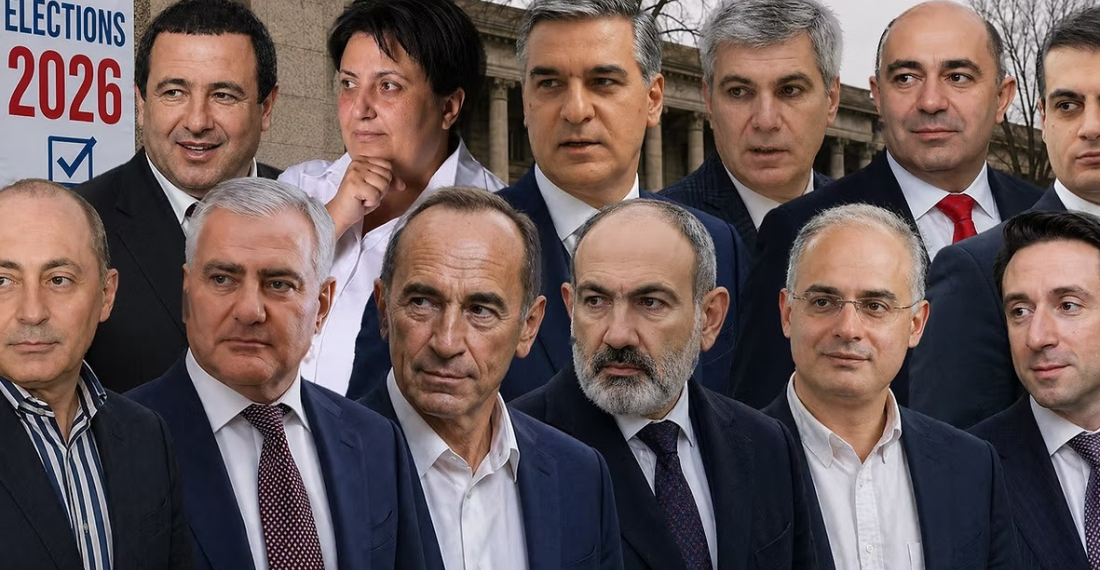
The campaign for the Armenian parliamentary elections began on Friday (8 May), with 17 parties and two electoral blocs in the running. All are seeking to enter parliament and win the support of around 2.5 million eligible voters across Armenia. With the campaign underway, each party is already mobilising public opinion against the other. Parties are divided on different themes: peace vs reconsideration of the current peace process, European vs Russian trajectories, and populist vs democratic tendencies, among other political cleavages shaping the campaign. Each party is targeting different segments of the Armenian electorate and hoping that its strategy will secure seats in parliament.
The ruling Civil Contract Party will run independently and once again be led by the current Prime Minister, Nikol Pashinyan. The party faces several challengers, including former President Robert Kocharyan’s Armenia Alliance party, the Strong Armenia alliance associated with businessman and philanthropist Samvel Karapetyan, and Gagik Tsarukyan’s Prosperous Armenia Party. Other parties include the former Human Rights Defender Arman Tatoyan’s Wings of Unity party, the Armenian National Congress, which is expected to participate under the leadership of Levon Zurabyan, and Edmon Marukyan’s Bright Armenia Party. In addition, former Yerevan mayor Hayk Marutyan is also entering the elections with his New Force party, and Aram Sargsyan, leader of the Republic Party and brother of former Prime Minister Vazgen Sargsyan, who was killed during the 1999 Armenian parliament shooting, confirmed that his party will also run independently. Lastly, among others, the newly formed movement called Against Everyone is also hoping to garner support from undecided voters.
The Civil Contract Party launched its campaign in Syunik, where Pashinyan argued that his party “secured peace and preserved Armenia’s statehood”. In the election manifesto, the party argued that its priorities will be the “institutionalization of peace, the continuation of the delimitation process, the implementation of the TRIPP project, and the final signing, ratification, and further implementation of the peace agreement between Armenia and Azerbaijan”. The manifesto also presented 100 concrete steps for 2026–2031 that will respond to different domestic economic and social problems, including employment rate, decreasing poverty, education, digital infrastructure, and the establishment of a visa-free regime with the EU.
One of the main government opponents, Armenia Alliance Party, led by Robert Kocharyan, started its campaign in Vagharshapat. Kocharyan argued that Pashinyan is leading Armenia into a dangerous geopolitical “adventure” by attempting to pull Armenia into confrontation with Russia. He criticized the anti-Russia statements made by various speakers during the EPC summit and the EU-Armenia summit and mentioned that the Civil Contract Party is using the fear of war as an electoral tool, while at the same time seeking European support to deflect growing concerns over democratic backsliding and political persecution within Armenia. Kocharyan argued that his party is not against peace, but insisted that real peace can only be built by a strong army, strong leadership, and reliable alliances. The election manifesto can be read here.
The Strong Armenia alliance, led by Samvel Karapetyan, held its first official campaign event in Yerevan. Samvel Karapetyan is in house arrest on charges of calling for the seizure of power. Replacing him is his nephew, Narek Karapetyan, who will also be at the top of the party’s electoral list as Samvel Karapetyan, due to his triple citizenship, cannot run. At the rally, his nephew argued that since 2018, Armenia has become smaller. He argued that in the party’s manifesto, there are plans to “provide 100,000–150,000 drams per month to extremely poor families with more than five members. Seventy percent of this amount will be funded by wealthy Armenian businesspeople around the world, and the state will contribute only 30 percent”.
In the past few weeks, dozens of Strong Armenia members have been detained on allegations of vote-buying. The opposition group argued that the allegations were politically motivated and accused the Civil Contract Party of using state resources to influence voters, while not facing prosecution.
Public rallies of Prosperous Armenia Party, led by Gagik Tsarukyan, began on Sunday (9 May) in Abovyan. The party promised debt relief, amnesty for people facing loans and economic hardship, and free public services. In its programme, the party argues that “In the Armenia we envision, there are no false divisions — no 'pro-Western' or 'pro-Russian' labels. Ultimately, such divisions only serve the interests of our enemies. In the Armenia we envision, what unites us is the national interest of Armenia — and that interest comes first.” More can be read here.
The Bright Armenia party, led by Edmon Marukyan, kicked off its campaign in Yeraskh. He called on all citizens to vote. His party’s manifesto can be accessed here. In Yeraskh, party officials argued that under the current government, Armenia’s national sovereignty has been in decline. The party claimed that “sovereignty is measured not by rhetoric but by a state’s ability to make decisions within its own territory free of foreign dictates”.
The New Force party, led by former Yerevan mayor Hayk Marutyan, is beginning its campaign with meetings in Yerevan’s countryside. The Wings of Unity party, headed by former Human Rights Defender Arman Tatoyan, is launching its voter outreach from Goshavank Monastery near the northern town of Ijevan.
While the campaign is gathering momentum on all sides, voters in Armenia will, in less than a month, be called upon to make their decision at the ballot box.
Source: This briefing was prepared by the editorial team of Commonspace.eu. This briefing first appeared in Issue 4 of Armenia Election Monitor 2026 on 13 May.



