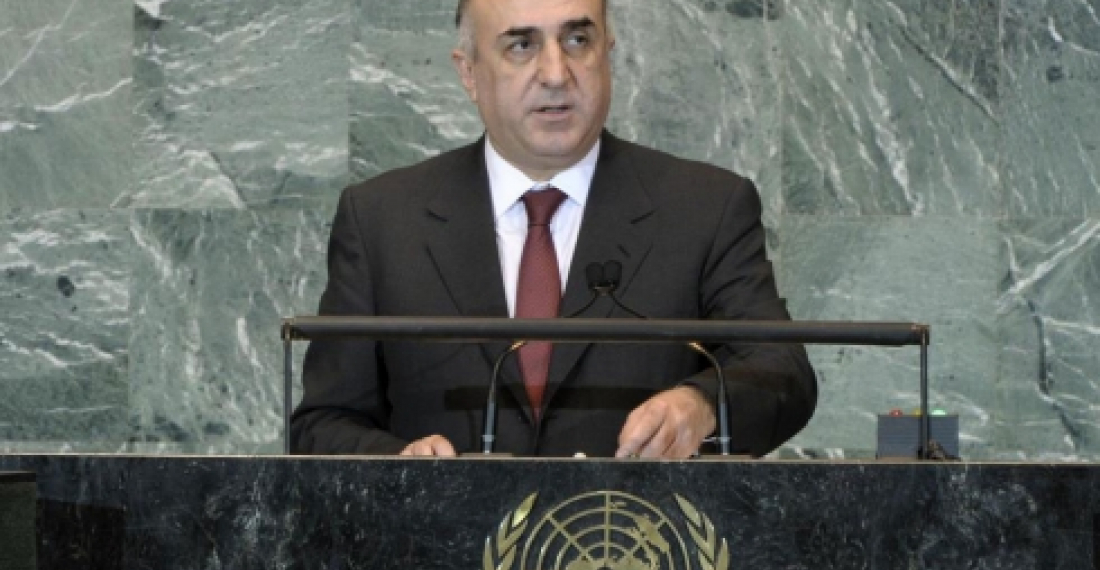
The Foreign Minister of Azerbaijan, Elmar Mammadyarov addressed the 66th Session of the UN General Assembly in New York on 27 September. This is the full text of his speech:
Mr. President,
Ladies and Gentlemen,
I would like to join the previous speakers in congratulating H.E. Mr. Nassir Abdulaziz Al-Nasser on his election as President of the sixty-sixth session of the United Nations General Assembly and wish him every success in this highly responsible post, and 1 thank his predecessor HE. Mr. Joseph Deiss, for his productive work during the last session.
I also express my profound respect and gratitude to the Secretary-General of the United Nations H.E. Mr. Ban Ki-moon for his leadership and dedication to revitalizing the United Nations Organization.
Mr. President,
In regard to the theme of this year's General Debate, we welcome the adoption at the sixty-fifth session of the General Assembly resolution on the strengthening the role of mediation in the peaceful settlement of disputes, conflict prevention and resolution. In this document, the General Assembly reiterated that all Member States should strictly adhere to their obligations as laid down in the UN Charter and reaffirmed, inter alia, the commitment to respect the sovereignty, territorial integrity and political independence of all States.
Azerbaijan looks forward to the relevant guidance for more effective mediation, as it was indicated in the resolution, and we are ready to actively contribute to its elaboration.
Unfortunately, we have to admit that not all States approach responsibly to their international obligations and comply with the generally accepted norms and principles of international law.
For almost two decades we have been facing the flagrant violation of the UN Charter and other documents of international law by the Republic of Armenia, which perpetrated aggression against the sovereignty and territorial integrity of the Republic of Azerbaijan. As a result of this aggression, almost 20 percent of the territory of Azerbaijan continues to remain under occupation and about 1 million Azerbaijani refugees and internally displaced persons are unable to return to their homes.
In 1993, the United Nations Security Council adopted four resolutions, which demanded the immediate, complete and unconditional withdrawal of Armenian forces from ail the occupied territories of Azerbaijan and reaffirmed the sovereignty, territorial integrity and inviolability of the internationally recognized borders of Azerbaijan. The same appeals were made also by other international organizations. Unfortunately, Armenia continues to ignore the calls of the international community.
What is even more worrisome is that, instead of preparing its people for peace, prosperous and stable future in friendship and cooperation with neighbouring countries, the leadership of Armenia continues to publicly incite the future generations ta new wars, violence and aggression and propagate by all means the dangerous ideas of animosity and hatred towards not only Azerbaijan, but also other peoples of the region.
Illegal activities in the occupied territories of Azerbaijan, including implantation of ethnic Armenian settlers as well as destruction and appropriation of historical and cultural heritage, represent another source of serious concern. Such activities serve ta further consolidation of the current status quo of the occupation, securing the results of ethnic cleansing and colonization of the seized lands, as well as seriously hamper the perspectives of the conflict resolution. Earlier in this hall we have witnessed a very aggressive and unconstructive statement of the President of Armenia. He openly confirmed this destructive policy of Armenia.
The Field Assessment Mission (FAM), conducted by the OSCE Minsk Group Co-Chairs last October to the occupied territories of Azerbaijan, stated, inter alia, that the status quo of the occupation is unacceptable and urged Armenia to put an end to its illegal practices in these territories.
As a country suffering from the occupation of its territories and the forcible displacement of hundreds of thousands of its citizens, Azerbaijan is the most interested party in the earliest negotiated settlement of the conflict. Our position is well known to the international community and is based on strict adherence to the norms and principles of international law, according to which the acquisition of territory by force is inadmissible and must be rejected resolutely and unconditionally.
It is absolutely illogical when the leadership of Armenia, who has implemented the total ethnic cleansing of not only the occupied territories of Azerbaijan, but also its own territory from their Azerbaijani population, is trying to apply the principle of self-determination. Il is obvious that one cannot expel peoples from their homes on ethnic ground and, at the same time, speak about self- determination on the same ground for those remained.
Azerbaijan recognizes that the right of peoples to self-determination can be implemented only and only at all times in conformity with the purposes and principles of the UN Charter and with the relevant norms of international law, including those relating to territorial integrity of States, as it is enshrined in the Helsinki Final Act.
Azerbaijan is confident that the conflict resolution must start with the withdrawal of Armenian armed forces from the occupied territories within the fixed time-table and follow by the restoration of communications, return of refugees and internally displaced persons and creation of conditions for peaceful coexistence of Azerbaijanis and Armenians in the Nagorno-Karabakh region within the territorial integrity of Azerbaijan. This step-by-step approach, which has been proposed by the mediators and supported by the international community, except, unfortunately, the leadership of Armenia, can bring durable peace, stability and predictability to the region.
Azerbaijan still maintains its interest, motivation and patience in this very hard and sensitive process of negotiations. We believe that the international community will convince the Armenian side to respect the generally accepted norms and principles of international law and cease abusing the right of Azerbaijanis to live within their own territory, including the Nagorno-Karabakh region. In return, we are ready to guarantee the highest level of self-rule for this region within the Republic of Azerbaijan.
Mr. President,
I would like to touch upon another important issue of the international agenda -Palestine. Azerbaijan reaffirms its adherence to the position expressed by the majority of the United Nations Member States. We reiterate our long-standing solidarity with the people and leadership of Palestine and believe that the time has come to reach a breakthrough on this long-standing and very important issue. The time has come for Palestine to be fully represented at the United Nations,
Mr. President,
Azerbaijan is determined to contribute further to the realization of the development goals and objectives agreed within the United Nations. Over the recent years, Azerbaijan has enhanced its humanitarian assistance to support international and national efforts aimed at eradicating poverty and promoting sustainable development and global prosperity for all. We pay particular attention to addressing the special needs and vulnerabilities of the developing and least developed countries, as well as those recovering from natural disasters and suffering from climate change, particularly small island States.
The recent humanitarian crisis in the Horn of Africa once again demonstrated the importance of global solidarity. Azerbaijan has provided urgent aid to support the on-going efforts towards the eradication of famine in this region. The Government of Azerbaijan is currently considering additional funding to support the international community to ramp up its efforts aimed at responding to the humanitarian situation and contributing to mid-and long-term sustainable solution to the crisis in the Horn of Africa.
Proceeding from fruitful cooperation between the United Nations and the Government of Azerbaijan, the resolution entitled "Building Connectivity through the Trans-Eurasian Information Super Highway", initiated by Azerbaijan, was adopted within the sixty-fourth session of the United Nations General Assembly on December 21", 2009 (AIRES/64/186). As the main coordinator of the project, Azerbaijan has conducted a feasibility study and is financing the Secretariat of the project. We have taken a number of steps towards the establishment of a consortium comprising of major big telecom operators in the region.
Mr. President,
Azerbaijan has always been a place for coexistence and tolerance among various faiths, ethnic groups and philosophies and is one of the unique places where different cultures and civilizations meet at the crossroads between East and West, North and South.
As a bridge between cultures and active member of the Group of Friends of the Alliance of Civilizations, Azerbaijan feels responsible for promoting inter-religious and intercultural dialogue based on mutual respect and understanding. Thus, over the last years, we hosted a number of high-profile and action-oriented events, including the Summit of World Religious Leaders (April, 2010), World Forum for Intercultural Dialogue (7-9 April, 2011) and other similar events.
Mr. President,
Desiring to contribute further to the maintenance of international peace, security, stability and prosperity, Azerbaijan has put forward its candidature for a non-permanent seat in the United Nations Security Council, for the term of 2012-2013. The elections will be held this year on October 2st at the United Nations General Assembly.
The year 2012 marks the 20th anniversary of Azerbaijan's membership to the United Nations, though, unlike other candidates from the Group of Eastern European States, we have never had an opportunity to be a member of the Security Council. Azerbaijan's election to the Security Council will contribute to redressing under-representation of small developing countries and bring a more balanced membership in this United Nations organ.
The Government of the Republic of Azerbaijan would highly appreciate the valuable support of the States Members of the United Nations ta the candidature of Azerbaijan for a non-permanent seat in the United Nations Security Council.
Thank you.
source: Permanent Mission of Azerbaijan to the United Nations in New York
photo: Foreign Minister Elmar Mammadyarov speaking at the UN 66 General Assembly (picture courtesy of the United nations)