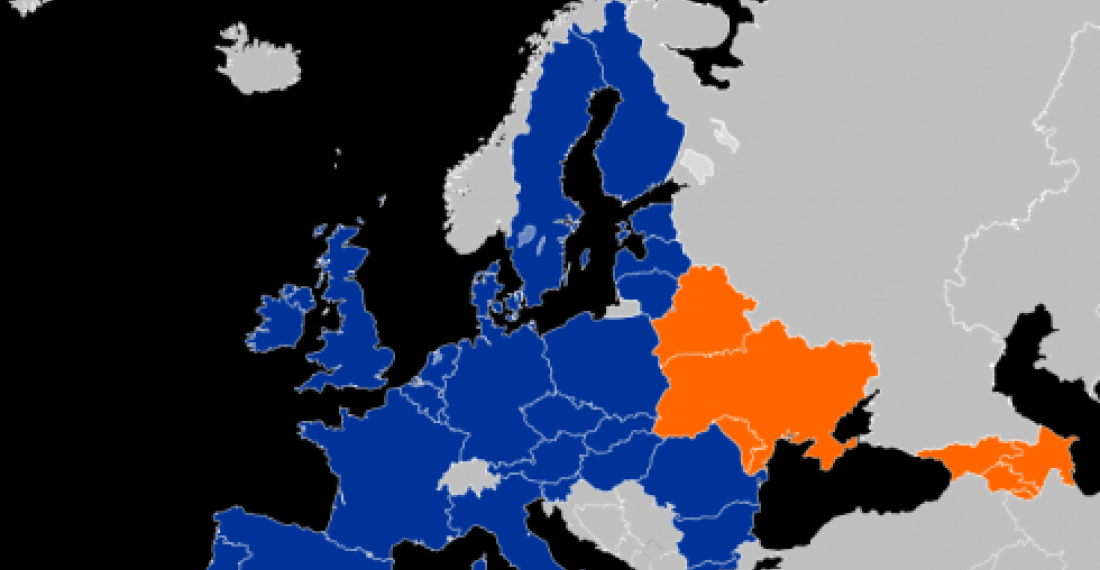
The work goes on. The third meeting of Eastern Partnership Foreign Ministers was held in Brussels.

The third Foreign Ministers’ meeting of the Eastern Partnership took place in Brussels on 23 July 2012. Ministers stated that the Roadmap put forward by the European Commission and High Representative for Foreign Affairs and Security Policy constituted a basis for guiding and monitoring the further implementation of the objectives of the Eastern Partnership defined in the Prague and Warsaw Declarations until the next Summit in Vilnius in autumn 2013.

Ministers agreed that the next Eastern Partnership Foreign Ministers' meeting in 2013 would be an occasion to review the implementation of the Roadmap and to discuss the forward-looking development of the Eastern Partnership in preparation of the next Summit in Vilnius.

Armenia was represented in the meeting by its Foreign Minister Edward Nalbandian. Azerbaijan was represented by the Deputy Foreign Minister Mahmud Mamed-Guliev.

source: commonspace.eu
Related articles

Editor's choice
News
Erdogan on important visit to Saudi Arabia. Meets Mohammed bin Salman and gives extensive interview to Asharq al-Awsat

Erdogan on important visit to Saudi Arabia. Meets Mohammed bin Salman and gives extensive interview to Asharq al-Awsat

Turkish president, Recip Tayip Erdogan, on Tuesday (3 February), started an official visit to Saudi Arabia, which is considered of crucial importance in the light of current tensions in the Middle East, and the role that a Turkish-Saudi axis can play in the wider region. Shortly after his arrival in Riyadh, President Erdogan met with Saudi Arabia's Crown Prince and prime minister, Mohammed bin Salman at al Yamamah Palace. President Erdogan gave an extensive interview on his arrival in Riyadh to the Saudi newspaper Asharq al-Awsat in which he discussed bilateral ties with the Kingdom, the situation around Iran, and regional issues: Erdoğan said: “Türkiye and Saudi Arabia are two friendly countries with deep historical ties, strong state traditions, and a shared sense of regional responsibility. We have never viewed this relationship through a narrow lens confined solely to bilateral matters. This is because the valuable friendship between our two countries also carries a strategic significance for the peace, stability, and prosperity of our region as a whole.” On the possibility of the eruption of a war between the US and Iran, president Erdogan said: “Let me begin by stating that experience has proven that scenarios which fail to grasp the values, identity, history, and future of this geography have inflicted far greater suffering on the region than peace. The wounds inflicted by the implementation of such scenarios in Gaza, Iraq, Syria, and Afghanistan remain vivid in our collective memory.” “For this reason, as Türkiye, we categorically oppose a new war or a new wave of destruction in our region,” he declared. (Click the image to read the interview of president Erdogan with Asharq al-Awsat in full)

Popular

Editor's choice
Interview
Thursday Interview: Murad Muradov

Thursday Interview: Murad Muradov

Today, commonspace.eu starts a new regular weekly series. THURSDAY INTERVIEW, conducted by Lauri Nikulainen, will host  persons who are thinkers, opinion shapers, and implementors in their countries and spheres. We start the series with an interview with Murad Muradov, a leading person in Azerbaijan's think tank community. He is also the first co-chair of the Action Committee for a new Armenian-Azerbaijani Dialogue. Last September he made history by being the first Azerbaijani civil society activist to visit Armenia after the 44 day war, and the start of the peace process. Speaking about this visit Murad Muradov said: "My experience was largely positive. My negative expectations luckily didn’t play out. The discussions were respectful, the panel format bringing together experts from Armenia, Azerbaijan, and Turkey was particularly valuable during the NATO Rose-Roth Seminar in Yerevan, and media coverage, while varied in tone, remained largely constructive. Some media outlets though attempted to represent me as more of a government mouthpiece than an independent expert, which was totally misleading.  Overall, I see these initiatives as important steps in rebuilding trust and normalising professional engagement. The fact that soon a larger Azerbaijani civil society visits to Armenia followed, reinforces the sense that this process is moving in the right direction." (click the image to read the interview in full)