President Ilham Aliev of Azerbaijan has concluded an official two day visit to Ankara during which Turkish leaders warmly welcomed the Azerbaijani leader, and the two countries expressed their intention to further strengthen and consolidate their relations. Aliev met with President Gul, Prime Minister Erdogan and Foreign Minister Davitoglu. A number of new bilateral agreements were also signed.
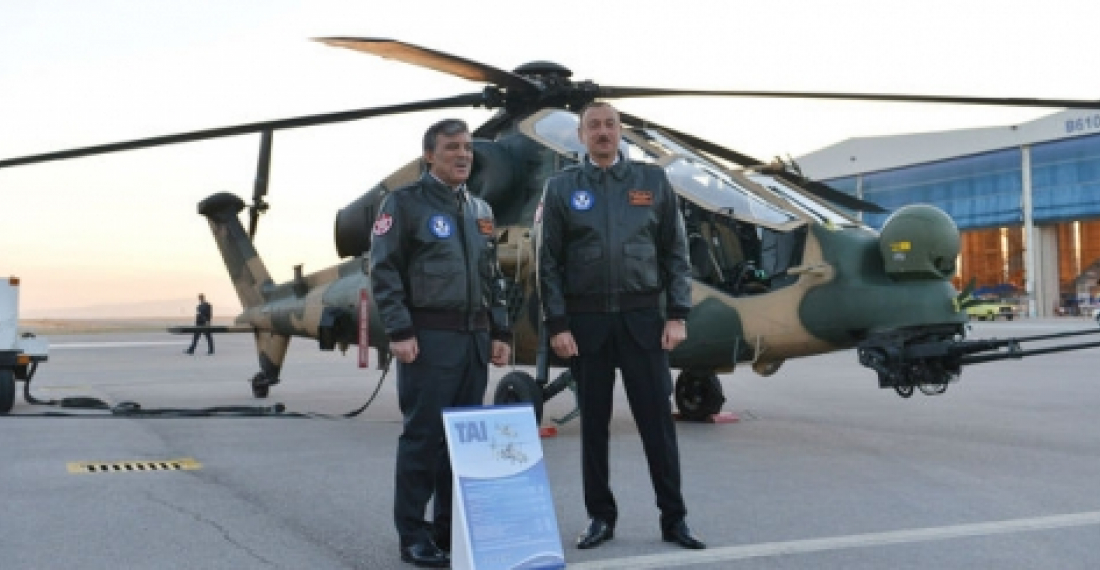
Speaking at a Press Conference with Prime Minister Erdogan, Aliev said that the development of Turkey's defence industry, which he visited the day before, had made a strong impression on him.
"Today Turkey has an international authority in this sphere too. The military equipment manufactured in Turkey meets the highest world standards," President Aliyev said.
Aliev said that the common historical and cultural ties linking Azerbaijan and Turkey, provide a solid foundation of relations.
"We are constructing a beautiful building on this foundation, we build, and as my dear brother noted, there are large multinational projects in this building. We did not just limit our work with transportation of Azerbaijani oil to Turkey by building the Baku-Tbilisi-Ceyhan oil pipeline. This was the opening of a corridor, thanks to which large-scale projects are carried out today," the Azerbaijani President said.
Aliev congratulated the Prime Minister of Turkey on realization of the Marmaray project.
"This is your historical merit. It will forever remain in the history among the works, which you do for the Turkish people," President Aliyev underscored. "Implementing this project, you connected the continents, brought together the peoples and provided long-term profits for Turkey. Naturally, the Baku-Tbilisi-Kars railway is also an integral part of this great project".
The Azerbaijani President noted that a great work is waiting for Azerbaijan and Turkey in the future. Implementation of the TANAP project will completely change Europe's energy map, he said, and Turkey and Azerbaijan will play a role in it. According to Azerbaijani President, the TANAP project is one of the largest energy projects in the world, and Turkey and Azerbaijan have undertaken the responsibility, political and financial burden.
"With the joint efforts we demonstrated a leadership in this regard too," President Aliyev said.
According to President Aliyev, the leadership of Azerbaijan and Turkey will be helpful to many countries. Today, in the world it is impossible to separate the energy policy from the foreign policy. Azerbaijan and Turkey discuss all matters together, and the nature and advantages of the Supreme Council lies in the fact that many issues are settled during the meetings.
Ilham Aliev referred to the investments that both countries have put in each other's economies.
"The ongoing projects confirm my words when I say that the basis of our relationship is brotherhood. Brotherhood and friendship are unbreakable and unshakable. The 21st century will be the century of Turkic world. In this regard the role of leadership was undertaken by Turkey and Azerbaijan. I am confident that we will continue further attaining great successes with joint efforts." President Aliyev said in conclusion.
Commonspace.eu political editor said in a comment:
"Turkish-Azerbaijani relations have gone beyond the realm of rhetoric and are now based on tangible areas of co-operation that are strategically important for both countries. Turkey rolled out the red carpet for Aliev during this visit, even more than previous times. Turkey is no longer able to see Azerbaijan as the junior partner in the relationship. Despite its size, Azerbaijan is now a major player in the economic sphere, and an important diplomatic partner for Turkey in the global and Islamic world.
There remain several areas where problems persist in the relationship. Turkey would like to have more access for its business community in Azerbaijan, and a bigger slice of the Azerbaijani economic cake, but by and large relations have moved to a new level. The "dark days" of 2009, when Turkey had unilaterally moved to restore relations with Armenia without consulting with Baku, are now gone. Turkey has committed itself not to establish diplomatic relations with Armenia unless progress is registered on the Karabakh conflict. Turkey however does not want unplanned military adventures on its borders, and continues to act as a restraining force on Baku.
All this notwithstanding, Turkish - Azerbaijani relations have entered a "golden moment" when the two countries see their bilateral relations as a crucial element for their substantial global and regional ambitions."
Source: commonspace.eu
Photo: President Ilham Aliev visiting the Turkish Aerospace Industry, accompanied by President Gul of Turkey, on Tuesday 12 November 2013. (Picture courtesy of the press Service of the president of Azerbaijan).