Tbilisi Armenians Pray for Gyumri Victims

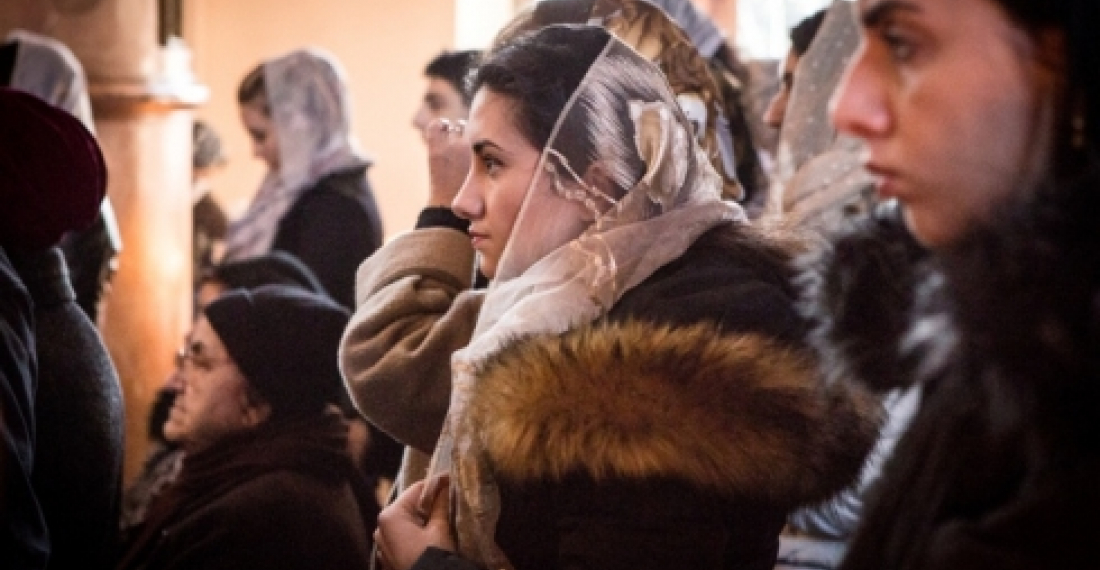
Shock at the cold-bloodied murder of an Armenian family in Gyumri by a renegade Russian soldier continues to resonate among Armenian communities throughout the world.  Joseph Alexander Smith reports from Tbilisi for commonspace.eu on how the community in the Georgian capital have reacted to the tragedy. The Armenian community in Tbilisi gathered on Sunday 18 January to commemorate the six family members who were killed in the northern Armenian city of Gyumri a week ago. Faithful of the Armenian Apostolic Church in Tbilisi attended a packed Sunday morning Liturgy, which was followed by a traditional memorial service for the six members of the Avetisyan family who were killed, apparently in cold blood, on Monday 12 January. The suspected killer, Valery Permyakov, is a Russian soldier who was serving at the 102nd Russian military base in Gyumri. His handover to Russian military authorities, who are investigating the case, has sparked outrage in Armenia, with sustained protests in both Gyumri and the Armenian capital Yerevan demanding that he be handed over to Armenian law enforcement agencies. The memorial service was held at Tbilisi's St Etchmiadzin Church in Avlabari, during which Bishop Vazgen, leader of the Armenian Apostolic Church's diocese in Georgia, spoke about the importance of praying for the souls of those who were killed. In a case which has shocked Armenian communities around the word, Seryozha Avetisyan was killed along with his wife, son, daughter-in-law, daughter and 2 year-old granddaughter. A six month-old baby boy was also recovered from the murder scene with severe stab wounds and was taken to hospital in a critical condition. "We're here to commemorate what happened in Gyumri - the murder of a family by a Russian serviceman - by holding a memorial service after Holy Liturgy" Father Narek, a priest serving at the church, told Commonspace.eu. "Memorial services have already been held in Armenia and we decided to hold one on Sunday when there would be more of the local faithful present." On Saturday, up to 60 Georgians and local Armenians attended a memorial demonstration outside the Armenian Embassy in Tbilisi, lighting candles and laying floral tributes. The demonstration was organized on Facebook by social sciences student Giorgi Chinchaladze and was attended by a small number of public figures, including Sergo Ratiani, an MP for the opposition UNM party. Georgia's deputy Ministry of Foreign Affairs, Davit Jalagania, delivered a statement of condolence on Saturday, after the "shocking and terrible" attack. "... In the 21st century, many tragic incidents have occurred, but since we are a neighboring, friendly country, a tragedy of this cruelty is probably one of the most remarkable" Jalagania said.   "We sincerely express our condolences to the families and their loved ones. We also believe that the offender will be prosecuted and appropriate legal measures will be implemented. We are confident that justice will prevail and the offender will be punished accordingly." The issue of how Permyakov will be tried and under which jurisdiction has been the subject of intense debate in Armenia, straining relations with its ally Russia. Ever since Permyakov's handover to Russian military authorities, there have been protests outside Armenian and Russian institutions in Gyumri demanding that the Russian soldier be handed over to Armenian prosecutors. According to eyewitnesses, protesters in Gyumri threw coins at the Prosecutor's Office there, implying that the Armenian government had 'sold' its internal sovereignty to the Russians. "The Armenian government should be the one to undertake this process, not the Russian government" said Hasmik Tonapetyan, a native of Gyumri studying in Tbilisi who also attended the memorial service at St Etchmiadzin church. "The people want the government to take responsibility and to judge this soldier according to Armenian law." "The image of a soldier is of one who protects not of one who murders. Also they still haven't found out why the members of this family and why this solider. Who kills people who are asleep in bed? This is really shocking." The long-term ramifications of the case are hard to predict. While Armenia, which recently entered the Russian-led Eurasian Economic Union, is unlikely to radically re-negotiate relations with its powerful military ally, the Armenian authorities are facing a level of public outrage which has rarely been seen since independence from the Soviet Union. There may also be a question mark over the future of Russia's military presence in Armenia. In a similar case in 1999, two Russian soldiers from the base went on a drunken killing spree in Gyumri. In 2013, two local youths were killed by a landmine at a shooting range used by the base. "The fact is that this has broken not the friendship between our countries, but the trust" says Tonapetyan. "This base is supposed to protect the civilians living there but this is the second time a soldier has killed peaceful civilians ... it's just repeating itself 16 years later!" source: Joseph Alexander Smith filed this report from Tbilisi for commonspace.eu photo: The memorial service for the murdered family in Gyumri held at the St Etchmiadzin Church in the Avlabari district of Tbilisi on Sunday, 16 January 2015. (picture credit: Helen Osborne)          

Related articles

Editor's choice
News
Germany accuses Russia of cyberattacks and disinformation campaign

Germany accuses Russia of cyberattacks and disinformation campaign

The German government holds Russia responsible for a cyberattack on German air traffic control, and for targeted disinformation campaigns before the last federal election. According to the German Foreign Office in Berlin, the incidents could be clearly attributed to the Russian military intelligence service, the GRU. In response, the Russian ambassador to Berlin was summoned to the Foreign Ministry. "We have been observing a massive increase in threatening hybrid activities by Russia for some time now," a spokesperson for the Foreign Ministry stated. These range from disinformation campaigns and espionage to cyberattacks and sabotage attempts. The aim is to divide society, sow distrust, and undermine confidence in democratic institutions. The spokesperson added that with these actions, Russia is "very concretely threatening our security, not only through its war of aggression against Ukraine, but also here in Germany."  The Foreign Ministry spokesperson explained that the cyberattack on air traffic control in August 2024 was clearly attributed to the hacker collective "APT28," known as "Fancy Bear," and to the responsibility of the Russian military intelligence service, the GRU. Furthermore, it could now be "conclusively stated" that Russia had attempted "to influence and destabilize both the last Federal election and the ongoing internal affairs of the Federal Republic of Germany." There was "absolutely irrefutable evidence" for this". The so-called "Storm 1516" campaign, which has been running since 2024, is allegedly backed by "reliable information" that the Moscow-based think tank "Center for Geopolitical Expertise" is behind it. The Center is also said to be supported by Russian military intelligence. Its primary aim is to influence democratic elections in the West. (Click the image to read more).
Editor's choice
News
NATO Chief says war is on Europe's doorstep, and warns against complacency

NATO Chief says war is on Europe's doorstep, and warns against complacency

Russia could attack a NATO country within the next five years, the Secretary General of NATO, Mark Rutte, said in a stark new warning. "NATO's own defences can hold for now," Rutte warned in Berlin, but conflict was "next door" to Europe, and he feared "too many are quietly complacent, and too many don't feel the urgency, too many believe that time is on our side. "Russia is already escalating its covert campaign against our societies," Rutte said in a speech in Germany. "We must be prepared for the scale of war our grandparents or great-grandparents endured." Earlier this month, Russia's President Vladimir Putin said his country was not planning to go to war with Europe, but it was ready "right now" if Europe wanted to - or started a war. But similar reassurances were given by Moscow in 2022, just before 200,000 Russian troops crossed the border and invaded Ukraine. Putin has accused European countries of hindering US efforts to bring peace in Ukraine - a reference to the role Ukraine's European allies have recently played in trying to change a US peace plan to end the war, whose initial draft was seen as favouring Russia. But Putin was not sincere, Nato's secretary-general said in the German capital, Berlin. Supporting Ukraine, he added, was a guarantee for European security. "Just imagine if Putin got his way; Ukraine under the boot of Russian occupation, his forces pressing against a longer border with Nato, and the significantly increased risk of an armed attack against us." Russia's economy has been on a war footing for more than three years now - its factories churn out ever more supplies of drones, missiles and artillery shells. According to a recent report by the Kiel Institute for the World Economy, Russia has been producing each month around 150 tanks, 550 infantry fighting vehicles, 120 Lancet drones and more than 50 artillery pieces. The UK, and most of its Western allies, are simply not anywhere near this point. Analysts say it would take years for Western Europe's factories to come close to matching Russia's mass-production of weapons. "Allied defence spending and production must rise rapidly, our armed forces must have what they need to keep us safe," the Nato chief said.

Popular

Editor's choice
News
Germany accuses Russia of cyberattacks and disinformation campaign

Germany accuses Russia of cyberattacks and disinformation campaign

The German government holds Russia responsible for a cyberattack on German air traffic control, and for targeted disinformation campaigns before the last federal election. According to the German Foreign Office in Berlin, the incidents could be clearly attributed to the Russian military intelligence service, the GRU. In response, the Russian ambassador to Berlin was summoned to the Foreign Ministry. "We have been observing a massive increase in threatening hybrid activities by Russia for some time now," a spokesperson for the Foreign Ministry stated. These range from disinformation campaigns and espionage to cyberattacks and sabotage attempts. The aim is to divide society, sow distrust, and undermine confidence in democratic institutions. The spokesperson added that with these actions, Russia is "very concretely threatening our security, not only through its war of aggression against Ukraine, but also here in Germany."  The Foreign Ministry spokesperson explained that the cyberattack on air traffic control in August 2024 was clearly attributed to the hacker collective "APT28," known as "Fancy Bear," and to the responsibility of the Russian military intelligence service, the GRU. Furthermore, it could now be "conclusively stated" that Russia had attempted "to influence and destabilize both the last Federal election and the ongoing internal affairs of the Federal Republic of Germany." There was "absolutely irrefutable evidence" for this". The so-called "Storm 1516" campaign, which has been running since 2024, is allegedly backed by "reliable information" that the Moscow-based think tank "Center for Geopolitical Expertise" is behind it. The Center is also said to be supported by Russian military intelligence. Its primary aim is to influence democratic elections in the West. (Click the image to read more).