


Tbilisi, and the promised land of a million trees

Progress often comes with a cost for the environment, as Tbilisi residents are finding out. But activists in the Georgian capital are determined to hold the municipal authorities to account. Dato Parulava reports for commonspace.eu

For several weeks now Tbilisi's city authorities have been besieged by green activists, angered by the cutting of dozens of mature trees that used to line the city's major avenue. The activists say that municipal authorities give a blank check to developers, letting sprawling tower blocks gobble up the city's green spaces.

Several environmental activists from a group calling itself "Guerrilla Gardeners" maintain a round-the-clock sit-in in front of Tbilisi's City Hall. Protesters' numbers occasionally swell as citizens with a variety of urban development grievances come to join their ranks. The gist of their demands is to review municipal development policies and reorganize an environmental preservation arm of the City Hall.

More than a hundred people took to the streets on September 2 calling for resignation of the City Hall's Ecology and Green Spaces Department's head Nino Sulkhanishvili and her deputy Nugzar Kakhniauri. This was one of the largest rallys in the series of protests initiated by Nata Peradze, the founder of "Guerrilla Gardeners". Peradze went on a hunger strike in protest of cutting 68 trees on Kazbegi Avenue. Despite growing number of people joining the protest, officials who sanctioned the cutting refuse to resign, but promise to change City Hall's green space preservation practices.

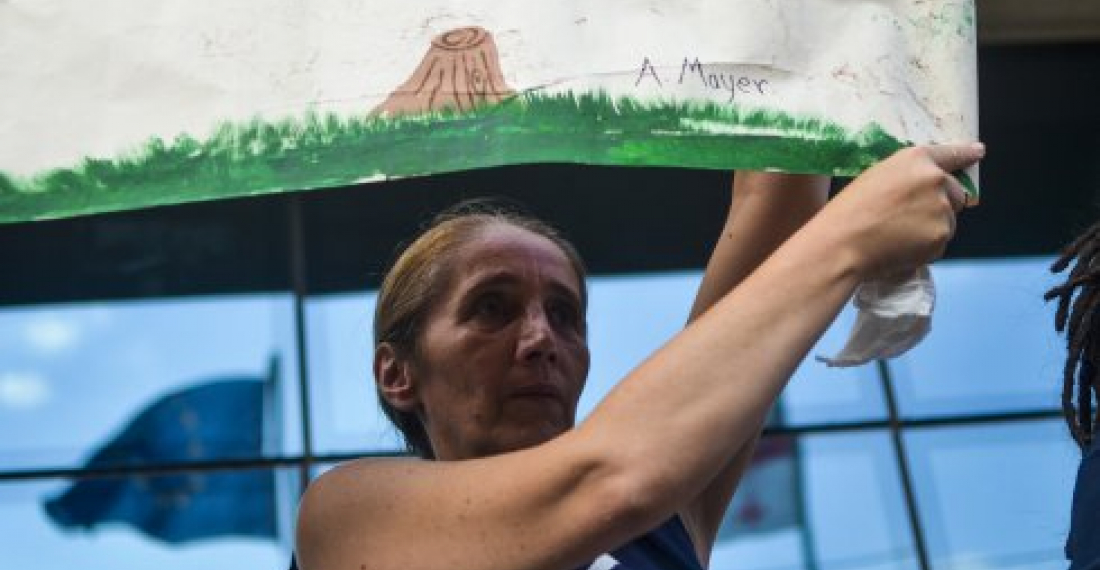
Peradze said that she resorted to the radical form of protest when City Hall's Sulkhanishvili told her that she had no idea if the felled trees were dead or not. "I made an emotional decision. Had I stayed home, I would have exploded," said Peradze. She lodged a complaint in the Prosecutor's Office, which launched an investigation. The probe is yet to produce any results.  

After seven days of hunger strike Nata Peradze was hospitalized on August 22 with deteriorated health. A fellow activist took her place in a yellow tent, pitched in front of the city hall.

I Am Tbilisi

The protests expanded beyond the subject of green zones being invaded by concrete. The protester's slogan - "I am Tbilisi," - covers a number of issues that the residents have with the city development practices.

Shrinking green spaces, expanding concrete jungle, polluted air, an environment not friendly to pedestrians and growing car traffic are among the problems the protesters want solved.

Tbilisi Mayor Davit Narmania added fuel to fire when he insulted a student for making a critical remark at a meeting between the activists and the city's chief. The mayor later apologized, but is far from being forgiven.

Demonstrations went on with loud music blasting in front of the city hall. A flea-market auction was organized, generating 782 Laris (339 US Dollars) for "Guerrilla Gardeners" to plant trees in the city.

What is there to protest about, and how do officials respond?

Urban planner Zurab Bakradze says that he joined the demonstrations because the City Hall treats city residents the way an invading enemy would.

"The city doesn't develop at all. It is collapsing every day. Public interest and public space is what makes a city. These spaces are shrinking every day because they are being occupied by buildings of different investors," he said.

He thinks that the City Hall has to stop being oriented on expansion of the city, that public spaces must be returned for community use, saying this is only possible by reducing the number of private cars, making city friendlier to pedestrians and cyclists.

"It has become impossible to live in this city. There is no green space, no air to breath or a place to gather. Social spaces that remained after Soviet Union are being destroyed. I have come here as I want to live in a European city, which definitely doesn't look like Tbilisi," says Tornike Shevardnadze, a student at Tbilisi State University.

He feels responsible for the current state of affairs because he voted for Narmania, but now finds himself in a situation where trees are being chopped down and pedestrians, especially people with disabilities are deprived of rights of free movement in the city.

Meanwhile, city officials promise constructive solution to problems. Head of Ecology and Greening Department Nino Sulkhanishvili said, in general, Guerrilla Gardener's protest on city's environmental issues is fair, but she doesn't agree with the forms they express it.

"Office means nothing to me, but resignation wouldn't be a smart decision right now as investigation is still proceeding. I will not leave with false accusations with a label of someone who is to blame," says Sulkhanishvili, adding, department authorized cutting of 45 dried tries only.

The Head of Tbilisi City Assembly Giorgi Alibegashvili agrees on the necessity of reorganization, but calls for constructive dialogue, stressing that the demonstrations could be politically motivated.

What Do Numbers say?

When he became a mayor, Narmania's made his famous promise to plant one million trees in Tbilisi, but it seems, the mayor bit off more than City Hall could possibly chew. In 2015 he announced, 130 000 trees were already planted, promising to reach the one million target by 2017. But he came under fire as hundreds, possibly thousands of saplings began to die because of what "Guerrilla Gardeners" say was an improper planting and care.

Earlier this year, even more people took to the streets as research by the International Energy Agency (IEA) said Tbilisi was the world's deadliest city in terms of death rate related to air pollution. Georgian Ministry of Environment claimed that IEA's numbers were did not reflect the current situation as they were taken from measurements taken by the World Health Organization in 2012. The Ministry said that the more up-to-date measurements from 2014 showed that air pollution in Tbilisi was in line with the average for other Eastern European and low-income countries.

One of the primary reasons for air pollution is the growing number of cars in Tbilisi. Mayor Davit Narmania recently stated, car numbers in the capital have doubled compared to 2010, reaching up to 400 000 in 2016.

Meanwhile, while City Hall is busy reorganizing departments, there is a yellow tent stuck on its footsteps as a reminder that there are more than 1.1 million residents in the capital who seek to live in a healthy environment, in the promised land of Tbilisi with 1 million trees.

Dato Parulava is a young Georgian journalist and Tbilisi resident. He contributed this report for commonspace.eu

Photo 1: Activist Nata Peradze Photo 2: A yellow tent reminds municipal officials of people's environmental concerns. (pictures courtesy of Dato Parulava



Latest

Editor's choice
Monday Commentary
Monday Commentary: PEACE IN OUR TIME?

Monday Commentary: PEACE IN OUR TIME?

Making peace between Armenia and Azerbaijan was never going to be simple, nor easy, nor quick. It is taking time, writes Dennis Sammut in this Monday Commentary. “There is a sense of realism coming from the leaders of the two countries – President Ilham Aliyev of Azerbaijan and prime minister Nikol Pashinyan of Armenia, that frankly, is necessary and welcome”, he writes. At a time when conflicts are raging all over the world – from Ukraine to the Gulf, from Africa to South Asia, the prospect that Armenia and Azerbaijan had finally, after decades of conflict that left thousands of dead and many more displaced, decided on embarking on a journey of peace was welcomed. Peace between Armenia and Azerbaijan can be top-down up to a point. Both leaders have spent political capital preparing for a peace deal. But both are aware that their people are not ready for peace yet. In fact, in Armenia, most of the elite are negative toward a peace deal with Azerbaijan. Pashinyan needs time to persuade his countryfolk. That is why 2031 is realistic. Ilham Aliyev runs a tighter shop, but he is also not immune to public opinion. Every time someone hits a landmine in Karabakh, which unfortunately happens often, peace comes into question. Which is why Aliyev chooses to sound hardline, more often than not. In pursuing the peace agenda, both Aliyev and Pashinyan need to proceed cautiously. But they are right in making peace the central issue in their agenda. It is the main issue, and the one that will define them in history. So forward, cautiously but resolutely! In pursuing the peace agenda, Aliyev and Pashinyan need to be supported clearly and unambiguously. There are too many people in Baku and Yerevan who are sitting on the sides, waiting. The international community is not doing enough. It is time to be counted. Otherwise, the spoilers will win, and the region will go back to its bad habits. (Click the image to read the full commentary).
Editor's choice
News
Ukraine Peace Talks Set to Expand as Russia and Europe Clash Over Post-war Security

Ukraine Peace Talks Set to Expand as Russia and Europe Clash Over Post-war Security

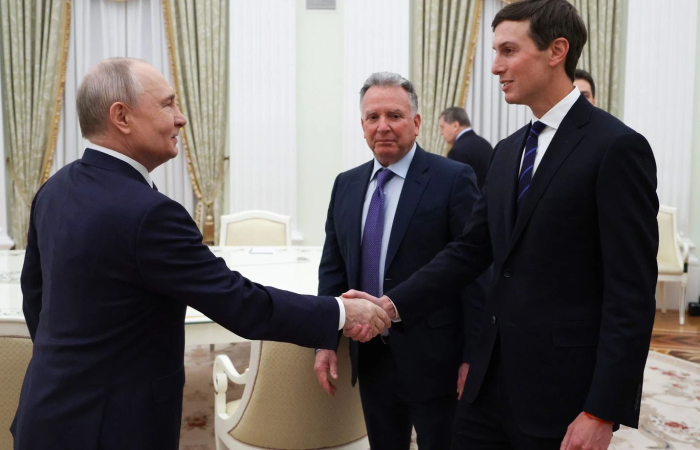
Ukraine and Russia could see European countries join the next round of peace negotiations, following talks between US special envoys Steve Witkoff and Jared Kushner and Russian President Vladimir Putin in Moscow on Thursday (November 12). However, conflicting positions over European military involvement, Ukraine’s territorial future and the continent’s security arrangements highlight the difficulties facing the diplomatic process. Speaking after the meeting, Witkoff said European participation would be an important development, describing the countries concerned as key partners. Kushner also indicated that Washington had noticed a shift in European attitudes and believed their involvement would not obstruct progress. In a statement published on X, he said the expanded discussions would address broader European security arrangements alongside territorial disputes between Russia and Ukraine. The US envoys subsequently travelled to Dublin, where they met Ukrainian President Volodymyr Zelenskyy during a European summit. Zelenskyy welcomed the possibility of European participation and expressed hope that the negotiations would include measures to reduce tensions and establish ceasefires. He also reiterated the importance of European representation in decisions concerning the continent’s security. Moscow, however, has offered a more cautious interpretation of the proposed expansion. Putin's aide, Yuri Ushakov, suggested that European countries should first reconsider their military assistance to Kyiv, arguing that their current actions demonstrated an unwillingness to pursue peace. Putin similarly called on Washington to work with its European allies to establish whether they genuinely wanted peace or continued confrontation with Russia. The Russian president also rejected the prospect of European peacekeeping troops being deployed to Ukraine following a potential agreement, describing such a presence as a continuation of the war. His position reflects wider disagreements over the future European security architecture, with Moscow seeking discussions on the continent's broader security arrangements, while European leaders insist that such negotiations cannot replace a settlement of the war. Simultaneously, Zelenskyy raised concerns about disruptions to Starshield, the US-made satellite communications service used by Ukrainian forces. He described Washington’s discussions with Moscow about Europe's future security as unusual and warned against decisions that could undermine Ukraine's sovereignty. Despite the diplomatic activity, fighting continued. Russian drone attacks killed two people in Ukraine's Sumy region and injured five in Rivne, while a separate attack in Russia's Belgorod region killed one person and injured four. Ukrainian agricultural company Kernel Holding also suspended operations at all its oilseed extraction facilities following repeated Russian attacks.

Popular

Editor's choice
Monday Commentary
Monday Commentary: European-Azerbaijan relations need an intensive and multifaceted dialogue that is frank and honest

Monday Commentary: European-Azerbaijan relations need an intensive and multifaceted dialogue that is frank and honest

Last week I visited Baku, Azerbaijan. My visit was relatively short, but very intensive, and had many meetings with stakeholders and colleagues. When I arrived in Baku first time in 1996,  Azerbaijan was a different country: weak, poor, and shaken by defeat in war. For thirty year the Karabakh issue dominated the agenda: the political agenda but also the popular mindset. Now, thirty years later, Azerbaijan has returned to Karabakh, and peace with Armenia is on the horizon. It is a new era for Armenia-Azerbaijan relations, for the South Caucasus, but also for Europe.  But we cannot be complacent: the Peace agreement has been initialed but not signed; borders remain closed; TRIPP is ambitious but remains an idea; and there are spoilers who want to turn the clock back. We must not allow them, and in this Europe and Azerbaijan must work together. Europe’ vanguard organization is the European Union – it is a free union of 27 member states; it is a strong global economic force, and increasingly a diplomatic and military force too. But it remains “work in progress” and can often appear dysfunctional. It often lacks collective and institutional memory. In its dealings with Azerbaijan the EU has made many mistakes – not least opening the delegation here late – in 2008. It sometimes appears condescending. Some utterances from the European Parliament and from some quarters in some member states are not understandable even for me. They irritate the Azerbaijanis, but serve no other purpose But Azerbaijan has also not handled relations with the EU well. It has failed to respond when the hand of friendship reached out; and it confused irritating actions, sometimes by well-meaning people; sometimes by outright spoilers, with strategic action. In short, EU-Azerbaijan relations have suffered from a lack of proper dialogue. This dialogue must be frank, honest and multi-faceted involving different segments of society on both sides.   Is Azerbaijan Europe? When Azerbaijan applied to join the Council of Europe in the 1990s, there were some who opposed, saying this was not Europe. I was one of the people who argued that Armenia and Azerbaijan may be on the periphery of the continent geographically, but were European in essence. Certainly their elites. During the discussion on 4 September in Baku, my friend Farhad Mammedov, mentioned that Azerbaijan is not interested in joining the EU, and was now close to the Central Asian countries in the 5 plus 1 format. Neither things mean that Azerbaijan is not Europe. There are several European countries that are not in the EU, and do not want to be, for example Norway and Switzerland. Iceland has recently voted to stay out of the EU. The UK was a member and left. Europe is bigger than the EU, and the holding of the European Political Community summit in Baku in 2027 proves that. Despite all the rhetoric, I never heard the president of Azerbaijan  saying that Azerbaijan is not Europe, nor have I heard any European president say it either. Not wanting to join the EU and forging close relations with neighbouring regions does not make Azerbaijan any less European. It is only logical that when Europeans talk to Azerbaijan they talk like family. The conversation is often frank. It must also be honest, and Europeans need always to remember this too. A frank, honest and multi-faceted dialogue A frank, honest and multifaceted dialogue will contribute to relations between Azerbaijan and the rest of Europe: it will avoid misperception, which unfortunately is very common on both sides; it will provide a forum where problems can be discussed and resolved, and it will increase mutual trust, so that together common problems can be addressed. (click image to read the full Monday Commentary)
Editor's choice
Monday Commentary
Monday Commentary: “The barren rocks of Aden” and “These lands of Yemen are so ruthless”

Monday Commentary: “The barren rocks of Aden” and “These lands of Yemen are so ruthless”

There are two early 20th-century tunes that mark foreign attempts to occupy and “pacify” Yemen. The Scottish tune “The barren rocks of Aden” marks the mobilisation of Highland soldiers, enlisted to be deployed to the Yemeni port of Aden, that in 1837 became the last colony to be incorporated into the British Empire. The tune talks of the harshness of the terrain, but is celebratory, It was even played as a farewell tune to Sir William Luce at the parade in Sharjah celebrating his end as “British Viceroy” in the Middle East in 1966. The second tune is an Anatolian lament. As Ilker Sezer reminded us this weekend, in his weekly feature on “Turkiye Today”, it “mourns the tragic fate of Ottoman soldiers dispatched to the harsh, remote deserts of Yemen during the fall of the empire, young men who marched away from their villages and never returned home. Most of their names, and numbers, were never recorded. Yet, their fate left a mark on the Turkish psyche.” Subsequent invaders have discovered that Yemen is a grave that cannot be overcome by the strength of modern technology, and that whilst Yemeni society is splintered and divided, building a reliable alliance with Yemeni factions is difficult. These are the harsh lessons facing Saudi Arabia, as the Kingdom faces its biggest challenge in its modern history. The leadership of the Kingdom now has to respond decisively. At stake is their very credibility. This is likely to be a long and messy conflict. Saudi military objectives need to be focused: to box in the Houthis rather than destroy them. This is likely to include: (a) regaining territory lost on the Red Sea coast; (b) control over Bab el Mandeb Strait; (c) some kind of cordon sanitaire on the Saudi-Yemeni border; and if things go well (d) the capture of Sanaa. All this would not eliminate the Houthi problem, but it will contain it. In the end the Saudis will have to continue managing Yemen with a mixture of carrot and stick. For the moment, the stick is likely, but the carrot cannot be forgotten either. (click the image to read the Monday Commentary in full)

