

Despite being firmly anchored in the Russian sphere of influence, Armenia has been quite successful in developing partner relations with the EU and NATO. In the early 1990s, Armenia joined the NATO Partnership for Peace program, and since 2005 bilateral relations have been developing within Individual Partnership Actions Plans. NATO played a key role in developing Armenia's peacekeeping potential and supported defence reforms, including defence education. Armenian peacekeepers participated in NATO-led operations in Iraq, Kosovo, and Afghanistan; Armenian troops took part in several NATO-led drills; and each year a "NATO Week" was held in Yerevan.
Armenia was also actively fostering its relations with the EU. Yerevan accepted the EU's offer to participate in the Eastern Partnership programme and in summer 2013 successfully finished negotiations over the Armenia-EU Association Agreement. Tensions in Russia-West relations, and Russia's pressure, prevented Armenia from signing the Association Agreement, however, despite the sanctions war between Russia and EU, Yerevan was able to revive its dialogue with the EU and sign a Comprehensive and Enhanced Partnership Agreement (CEPA) in November 2017, just before the 2018 April "Velvet revolution".
The development of relations with NATO and EU was one of the few diplomatic success stories of the previous Armenian government. Since late 2017 the Armenian case was often mentioned as the positive example of bridging European and Eurasian integration processes, since Armenia entered the Eurasian Economic Union in January 2015.
It seemed the "Velvet revolution" created additional favourable conditions for the development of Armenia-EU, and Armenia-NATO relations. The new government of Armenia declared its intention to accelerate the reform process in Armenia, including the fight against corruption, creation of independent judiciary, and fostering the rule of law. Prime Minister Pashinyan stated that the Armenian revolution had no geopolitical orientation and that Armenia was not going to change its foreign policy and end its alliance with Russia. However, the first actions of the new Armenian authorities – a criminal investigation against the incumbent CSTO secretary general Yuri Khachaturov; the arrest of the second President of Armenia Robert Kocharyan, who is perceived in Russia as a staunch supporter of strategic Armenia-Russia relations and enjoys friendly relations with Russian President Putin; and criminal cases opened against key Russian companies operating in Armenia – were indications that Armenia-Russia relations entered uncharted waters. The appointment to key positions of former NGO activists with tough anti-Russian and anti-Putin views only added tensions in bilateral relations. Thus, it seemed that both the alleged democratic credentials of the new government, and the clear deterioration of Armenia - Russia relations, had created a sound base for the development of Armenia-EU, and Armenia-NATO relations. Surprisingly, the reality was a little bit different.
During his first official visit to Brussels in July 2018, Prime Minister Pashinyan called on the EU to provide an additional minimum of one billion Euros in assistance to Armenia as a reward for the realisation of the brightest democratic revolution since the fall of the Berlin wall in November 1989. He was surprised to hear what the EU was ready to offer to Armenia which was much less, arguing that he could get from the pockets of even one Armenian oligarch up to 50 million Euros, and that he had no intention to receive such small amounts of money from one of the world’s biggest economic blocs. The new government of Armenia talked about the necessity to have something much bigger than CEPA, but was told that the only way to deepen relations beyond CEPA was to sign an Association Agreement, including DCFTA. However, that required leaving the Eurasian Economic Union, and Pashinyan was not ready to fully destroy relations with Russia.
Thus, within several months after the revolution, it became clear that CEPA was the only possible framework for the development of Armenia-EU relations, and Yerevan had to concentrate its efforts to implement CEPA reforms rather than demand billions of Euros in additional resources from the EU. The election of President Zelensky in April 2019 and the domestic political crisis in Georgia triggered by the "Gavrilov's night" in June 2019 fully shifted EU attention from Armenia and its revolution, back to those two countries that have an association agreements with the EU.
There was no breakthrough in Armenia-NATO relations either. Armenia’s new government understood very quickly that to have a qualitative change in bilateral relations – such as the establishment of Armenia-NATO Commission or Substantial NATO-Armenia Package, Armenia had to leave CSTO and take concrete actions to kick out the Russian military base from Gyumri. Otherwise relations will continue within the IPAP framework.
The second Karabakh war, which ended with complete Armenian capitulation and the de facto destruction of the Nagorno Karabakh Republic (80 percent territories of the NKR is currently controlled by Azerbaijan and 20 percent by Russia), will have long term implications for Armenia-EU and Armenia-NATO relations. Political and expert circles in Armenia viewed with surprise the absence of any meaningful NATO reaction, while one of its strongest members – Turkey, was directly involved in hostilities against the Nagorno Karabakh Republic and violated international humanitarian law by deploying up to 2000 Syrian mercenaries in the battlefield. The October 5 2020 visit of NATO Secretary-General Jens Stoltenberg to Turkey and his statement about Turkey being a valued NATO ally, made shockwaves in Armenia sending a clear message that all the talk of NATO being an alliance of shared values of democracy, rule of law and protection of human rights, was not worth a penny.
A similar failure by the EU to sanction Turkey for its violations of international humanitarian law significantly damaged the EU standing in Armenia. The most common question on the EU being raised today in Armenia is: if EU imposes additional sanctions on Russia for an alleged attempt of poisoning Mr Navalny but does not lift a finger to put pressure on Azerbaijan and Turkey while Armenian civilian infrastructure was bombed by cluster bombs, and mercenaries were deployed – how can we believe that all talk about human rights and rule of law are not mere geopolitical tools in the hand of the EU to reach its foreign policy goals?
As a result of Armenian capitulation and the transformation of the small part of the Nagorno Karabakh Republic into a de facto Russian protectorate, the Kremlin now enjoys more influence in Armenia than at any time since the collapse of the Soviet Union. The huge disappointment with the attitude of the EU and NATO, and the significant growth of Russian influence in Armenia will definitely impact negatively Armenia-EU and Armenia-NATO relations. Of course, neither Pashinyan, nor any new government that will replace him if he resigns, will cancel CEPA or stop signing new IPAPs with NATO. However, from now on, both the EU and NATO will be perceived in Armenia as mere sources of money and technical assistance, but not as clubs of modern, developed, and democratic states, where membership is worth fighting for.
Source: Benyamin Poghosyan is the Founder and Chairman of the Center for Political and Economic Strategic Studies in Yerevan
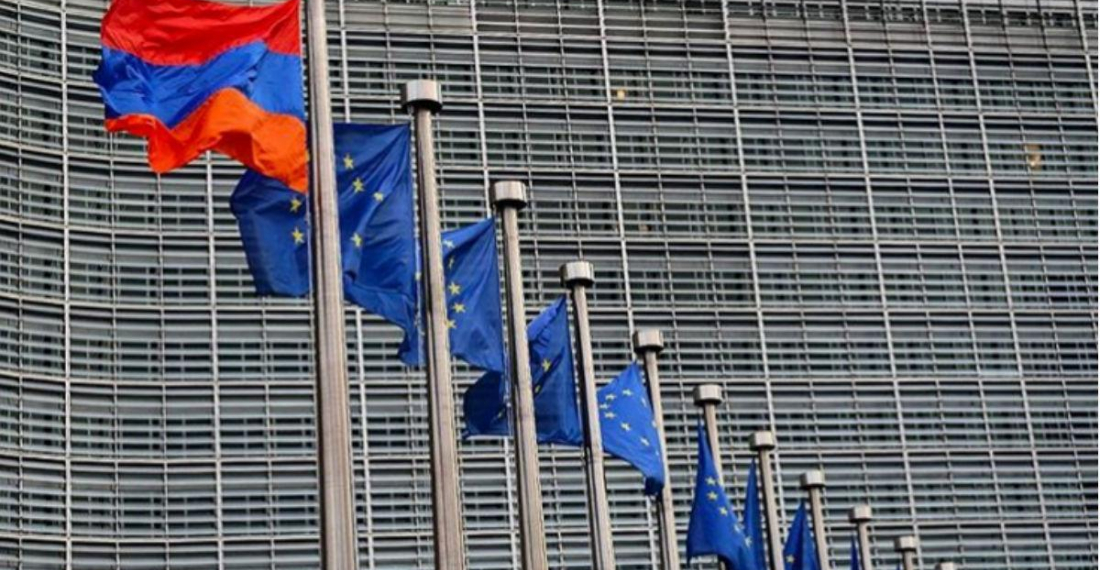
Photo: The Armenian flag flies at the European Commission building in Brussels during a visit of the Armenian prime minister to the European capital.
The views expressed in opinion pieces and commentaries do not necessarily reflect the position of commonspace.eu or its partners