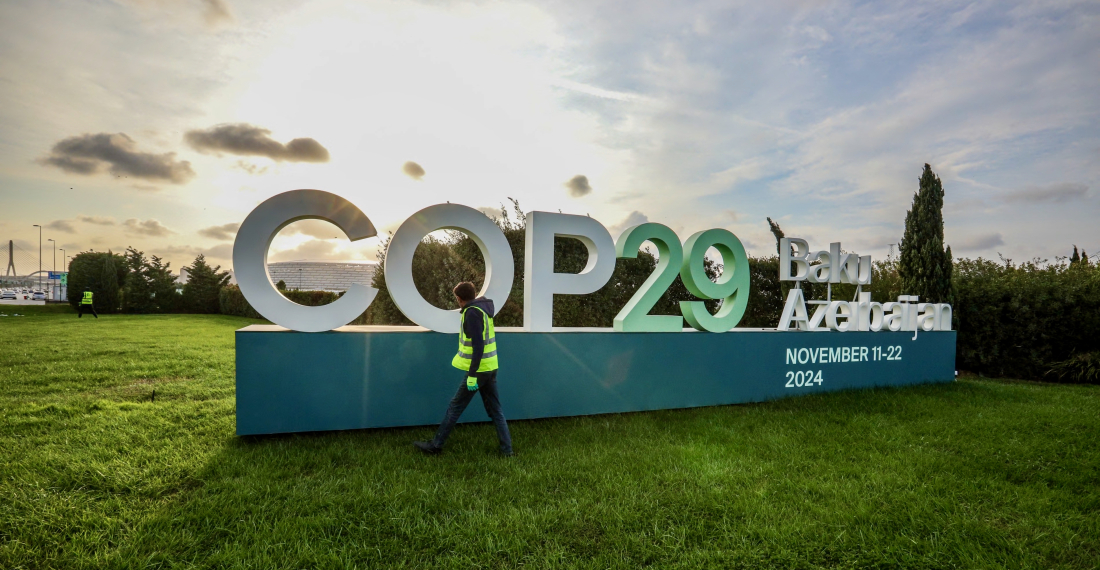
As the sun sets over the Caspian Sea, the world turns its gaze to the Azerbaijani capital for the United Nations (UN) Framework Convention on Climate Change (COP29). This year, Baku isn't just a geographical meeting point; it's a symbolic crossroads where nations must decide our planet's future. At the same time, Azerbaijan finds itself at the intersection of traditional energy systems and climate imperatives. While slow progress in the transition away from fossil fuels is due to increased energy demand from a growing economy and population, the importance of COP29 cannot be overstated - it is a destiny date for climate action.
The choice of Baku to host COP29 is a statement in itself, but it is also controversial. On the one hand, Azerbaijan, located at the crossroads of Europe and Asia, embodies the bridge between developed and developing countries. But critics say Azerbaijan's status as an authoritarian "petro-state" with a questionable human rights record makes it an unlikely host. Azerbaijan's economy is built on fossil fuels, with oil and gas exports from the state oil company SOCAR accounting for almost 90% of the country's exports. SOCAR is now a major source of income for the government of President Ilham Aliyev. However, Azerbaijan must also do its fair share to achieve a rapid and fair phase-out of fossil fuels, even if the country can be considered the cradle of the hydrocarbon industry.
Meanwhile, Baku has played a crucial role in strengthening the European Union's energy security, as Azerbaijan has supplied Europe with transit gas. Although Azerbaijan cannot fully replace Russian energy supplies in the foreseeable future, as it now accounts for less than three per cent of total EU gas exports, it has already significantly increased gas exports to the EU and has promised more in the future. Baku says it could replace Russian gas transiting through Ukraine by the end of 2024. This resource remains a cornerstone of today's energy landscape, as alternatives to fossil fuels have yet to fully meet global demand.
Nevertheless, this year's meeting is crucial. COP29 comes at a critical juncture in the global climate debate. The window of opportunity to limit global warming to 1.5 degrees Celsius above pre-industrial levels is closing fast. Despite previous commitments, global emissions continue to rise, and the impacts of climate change are becoming increasingly tangible - from unprecedented wildfires to devastating floods. The challenge at this year's COP will be to reach an agreement on finance to keep climate negotiations on track.
One of the key issues being discussed at COP29 is the implementation of more aggressive Nationally Determined Contributions (NDCs). Countries are being asked to submit updated plans that reflect the urgency of the climate crisis. There is also a strong focus on climate finance, particularly the unmet commitment of $100 billion per year from developed countries to support adaptation and mitigation efforts in developing countries. Negotiations are focusing on increasing the current climate fund from $100 billion a year to possibly $1 trillion, although Western countries are reluctant to commit.
Another pressing issue is the further development of loss and damage mechanisms. Vulnerable countries are calling for concrete financial support to deal with the irreversible impacts of climate change - impacts they have often done the least to cause. In this context, COP29 must agree to fully finance the Loss and Damage (L&D) Fund established at COP27 in Egypt. While initial resources were pledged at COP28 in Dubai and the World Bank has established the institutional framework for the fund, ensuring that it is fully funded to fulfil its mandate would be an important milestone.
COP29 should also strengthen the global commitment to phase out fossil fuels. According to the IMF, fossil fuel subsidies reached a staggering $7 trillion in 2022, or $13 million every minute - far more than the $2.4 trillion needed annually to meet global climate goals. Shifting even half of these subsidies to climate finance would raise $3.5 trillion, far more than is currently pledged.
COP29 is crucial to turning promises into action. The Paris Agreement laid the groundwork, but without rigorous implementation and accountability, it risks becoming a well-intentioned but ineffective document. The conference is an opportunity for countries to move beyond rhetoric and establish binding commitments, robust monitoring mechanisms and transparent reporting.
However, on 6 November 2024, COP29 was hit by a major new political obstacle: the election of Donald J. Trump as president-elect of the United States. The climate sceptic Republican has promised to pull the country out of the Paris Agreement again, as he did in 2017 - the US rejoined in 2021 under Joe Biden. During his first term, Trump rolled back dozens of environmental regulations. Trump wants to slow down the energy transition and massively increase fossil fuel production again. Without the US, developed countries are likely to find targets on climate finance harder to meet. This will increase pressure on Europe and China to lead international progress on limiting global warming.
A delayed road to COP30
While COP29 addresses many critical issues, some of the most contentious debates have been deferred to COP30 in Brazil. Chief among these is the global carbon market mechanism outlined in Article 6 of the Paris Agreement. The complexity of establishing a fair and effective carbon trading system has led negotiators to postpone the discussion in the hope that more time will lead to consensus.
In addition, the debate on deforestation, particularly in the Amazon Basin, has been scheduled for greater discussion in Brazil. This shift is strategic, allowing the host country Brazil - home to a significant proportion of the world's rainforests - to lead the conversation on preserving these critical carbon sinks. The success of these talks will determine the global commitment to reducing deforestation and tackling climate change.
The delayed talks are not without controversy. Critics argue that postponing decisions on carbon markets and deforestation undermines the urgency needed to address these issues. The lack of consensus on Article 6 is holding back potential investment in renewable energy projects and hampering international cooperation.
In addition, deforestation remains a glaring problem. Forests are essential for carbon sequestration and their destruction accelerates climate change. It is hoped that hosting COP30 in Brazil will galvanise action, but the postponement raises concerns about the immediacy with which these issues will be addressed.
As COP29 unfolds, the world is watching with bated breath. Baku has the opportunity to cement its place in history as a turning point where nations chose cooperation over complacency. Participants must remember that in the face of escalating climate emergencies, incremental progress is no longer enough. The time has come for bold commitments, innovative solutions and unwavering political will.