


Armenia Power Struggle Intensifies Before Elections

Tensions are mounting in Armenia ahead of next years parliamentary elections, with the nations future hanging in the balance. Despite the excitement surrounding the Trump-brokered Washington Declaration in August, it is unclear whether it can overcome the lingering division that set in after defeat by Azerbaijan in the 44-day war. Recent surveys have shown a slight majority against the proposed TRIPP.

At the weekend, supporters of Russian-Armenian billionaire Samvel Karapetyan, currently under pre-trial detention, took to the streets of Yerevan and Etchmiadzin. Karapetyan is charged with calling for the overthrow of the Pashinyan government though many believe that his detention was unwarranted and politically motivated because of the coming vote.

According to the survey conducted in August by local pollster MPG, 77 percent of respondents disapproved of the government’s approach. If elections were held that weekend, 13.4 percent also said they would vote for Karapetyan’s new political movement if it were to run. That might not sound like much but Pashinyan’s Civil Contract does not fare much better at 17.3 percent.

The furore stems from an interview given by Karapetyan in June during which he said that the opposition would defend the Catholicos of All Armenians, Karekin II, if Pashinyan moves to forcibly remove him from his position. That same month, two archbishops and other clergy were detained and charged with planning to instigate a coup. It is believed that the church's opposition to a compromise deal with Azerbaijan is the reason.

Pashinyan also seeks to establish a fourth republic in the country in order to turn the page on the rule of his predecessors, Robert Kocharyan and Serzh Sargsyan, and to end over three decades of conflict with its neighbours.

Such a move would not only secure Pashinyan’s political future but also create an environment conducive to specifically normalise relations with Azerbaijan and Turkiye. The problem is that Pashinyan's popularity is incredibly low. This was also highlighted by the results of the last International Republican Institute (IRI) survey conducted in June that virtually identical to the later MPG poll.

Pashinyan faces mounting challenges. In 2023, his Civil Contract party almost lost Yerevan. And in March 2025, it lost the second largest city of Gyumri as well as the Parakar community just outside of the capital. In September, incidentally, the opposition mayor of Parakar was shot dead just five months after taking office, though this is believed to be a personal feud and not political.

On Monday, however, Vartan Ghukasyan, the opposition mayor of Gyumri, was detained in a dramatic raid by police that was clearly political. Scores of police were deployed from Yerevan to Gyumri to detain the controversial municipal head. There were reports of clashes between special units and the mayor's supporters as church bells rang out to sound the alarm.

Ironically, he seemed jubilant as he was whisked away by masked men. Nonetheless his powers have already been suspended. Like many others, he is now in pre-trial detention.

Ghukasyan is no stranger to controversy and has been implicated in many cases of violence and financial malfeasance over the past 25 years. He is a staunch supporter of establishing a Russia-Armenia Union State and a vehement opponent of normalisation with Azerbaijan and Turkiye. Earlier this month, the city’s top cleric had already been sentenced to two years imprisonment on coup charges.

Pashinyan’s battle against local government is not new. Armenia’s third largest city of Vanadzor has been without a mayor for four years now. Next month in Etchmiadzin, seat of the Catholicos, more local elections are planned that could prove another test of the premiere's electoral chances. It could also demonstrate if any of traditional propensity towards violence in domestic politics still lingers.

Pashinyan has already vowed to remove Karekin II and had hoped to force his resignation this summer. He appeared to have backed down at the last moment but has not disavowed his clearly stated intent. There are other reasons why. All of Pashinyan’s political foes represent discredited previous regimes that he had ousted in 2018 after two decades of criminality and corruption.

The problem is that pursuing these objectives carries with it major risks. It was clear even last year that the upcoming parliamentary elections could prove existential in nature. While it is understandable that a showdown was inevitable, the outcome is unpredictable. It could be that Pashinyan is now attempting to prevent any later unrest by nipping it in the bud sooner rather than later.

At stake is more than just political power. It is the prospect of a long-awaited peace agreement with Azerbaijan that could finally close that chapter in the modern history of both countries. If the coming months are instead disrupted by infighting and clashes, progress made since the Washington Declaration could easily unravel.

But if the country can ensure stability and start to heal its many divisions then it would prove the first successful test for Pashinyan’s since his much touted velvet revolution.

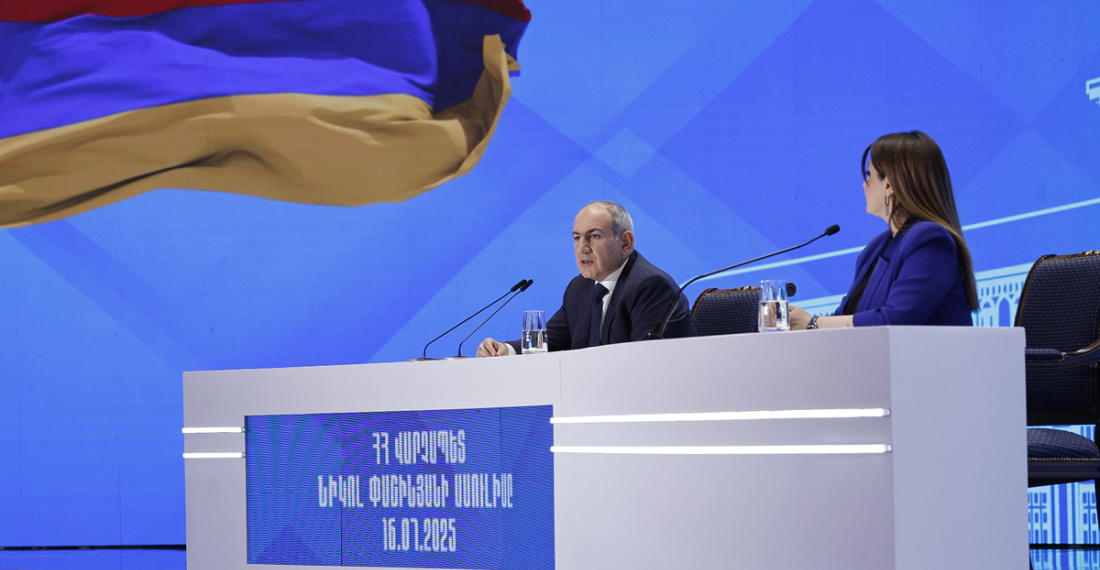
source: Onnik James Krikorian is a journalist, photojournalist, and consultant from the U.K. who has covered the Armenia-Azerbaijan conflict since 1994. Photo: Prime Minister Pashinyan addressing a media conference in July 2025/Government of Armenia
The views expressed in opinion pieces and commentaries do not necessarily reflect the position of commonspace.eu or its partners.

Related articles

Editor's choice
News
Borrell tells the European Parliament that the situation in Afghanistan was critical, but the EU will remain engaged

Borrell tells the European Parliament that the situation in Afghanistan was critical, but the EU will remain engaged

Borrell underlined that the European Union will make every effort to support the peace process and to remain a committed partner to the Afghan people. "Of course, we will have to take into account the evolving situation, but disengagement is not an option.  We are clear on that: there is no alternative to a negotiated political settlement, through inclusive peace talks.
Editor's choice
News
Mystery surrounds the crash of a Turkish airline in Georgia which resulted in the death of 20 Turkish Airforce personnel

Mystery surrounds the crash of a Turkish airline in Georgia which resulted in the death of 20 Turkish Airforce personnel

​ Twenty Turkish Airforce personnel died when a military plane crushed on the Georgian side of the Azerbaijan - Georgia border on Tuesday (11 November). The C130 took off from Ganja and was heading to Merzifon, transporting service members that had participated in Azerbaijan's Victory Day celebrations. Half an hour after takeoff, the aircraft lost altitude and broke apart in mid-air over a mountainous area on the Georgian border. Lockheed C130 Hercules have been in service with Turkey since the 1960s and are considered among the most reliable in their class. However, some of these aircraft are 50–60 years old. In October, the Turkish Ministry of Defense announced plans to replace them with new C130J Super Hercules models, with deliveries expected to begin in the coming years. All aircraft fragments have already been collected for technical examination. The cause of the crash has not yet been officially determined. A Turkish expert and retired military officer Coşkun Başbuğ noted on CNN Türk, a technical malfunction "should be ruled out" as the cause of the crash. "Various possibilities should be considered, but the first thing to consider is that the C-130 is a time-tested military transport aircraft, the last known incident involving which occurred in 1982." "A technical malfunction should be ruled out as the cause of the crash. The same applies to weather conditions, as the relevant authorities would have reported bad weather. The remaining theories include a mid-air collision, sabotage, or an attack," he emphasized. Former Turkish Armed Forces Logistics Commander and retired Army General Erdoğan Karakuş stated in an interview with Turkish television that although the C-130 aircraft are old, they have undergone a complete modernization in Turkey, and their technical condition is thoroughly inspected before each flight. The Turkish Air Force is expected to operate the C-130 aircraft until 2040. ​

Popular

Editor's choice
News
Mystery surrounds the crash of a Turkish airline in Georgia which resulted in the death of 20 Turkish Airforce personnel

Mystery surrounds the crash of a Turkish airline in Georgia which resulted in the death of 20 Turkish Airforce personnel

​ Twenty Turkish Airforce personnel died when a military plane crushed on the Georgian side of the Azerbaijan - Georgia border on Tuesday (11 November). The C130 took off from Ganja and was heading to Merzifon, transporting service members that had participated in Azerbaijan's Victory Day celebrations. Half an hour after takeoff, the aircraft lost altitude and broke apart in mid-air over a mountainous area on the Georgian border. Lockheed C130 Hercules have been in service with Turkey since the 1960s and are considered among the most reliable in their class. However, some of these aircraft are 50–60 years old. In October, the Turkish Ministry of Defense announced plans to replace them with new C130J Super Hercules models, with deliveries expected to begin in the coming years. All aircraft fragments have already been collected for technical examination. The cause of the crash has not yet been officially determined. A Turkish expert and retired military officer Coşkun Başbuğ noted on CNN Türk, a technical malfunction "should be ruled out" as the cause of the crash. "Various possibilities should be considered, but the first thing to consider is that the C-130 is a time-tested military transport aircraft, the last known incident involving which occurred in 1982." "A technical malfunction should be ruled out as the cause of the crash. The same applies to weather conditions, as the relevant authorities would have reported bad weather. The remaining theories include a mid-air collision, sabotage, or an attack," he emphasized. Former Turkish Armed Forces Logistics Commander and retired Army General Erdoğan Karakuş stated in an interview with Turkish television that although the C-130 aircraft are old, they have undergone a complete modernization in Turkey, and their technical condition is thoroughly inspected before each flight. The Turkish Air Force is expected to operate the C-130 aircraft until 2040. ​

