Nearly half a million Russians killed in Ukraine but Moscow far from reaching its objectives despite the bombing of civilian targets in Kyiv (updated)

Nearly half a million Russians have died in fighting in Ukraine, as Vladimir Putin continues to push his country to the brink. His aim of completely controlling the Donbass region, which he annexed after invading Ukraine in 2022, seems more distant than ever. . However, Putin can still bomb civilian targets in Kyiv. The Ukrainian Air Force says a "serious shortage" of interceptor missiles meant none of the 23 ballistic missiles fired by Russia at Kyiv on Sunday night were shot down. At least 15 people were killed in the second large-scale Russian attack on the Ukrainian capital in a week, officials said. Seven more were killed in the wider Kyiv region. Ukrainian President Volodymyr Zelensky has appealed for allies to take "strong decisions" at this week's Nato summit to provide Kyiv with air defences. After the strikes, he said the Ukrainian military had been successful in intercepting cruise missiles and drones – but not ballistic missiles. Sunday's "massive Russian attack" consisted of 68 missiles and 351 strike drones, he said in a post on X. The air force shot down or suppressed 37 missiles and 326 drones, it said. Zelensky warned that Moscow would continue to hit residential buildings as long as defensive Patriot missiles "remain in our allies' stockpiles". 

After a bleak winter which saw months of fierce Russian bombing of Ukrainian energy infrastructure, the future is beginning to look more positive for Kyiv

Russia’s frontline advances have slowed almost to a halt, as Ukrainian counter-attacks and defensive tactics become more effective.

Successes in local counterattacks have become more frequent, as Ukrainian forces scale up their use of ground robots and sshort-range drone warfare

Also, Kyiv has succeeded in bringing home the  war to Russia, inflicting costly damage to its fuel infrastructure which has caused major shortages. This has fomented public discontent in Russia, increasing the pressure on Putin to end the conflict.

Moscow;'s gains on Ukrainian territory have dropped significantly since last year, to just a fraction of the territory they seized in May 2025, according to data from the Institute for the Study of War (ISW).

Between December 2025 and May 2025, Russians gained control of or infiltrated 40.64 square km - compared to 515.84 square km in the same period from last year.

“Russian forces thus seized or infiltrated into only 7.87 percent as much territory in 2026 as they advanced into in 2025,” the ISW said in its analysis.

For the first time in years, Moscow’s footprint in Ukraine stopped growing in spring 2026.

A combination of Ukraine’s expanded medium-range drone strike campaign, improved defensive tactics including frequent local counterattacks, and a drone dominated battlefield, have all contributed to slowing Russian advances.

The Centre for Strategic and International Studies (CSIS) says that Russia has advanced at historically slow rates, a product of the defensive advantage that has shaped the war since 2023.

The dense minefields, multi-layered fortifications, heavy shelling and drone-saturated areas have created a danger zone more than 20 kilometres wide, slowing both Russian and Ukrainian advances.

In the most prominent Russian and Ukrainian offensives in the first half of 2026, troops advanced at an average of between 50 and 90 metres per day.

This is a world away from the opening phase of the war in 2022, where Russian forces gained from roughly 3,000 to more than 7,000 meters per day.

“Russian forces currently control about 118,000 square kilometers of Ukraine, including Crimea and the parts of Donbas held before 2022,” CSIS says. “Within that area, roughly 75,000 square km (about 12 percent of Ukraine) has been taken since the February 2022 invasion.”

The Centre for Strategic and International Studies (CSIS) paints a bleak picture of Russian casualties.

Between February 2022 and June 2026, there have been as many as 450,000 Russian battlefield deaths and 1.4 million casualties, it says.

The UK’s biggest spy agency, GCHQ, has produced a similar figure. In May, GCHQ director Anne Keast-Butler said in her inaugural public speech that nearly 500,000 Russian soldiers had been killed.

The massive death toll is a product of several factors, including an attritional warfare strategy in which Moscow sends thousands of troops towards fortified Ukrainian defences, attempting to grind Kyiv’s forces down with sheer manpower.

Estimates by Russian military bloggers suggested that Russian troops in some areas of the Ukrainian frontline can expect to live for just 20 to 35 minutes due to rising drone attacks, as cited by Oxford historian Peter Frankopan in a report for Foreign Policy.

Meanwhile, Ukrainian president Volodymyr Zelensky said in February that Ukraine had lost 55,000 soldiers since 2022

But CSIS puts the figure higher than this, stating that between there have been 125,000 and 150,000 Ukrainian deaths out of between 525,000 and 625,000 total casualties.

Combined casualties in the war have now exceeded two million, CSIS said in its report.

source: commonspace.eu with The Independent (London) and  agencies

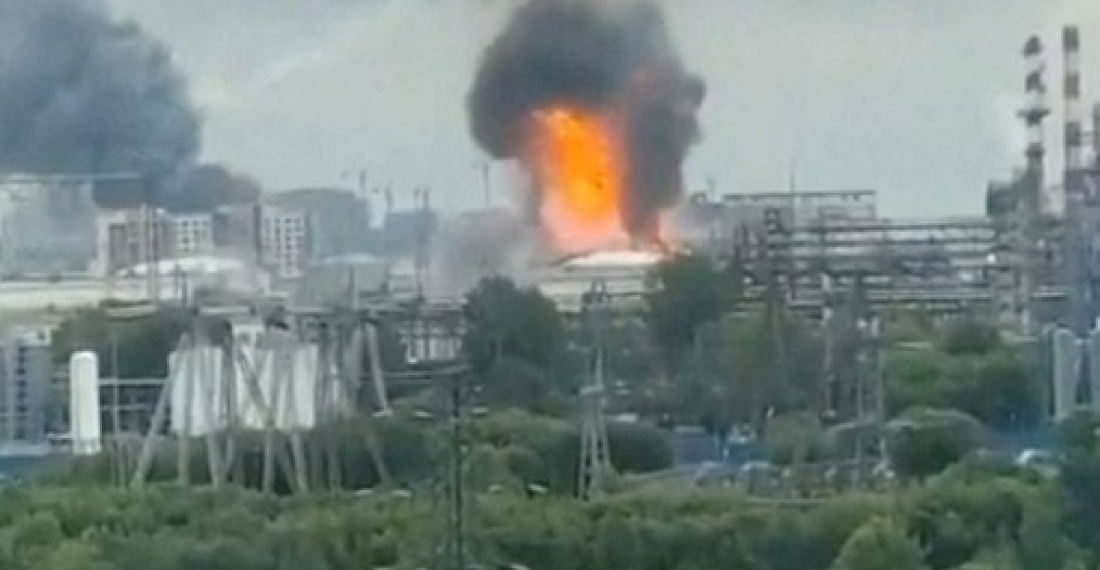
photo: The ceiling of a Moscow oil refinery was blown clean off by Ukrainian drone attack  (picture from social media)

Latest

Editor's choice
Monday Commentary
Monday Commentary: PEACE IN OUR TIME?

Monday Commentary: PEACE IN OUR TIME?

Making peace between Armenia and Azerbaijan was never going to be simple, nor easy, nor quick. It is taking time, writes Dennis Sammut in this Monday Commentary. “There is a sense of realism coming from the leaders of the two countries – President Ilham Aliyev of Azerbaijan and prime minister Nikol Pashinyan of Armenia, that frankly, is necessary and welcome”, he writes. At a time when conflicts are raging all over the world – from Ukraine to the Gulf, from Africa to South Asia, the prospect that Armenia and Azerbaijan had finally, after decades of conflict that left thousands of dead and many more displaced, decided on embarking on a journey of peace was welcomed. Peace between Armenia and Azerbaijan can be top-down up to a point. Both leaders have spent political capital preparing for a peace deal. But both are aware that their people are not ready for peace yet. In fact, in Armenia, most of the elite are negative toward a peace deal with Azerbaijan. Pashinyan needs time to persuade his countryfolk. That is why 2031 is realistic. Ilham Aliyev runs a tighter shop, but he is also not immune to public opinion. Every time someone hits a landmine in Karabakh, which unfortunately happens often, peace comes into question. Which is why Aliyev chooses to sound hardline, more often than not. In pursuing the peace agenda, both Aliyev and Pashinyan need to proceed cautiously. But they are right in making peace the central issue in their agenda. It is the main issue, and the one that will define them in history. So forward, cautiously but resolutely! In pursuing the peace agenda, Aliyev and Pashinyan need to be supported clearly and unambiguously. There are too many people in Baku and Yerevan who are sitting on the sides, waiting. The international community is not doing enough. It is time to be counted. Otherwise, the spoilers will win, and the region will go back to its bad habits. (Click the image to read the full commentary).

Popular

Editor's choice
Monday Commentary
Monday Commentary: European-Azerbaijan relations need an intensive and multifaceted dialogue that is frank and honest

Monday Commentary: European-Azerbaijan relations need an intensive and multifaceted dialogue that is frank and honest

Last week I visited Baku, Azerbaijan. My visit was relatively short, but very intensive, and had many meetings with stakeholders and colleagues. When I arrived in Baku first time in 1996,  Azerbaijan was a different country: weak, poor, and shaken by defeat in war. For thirty year the Karabakh issue dominated the agenda: the political agenda but also the popular mindset. Now, thirty years later, Azerbaijan has returned to Karabakh, and peace with Armenia is on the horizon. It is a new era for Armenia-Azerbaijan relations, for the South Caucasus, but also for Europe.  But we cannot be complacent: the Peace agreement has been initialed but not signed; borders remain closed; TRIPP is ambitious but remains an idea; and there are spoilers who want to turn the clock back. We must not allow them, and in this Europe and Azerbaijan must work together. Europe’ vanguard organization is the European Union – it is a free union of 27 member states; it is a strong global economic force, and increasingly a diplomatic and military force too. But it remains “work in progress” and can often appear dysfunctional. It often lacks collective and institutional memory. In its dealings with Azerbaijan the EU has made many mistakes – not least opening the delegation here late – in 2008. It sometimes appears condescending. Some utterances from the European Parliament and from some quarters in some member states are not understandable even for me. They irritate the Azerbaijanis, but serve no other purpose But Azerbaijan has also not handled relations with the EU well. It has failed to respond when the hand of friendship reached out; and it confused irritating actions, sometimes by well-meaning people; sometimes by outright spoilers, with strategic action. In short, EU-Azerbaijan relations have suffered from a lack of proper dialogue. This dialogue must be frank, honest and multi-faceted involving different segments of society on both sides.   Is Azerbaijan Europe? When Azerbaijan applied to join the Council of Europe in the 1990s, there were some who opposed, saying this was not Europe. I was one of the people who argued that Armenia and Azerbaijan may be on the periphery of the continent geographically, but were European in essence. Certainly their elites. During the discussion on 4 September in Baku, my friend Farhad Mammedov, mentioned that Azerbaijan is not interested in joining the EU, and was now close to the Central Asian countries in the 5 plus 1 format. Neither things mean that Azerbaijan is not Europe. There are several European countries that are not in the EU, and do not want to be, for example Norway and Switzerland. Iceland has recently voted to stay out of the EU. The UK was a member and left. Europe is bigger than the EU, and the holding of the European Political Community summit in Baku in 2027 proves that. Despite all the rhetoric, I never heard the president of Azerbaijan  saying that Azerbaijan is not Europe, nor have I heard any European president say it either. Not wanting to join the EU and forging close relations with neighbouring regions does not make Azerbaijan any less European. It is only logical that when Europeans talk to Azerbaijan they talk like family. The conversation is often frank. It must also be honest, and Europeans need always to remember this too. A frank, honest and multi-faceted dialogue A frank, honest and multifaceted dialogue will contribute to relations between Azerbaijan and the rest of Europe: it will avoid misperception, which unfortunately is very common on both sides; it will provide a forum where problems can be discussed and resolved, and it will increase mutual trust, so that together common problems can be addressed. (click image to read the full Monday Commentary)
Editor's choice
Monday Commentary
Monday Commentary: “The barren rocks of Aden” and “These lands of Yemen are so ruthless”

Monday Commentary: “The barren rocks of Aden” and “These lands of Yemen are so ruthless”

There are two early 20th-century tunes that mark foreign attempts to occupy and “pacify” Yemen. The Scottish tune “The barren rocks of Aden” marks the mobilisation of Highland soldiers, enlisted to be deployed to the Yemeni port of Aden, that in 1837 became the last colony to be incorporated into the British Empire. The tune talks of the harshness of the terrain, but is celebratory, It was even played as a farewell tune to Sir William Luce at the parade in Sharjah celebrating his end as “British Viceroy” in the Middle East in 1966. The second tune is an Anatolian lament. As Ilker Sezer reminded us this weekend, in his weekly feature on “Turkiye Today”, it “mourns the tragic fate of Ottoman soldiers dispatched to the harsh, remote deserts of Yemen during the fall of the empire, young men who marched away from their villages and never returned home. Most of their names, and numbers, were never recorded. Yet, their fate left a mark on the Turkish psyche.” Subsequent invaders have discovered that Yemen is a grave that cannot be overcome by the strength of modern technology, and that whilst Yemeni society is splintered and divided, building a reliable alliance with Yemeni factions is difficult. These are the harsh lessons facing Saudi Arabia, as the Kingdom faces its biggest challenge in its modern history. The leadership of the Kingdom now has to respond decisively. At stake is their very credibility. This is likely to be a long and messy conflict. Saudi military objectives need to be focused: to box in the Houthis rather than destroy them. This is likely to include: (a) regaining territory lost on the Red Sea coast; (b) control over Bab el Mandeb Strait; (c) some kind of cordon sanitaire on the Saudi-Yemeni border; and if things go well (d) the capture of Sanaa. All this would not eliminate the Houthi problem, but it will contain it. In the end the Saudis will have to continue managing Yemen with a mixture of carrot and stick. For the moment, the stick is likely, but the carrot cannot be forgotten either. (click the image to read the Monday Commentary in full)