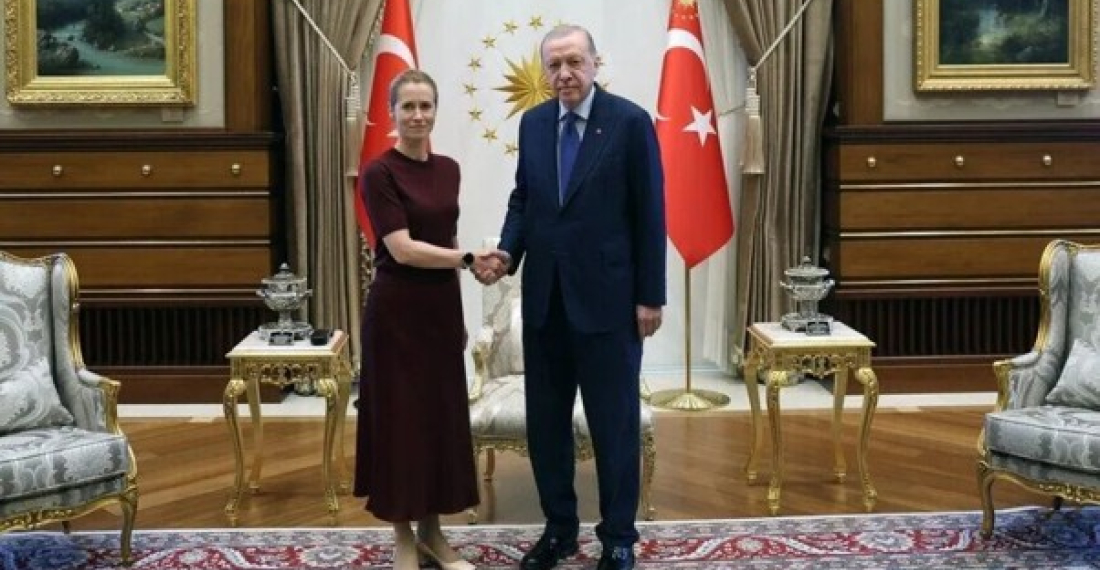
EU High Representative for Foreign Affairs and Security Policy and Vice-President of the European Commission Kaja Kallas, accompanied by the EU Commissioner for Enlargement Marta Kos and EU Commissioner for Internal Affairs and Migration Magnus Brunner were in Turkiye on Tuesday (30 June). Kallas and her delegation met with Turkish president, Recip Tayib Erdogan, and with Foreign Minister, Hakan Fidan.
They discussed EU-Türkiye relations in a global perspective, recalling Türkiye’s candidate status and acknowledging the strategic value of Türkiye-EU relations in promoting regional stability and economic resilience in a rapidly shifting geopolitical landscape. They reviewed issues of common interest including economic and trade cooperation, connectivity, migration, security and common challenges in foreign and security policy.
They reaffirmed the shared determination to take steps that would further enhance the cooperative and mutually beneficial relationship in these areas.
The visit comes on the eve of a major NATO summit, which is due to be held in Turkiye 7-8 July,
In the meeting with Erdogan, the two sides discussed relations between Turkey and the European Union, regional and international issues, and preparations for the upcoming NATO summit in Ankara.
 According to Anadolu, the talks were held behind closed doors. Also present on the Turkish side were Foreign Minister Hakan Fidan, Head of the Communications Directorate of the Presidential Administration Burhanettin Duran, and Presidential Adviser on Foreign Policy and Security Akif Çağatay Kılıç.
Kaja Kallas, in turn, commented on her meeting with the Turkish President on social media. "Turkey is a key partner in security, migration, and energy issues, as well as a candidate country for EU membership," Kallas wrote.
"It was a pleasure to speak with President Erdoğan today about further strengthening relations between the EU and Turkey, as well as the importance of good neighborly relations," she noted. "We also discussed Russia's war against Ukraine, conflicts in the Middle East, and preparations for the NATO summit in Ankara. Turkey makes a significant contribution to defending NATO's eastern flank," the EU High Representative concluded.
Joint Statment with Hakan Fidan
A joint statement issues by Fidan and Kallas after their meeting said that the two sides agreed on the importance of regional stability and good neighbourly relations.
They voiced support to the efforts by the UNSG on the Cyprus issue.
The EU side stressed, in the context of enlargement, the need of strengthening the rule of law, the protection of fundamental rights and ensuring high democratic standards.
The statement added:
They exchanged views on recent global and regional issues, including Ukraine, Russia, the Middle East, Africa and South Caucasus, reiterating their shared interest and responsibility to address them through enhanced consultation and coordination, and their commitment to multilateralism and a rules-based multilateral order.
They agreed that the European Union and Türkiye share a commitment to upholding Ukraine's sovereignty and territorial integrity and to supporting a just and lasting peace based on international law. The EU recalled the importance of preventing the circumvention of EU sanctions by all states.
They agreed to coordinate mutually complementary Turkish and EU efforts to better contribute to regional peace and prosperity across the South Caucasus, strengthening connectivity, trade and economic links. Together they will support concrete steps to this end.
They underlined the importance of strengthening dialogue and cooperation on security and defence matters in complementarity with NATO.
They reaffirmed their willingness to continue efforts to improve the implementation of the Customs Union while paving the way to its modernisation. Both sides underlined the importance of an inclusive and reciprocal approach in industrial policy for the competitiveness and economic security of the EU and Türkiye. They also agreed that Türkiye’s potential participation in the Single Euro Payments Area (SEPA) would be beneficial.
They discussed the current state of play in the Visa Liberalization Dialogue and exchanged views on matters concerning the visa application and processing procedures of Turkish citizens. They acknowledged the current geopolitical situation and its possible impact on population movements, raised shared challenges for the EU and Türkiye and expressed their determination to work together in addressing them, including enhancing cooperation on border management and fight against migrant smuggling.
They underlined the importance of cooperation in trade, energy, transport and digitalisation, also in the context of the regional connectivity agenda. In that regard, they welcomed the gradual resumption of the European Investment Bank’s (EIB) operations in Türkiye.
They agreed to meet again, and to schedule upcoming rounds of high-level dialogues preferably before the end of the year, including on economy, trade, migration and security, health, science and innovation and agriculture.
source: commonspace.eu with the press service of the EEAS (Brussels), Anadolu Agency (Ankara) and agencies
photo: EU High Representative Kaja Kallas and Turkish president Erdogan at the presidential palace in Ankara on 30 June 2026