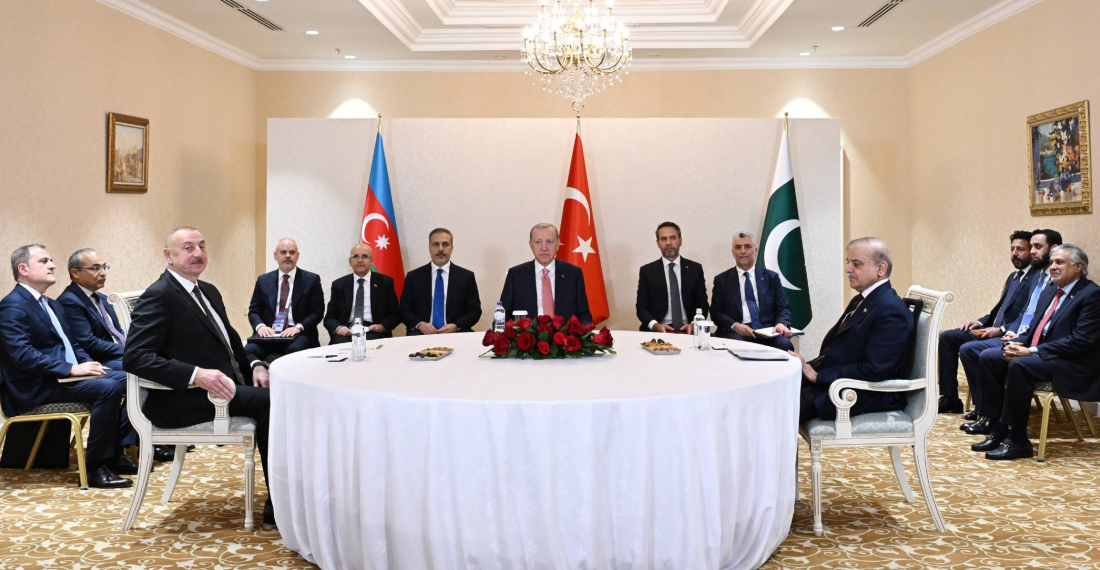
On July 3, 2024, Ilham Aliyev, President of Azerbaijan, Recep Tayyip Erdoğan, President of Türkiye, and Shahbaz Sharif, Prime Minister of Pakistan came together in their first trilateral summit in Astana, Kazakhstan. The summit, held on the sidelines of the 24th Meeting of the Council of Heads of State of the Shanghai Cooperation Organization (SCO), marks a significant milestone in the growing cooperation among the three countries. It underscored an elevation of the trilateral format in their cooperation from the existing parliamentary and ministerial levels to the state leadership and as such highlighted their interest in deeper collaboration in various spheres, including economy and military.
The historical and cultural bonds between Azerbaijan, Türkiye, and Pakistan are well-rooted. These fraternal ties, grounded in shared cultural, historical, and religious values, have been a foundation for their partnership and proved to be important in critical moments. In 2017, the three countries made a move to launch a trilateral format for cooperation and consultations concerning common challenges and opportunities. In November of that year, they laid the groundwork for this format with Azerbaijan’s then-foreign minister Elmar Mammadyarov host a trilateral meeting with his counterparts Mevlüt Çavuşoğlu of Türkiye and Khawaja Muhammad Asif of Pakistan. The three countries boosted the trilateral cooperation in the wake of Azerbaijan’s historic victory in the Second Karabakh War (2020) during which Baku received significant political support from Ankara and Islamabad.
In July 2021, Azerbaijan, Türkiye, and Pakistan established another dimension of the trilateral cooperation by launching the parliamentary format. The declaration of the three parliamentary speakers after their first meeting in Baku vowed to build lasting tripartite cooperation between their parliaments and was more explicit than the earlier trilateral declaration of the foreign ministers (2017) in its support of the territorial integrity of the three countries. The declaration expressed support to Azerbaijan in its efforts to rebuild and rehabilitate the liberated Karabakh territories; to Pakistan in its conflict over Jammu and Kashmir, calling for a resolution in accordance with the respective United Nations Security Council resolutions; and to Türkiye in the settlement of the disputes in Cyprus, the Aegean and the Eastern Mediterranean, on the basis of international law.
The leaders’ meeting in Astana highlighted these connections and underlined the importance of further deepening their bonds. They expressed a commitment to regular high-level meetings and continued support for each other within various platforms and international organisations. The three leaders stressed the importance of broader initiatives to bring their nations closer and proposed some steps towards this purpose.
Economic cooperation was a central theme of the trilateral discussions at the summit. The leaders emphasized the need to boost trade and economic relations, recognizing the significant potential for collaboration in various sectors, including innovation, energy, agriculture, and education. The trade relations between Pakistan and its Turkic partners are positively affected by their commitments for deeper ties.
Azerbaijan’s trade turnover with Pakistan reached a record level of 28 million USD in 2022, while Türkiye’s trade with this country also marked a record growth reaching 1.3 billion USD in that year. All three countries agree that this falls short of the real potential, and they must take more steps to strengthen economic bonds. Baku and Islamabad are expected to finalize the Preferential Trade Agreement soon, which includes tax and customs privileges on 15 or more products and services. It is expected that as a result of these privileges, the trade turnover between the two countries will exceed $40 million in the next 2-3 years.
One of the key highlights was the discussion on the Middle Corridor initiative, which is crucial for enhancing trade routes and economic integration across the region. This corridor, which passes through Azerbaijan and Türkiye, offers a strategic route connecting Asia and Europe. The commitment to developing this corridor underscores the strategic economic importance of the trilateral cooperation, promising new opportunities for trade, investment, and economic growth. At the trilateral summit, Pakistan's participation in the Middle Corridor was discussed and its potential to contribute to the promotion of economic and trade relations between the countries involved was stressed.
Furthermore, defence collaboration featured prominently in the summit. The leaders discussed the importance of regular joint military exercises to strengthen their defence capabilities. The success of the "Three Brothers" military exercises held in 2021 was cited as a model for future collaborations. These exercises not only enhanced military readiness but also fostered greater understanding and interoperability among the armed forces of the three nations. The potential for joint defence production was also explored, reflecting a strategic move towards self-reliance and mutual support in defence technologies. This aspect of trilateral cooperation is particularly significant given the complex security dynamics of the wider region.
Cultural and educational exchanges were also a key focus of the summit. The leaders agreed on the importance of promoting cultural understanding and academic collaboration, aiming to strengthen the historical bonds and foster deeper connections among their peoples. Initiatives in this area include educational exchanges, joint cultural projects, and people-to-people contacts. The launch of direct flights between Azerbaijan and Pakistan has significantly contributed to these contacts between the countries and bilateral tourism. The two countries are working on expanding flight connectivity and conducting flights from various cities of the two countries.
The future of the trilateral cooperation between Azerbaijan, Türkiye, and Pakistan looks promising. Their collaborative efforts in economic integration, security collaboration, and cultural exchange will not only benefit their respective populations but also contribute to broader regional stability and prosperity. The commitment to regular high-level meetings and enhanced collaboration in various sectors ensures that this trilateral cooperation will continue to evolve, addressing emerging challenges and leveraging new opportunities for mutual benefit.
source: Dr Vasif Huseynov, is a Senior Advisor at the Center of Analysis of International Relations (AIR Center) and Adjunct Lecturer at Khazar University in Baku, Azerbaijan.
photo: The leaders of Azerbaijan, Pakistan and Turkey at their trilateral summit on 3 July 2024 (picture courtesy of the press service of the president of Azerbaijan
The views expressed in opinion pieces and commentaries do not necessarily reflect the position of commonspace.eu or its partners