


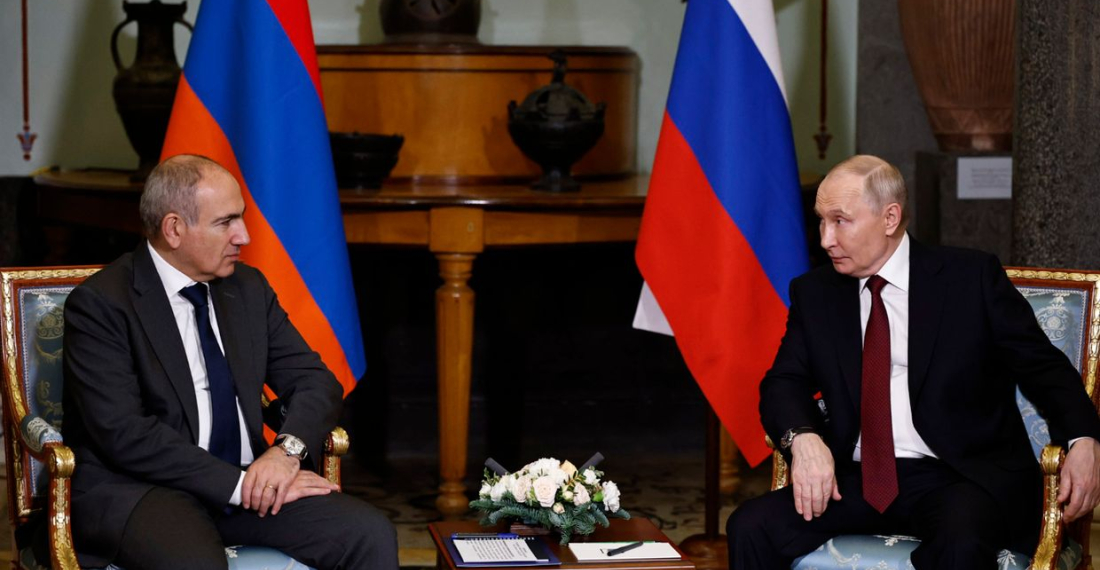
Armenian Prime Minister Nikol Pashinyan said relations with Russia are undergoing a “constructive transformation,” following his 1 April meeting with President Vladimir Putin. Speaking at a weekly briefing on 2 April, he said he viewed the process “positively” and stressed that Armenia would “not deviate from the logic of friendly dialogue,” with another meeting expected later in June.
Despite this optimistic tone, the talks in Moscow did not produce agreements on several key issues. One of the main points of disagreement remains Armenia’s railway network, which has been operated by Russia under a concession agreement since 2008. Russian Deputy Prime Minister Aleksei Overchuk said on 2 April that there were “no objective reasons” to transfer control, while Armenian officials argue the current system limits the country’s role in regional transport. Pashinyan has suggested that a third country, such as Kazakhstan, could potentially take over management, but said Armenia would not act “behind Russia’s back or against Russia.”
Energy policy has also emerged as a point of tension. Pashinyan said there was “no basis” for any Russian increase in gas prices, pointing to long-term agreements, after Putin highlighted that Armenia pays significantly less than European countries. The issue led to warnings that Armenia may, in response, leave Russian-led organisations like the Eurasian Economic Union (EAEU) and the Collective Security Treaty Organisation (CSTO), though officials indicated such a step is unlikely.
Moscow reacted critically to such statements. On 8 April, Foreign Ministry spokesperson Maria Zakharova compared the threats to “threatening a hedgehog,” and said she would not “seriously comment on the statements of emotional politicians,” adding that Armenia is responsible for ensuring its own energy security.
Former Armenian president Robert Kocharyan also weighed in on the "Big Politics" podcast. Kocharyan, considered by analysts as a pro-Russian figure, warned that distancing from Russia could disproportionally impact Armenia, as Armenia’s trade, remittances, and labour ties remain heavily dependent on Russia. He added that leaving the EAEU could lead to “economic collapse,” while Russia would “barely notice such a move.” Kocharyan further criticised what he described as an inconsistent foreign policy and cautioned against attempts to balance between Russia and the European Union. In his view, Armenia should refrain from choosing a side, balancing economic relations with its primary market, Russia, and benefiting from ties with the EU.
Source: commonspace.eu with OC Media and Caucasus Watch



