


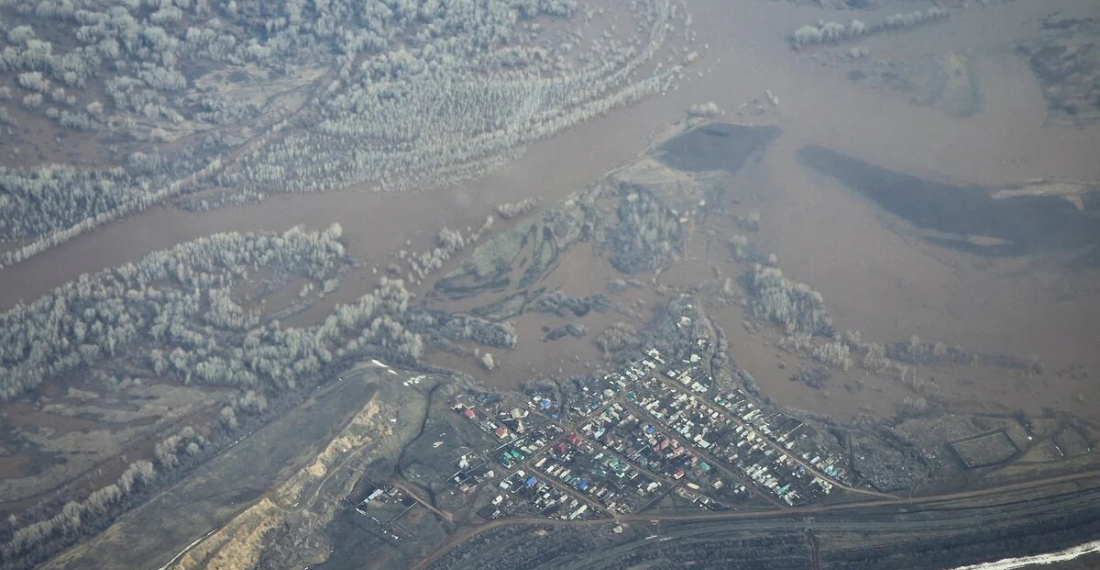
Kazakhstan struggles to deal with massive flooding

Kazakhstan has for nearly two weeks been grappling with the worst flooding in living memory after very large snow falls melted swiftly amid heavy rain over land already waterlogged before winter. Swathes of northern Kazakhstan were flooded again on Monday (15 April) as melt waters swelled the tributaries of the world's seventh longest river system, forcing more than 125,000 people to flee their homes. This is Kazakhstan's largest natural disaster in living memory. 

Since the onset of the flooding, 111,194 people have been rescued and evacuated, with 39,222 of them being children, reported the Ministry of Emergency Situations on April 15.

 Kazakh President, Kassym-Jomart Tokayev, addressed the nation on April 6 amid the devastating floods that wreaked havoc across the country’s regions, leaving hundreds homeless, and criticism that his government had not done enough quickly enough to support the thousands affected.    “Perhaps it is the biggest disaster in terms of its scale and consequences for the last 80 years,” he said in his nearly 15-minute address.

 In his televised speech Tokayev said that a state of emergency was declared in 10 regions of Kazakhstan.

Hinting at the slow response by government agencies Tokayev said: “Following my criticism, the government has ramped up efforts to mitigate the impacts of flooding and took appropriate measures”.  He said that all rescue work on the ground was now under his personal control.

Tokayev reiterated the main task is to prevent human casualties, while pledging full support to those affected.

“Addressing the citizens affected by the flood, I want to declare: none of you will be left without the state’s attention. Financial and other necessary assistance will be provided to all of you, and all your material losses will be compensated,” he said.

President Tokayev tasked the Ministry of Defence with sending additional military units to address the disaster and the government with unsealing the state material reserve to assist those affected.  Financial aid should also be provided, said Tokayev.

“The government must also quickly develop an effective mechanism for compensating damage and explain it to all the affected. The amounts should be proportional to the damage incurred,” he noted.

Recognizing the broader implications of the floods, the President touched on the need for enhanced national preparedness against extreme weather events.

“We must learn all the lessons from these massive floods. There are many, starting from the shortcomings in the organizational measures to prevent natural disasters, the shortage of skilled personnel in water management, and ending with our negligent attitude towards nature,” said Tokayev.

Kazakhstan cancels its landmark Astana Forum to concentrate on dealing with the flooding disaster

In an unprecedented move, seen as an admission of the seriousness of the flooding crisis, the Kazakh government this week cancelled the Astana International Forum (AIF) scheduled for June 13-14, 2024. The forum is a prestige national event for Kazakhstan that annually convenes world and business leaders to engage in dialogue on pressing issues and seek new opportunities for collaboration. In 2023, it gathered over 5,000 participants from more than 50 countries in Astana.

 .“Due to the severe flooding in Kazakhstan and the need to allocate financial resources for relief efforts and aid for affected citizens, I have made the decision to cancel the Astana International Forum that was scheduled for June 13-14 this year,” wrote Tokayev in his X account.

President Tokayev expressed his hopes for the understanding of the invited participants and confirmed the event will come back in 2025.  

source: commonspace.eu with Reuters (London) Astana Times (Astana) and agencies
photo: aerial shot of flooding in Kazakhstan


Related articles

Editor's choice
News
UAE says it will withdraw from Yemen, but division emerges in Yemeni presidential council

UAE says it will withdraw from Yemen, but division emerges in Yemeni presidential council

In a move seen as an attempt to de-escalate a crises with Saudi Arabia, the United Arab Emirates, on Tuesday (30th December) announced that it was heeding a call to withdraw its troops from Southern Yemen. UAE says that its presence included counter-terrorism teams that were crucial in fighting against Islamist groups. UAE sources said that parts of Yemen not controlled by the Houthis have had Al Qaeda in the Arab Peninsula (AQAP) operatives using the territory to launch attacks on Europe, the US and Middle East. UAE teams have co-ordinated with American and British special forces and intelligence. The sources added that Emirati forces and their Yemeni allies also helped reverse Houthi gains in the south. including the liberation of Aden port. The small UAE contingent has remained in place since the UAE withdrew most of its military personnel in 2019. The leading English-language newspaper in Abu Dhabi, The National, said that the main UAE force was based at Riyan Mukalla International Airport, with access to fixed-wing aircraft and helicopters, but also operated smaller contingents in the port town Balhaf and Shabwa. "It is understood it also flew a number of drones from the airbase that were able to track terrorist movements, pass information back to its allies and assisted special forces' missions." Meanwhile a division has emerged in Yemen's presidential council after four members denounced what they called the 'unilateral decisions' by the chairman. Four of Yemen’s eight Presidential Leadership Council members on Tuesday denounced an announcement by the council’s chairman accusing him of breaching the governing agreement. Tension between Yemeni leaders has been rising for weeks, underscoring the fragility of the country's already fractured political landscape and further complicating efforts to confront the Iran-backed Houthi rebels. The latest rift took an unprecedented turn on Tuesday morning, marked by a Saudi-led coalition “limited operation” striking combat vehicles Riyadh linked to the Southern Transitional Council, which has three members in the PLC. The PLC Chairman, Rashad al Alimi, on Tuesday said that he was seeking to cancel the joint defence agreement with the UAE. “What has been issued … constitutes a clear violation of the Declaration of the Transfer of Power [agreement], which explicitly stipulates that the Presidential Leadership Council is a collective body whose decisions are taken by consensus, or by majority when consensus is not possible,” the statement by the four members said. “It does not, under any circumstances, allow for unilateral decision-making on sovereign, military, or major political matters." The statement was signed by STC chief Aidarous Al Zubaidi, Faraj Al Bahsani, Tariq Saleh and Abu Zaraa al Muharrami. (click the picture to read the full article).

Popular

Editor's choice
News
UAE says it will withdraw from Yemen, but division emerges in Yemeni presidential council

UAE says it will withdraw from Yemen, but division emerges in Yemeni presidential council

In a move seen as an attempt to de-escalate a crises with Saudi Arabia, the United Arab Emirates, on Tuesday (30th December) announced that it was heeding a call to withdraw its troops from Southern Yemen. UAE says that its presence included counter-terrorism teams that were crucial in fighting against Islamist groups. UAE sources said that parts of Yemen not controlled by the Houthis have had Al Qaeda in the Arab Peninsula (AQAP) operatives using the territory to launch attacks on Europe, the US and Middle East. UAE teams have co-ordinated with American and British special forces and intelligence. The sources added that Emirati forces and their Yemeni allies also helped reverse Houthi gains in the south. including the liberation of Aden port. The small UAE contingent has remained in place since the UAE withdrew most of its military personnel in 2019. The leading English-language newspaper in Abu Dhabi, The National, said that the main UAE force was based at Riyan Mukalla International Airport, with access to fixed-wing aircraft and helicopters, but also operated smaller contingents in the port town Balhaf and Shabwa. "It is understood it also flew a number of drones from the airbase that were able to track terrorist movements, pass information back to its allies and assisted special forces' missions." Meanwhile a division has emerged in Yemen's presidential council after four members denounced what they called the 'unilateral decisions' by the chairman. Four of Yemen’s eight Presidential Leadership Council members on Tuesday denounced an announcement by the council’s chairman accusing him of breaching the governing agreement. Tension between Yemeni leaders has been rising for weeks, underscoring the fragility of the country's already fractured political landscape and further complicating efforts to confront the Iran-backed Houthi rebels. The latest rift took an unprecedented turn on Tuesday morning, marked by a Saudi-led coalition “limited operation” striking combat vehicles Riyadh linked to the Southern Transitional Council, which has three members in the PLC. The PLC Chairman, Rashad al Alimi, on Tuesday said that he was seeking to cancel the joint defence agreement with the UAE. “What has been issued … constitutes a clear violation of the Declaration of the Transfer of Power [agreement], which explicitly stipulates that the Presidential Leadership Council is a collective body whose decisions are taken by consensus, or by majority when consensus is not possible,” the statement by the four members said. “It does not, under any circumstances, allow for unilateral decision-making on sovereign, military, or major political matters." The statement was signed by STC chief Aidarous Al Zubaidi, Faraj Al Bahsani, Tariq Saleh and Abu Zaraa al Muharrami. (click the picture to read the full article).

