

Force will not resolve the conflict. "EU Council President ends his visit to the South Caucasus"

Herman Van Rompuy, President of the European Council, has concluded his official visit to the South Caucasus with meetings in Azerbaijan.  He held talks with President Ilham Aliyev, then with Parliamentary Speaker Ogtay Asadov, followed by a visit to Baku's University of Foreign Languages, where Mr Van Rompuy was awarded the degree of Doctoris Honoris Causa.

In a statement to the press after his morning meeting with President Aliyev, Mr Van Rompuy commented on the strengthening of ties between the EU and Azerbaijan, particularly with regard to energy cooperation. Azerbaijan is a key player in the development of new oil and gas pipelines in the region, and the EU has welcomed the formalisation of Azerbaijani-Turkish cooperation on the Southern Corridor project. Despite progress already made, Mr Van Rompuy pressed President Aliyev "to make better use of the opportunities provided by the Eastern Partnership for Azerbaijan", which includes the promotion of trade and investment and the gradual liberalisation of visa regimes.

With regard to the Nagorno-Karabakh conflict, meanwhile, he repeated remarks he made the day before in Yerevan, emphasising the EU's capacity for confidence-building and reconciliation measures: 
"Military force will not resolve the conflict. Only a peaceful, negotiated settlement can allow the entire region to move beyond the status quo toward a secure and prosperous future. If a secure and stable regional environment can be prepared, the benefits will be for all in Azerbaijan...Both Azerbaijan and Armenia need to take decisions to reach a lasting and peaceful settlement based on the Madrid principles. Both countries need to fully implement the commitments made by their Presidents in the framework of the OSCE Minsk Group. Both sides should also strictly respect the ceasefire and exercise restraint on the ground and refrain from hostile rhetoric in public statements...The appointment of Ambassador [Philippe] Lefort as the new EU Special Representative for the South Caucasus and the crisis in Georgia demonstrates the increased commitment of the EU to the settlement of the conflict and contributing to all aspects of any solution package."
Mr Van Rompuy's first visit to Baku was welcomed by the country's President as "an important indicator of partnership and friendship between Azerbaijan and the European Union". Mr Aliyev also took the opportunity at the joint press conference to reiterate that a fifth of Azerbaijan's territory remains under Armenian occupation, with the result that over a million people are living as refugees and internally displaced persons.

source: commonspace.eu


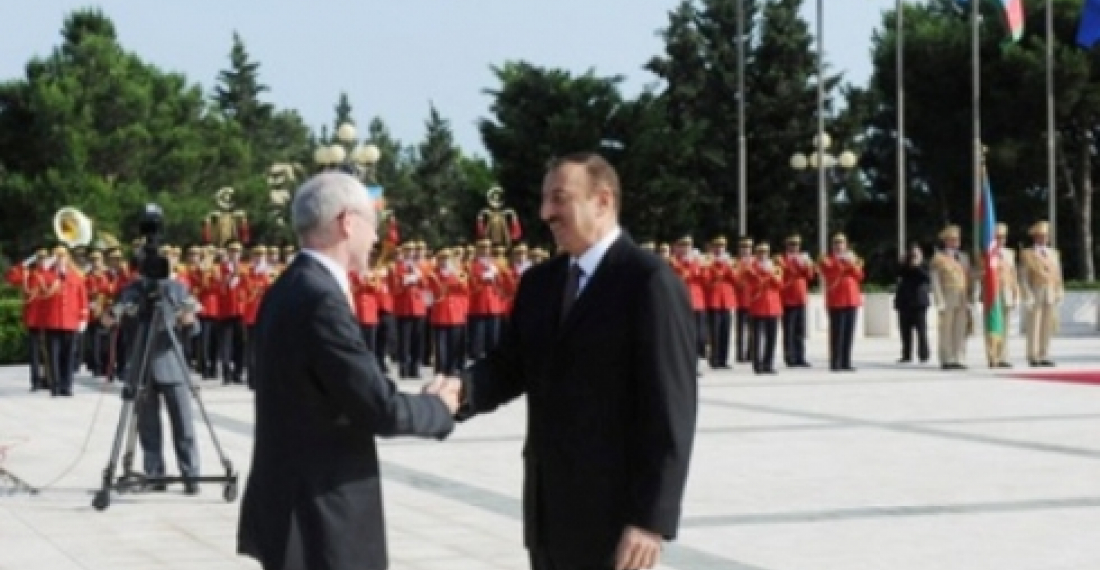
photo: President Aliev welcoming Herman Van Rompuy in Baku on 5 July 2012 (picture courtesy of the press service of the president of Azerbaijan.)
Related articles

Editor's choice
News
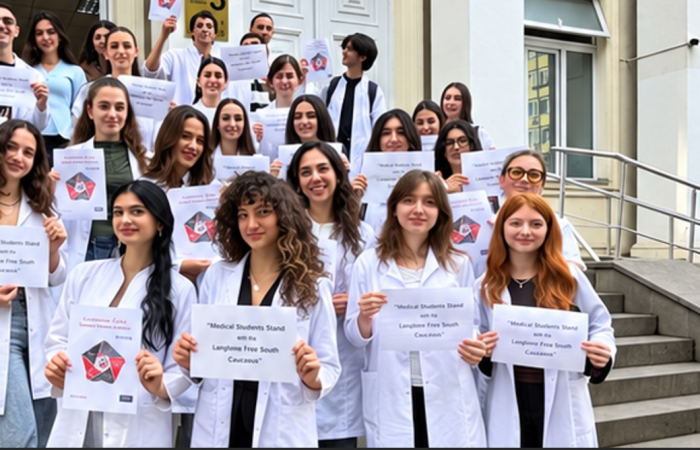
Medical Students stand for a Landmine Free South Caucasus

Medical Students stand for a Landmine Free South Caucasus

Medical Students in Tbilisi have participated in the campaign LANDMINE FREE SOUTH CAUCASUS 2026. The regional’ Landmine Free South Caucasus’ (LFSC) campaign was initiated by LINKS Europe Foundation in 2018 to address the critical issue of landmine and unexploded ordnance contamination in Armenia, Azerbaijan and Georgia. With significant landmine contamination in the region posing an ongoing threat to life and eliciting high economic costs, LFSC advocated for a regional, holistic approach to complete clearance.  Future Doctors Join the Conversation on Friday, 16 October in Tbilisi. "As part of the Landmine Free South Caucasus 2026 campaign, an informative and interactive meeting was held in Tbilisi with medical students. The session was conducted by George Simonishvili, South Caucasus Co-ordinator for LINKS Europe.  The meeting focused on the humanitarian consequences of landmines and other explosive remnants of war in Armenia, Azerbaijan, and Georgia, with particular attention to the Red Bridge minefield near the borders of the three countries, and emphasised that these dangers remain a current humanitarian challenge. It also underlined that future medical professionals will encounter the long-term effects of explosion injuries and can play a role in awareness and prevention.  Students actively engaged throughout the discussion, showing strong interest in the humanitarian impact and the need for cooperation. Under the slogan "Future Doctors for a Landmine Free South Caucasus," the event encouraged students to support public awareness, solidarity with survivors, and a safer South Caucasus free from landmine threats.  The event was organised by LINKS Europe as part of LFSC26.  "Medical Students Stand for a Landmine Free South Caucasus," "Future Doctors, Safer Futures: Together Against Landmines." "Future Doctors for a Landmine Free South Caucasus".
Editor's choice
News
European Commission Disburses €1.24 Billion to Boost Ukraine’s Defence Industry

European Commission Disburses €1.24 Billion to Boost Ukraine’s Defence Industry

The European Commission disbursed €1.24 billion to Ukraine on Wednesday (October 7) under the defence component of the €90 billion Ukraine Support Loan, earmarked for drones, drone interceptors, ammunition, and missiles produced by Ukrainian entities. European Commission President Ursula von der Leyen said the payment would strengthen Ukraine’s defence industry and its ability to protect people and infrastructure. She described Russia’s ongoing attacks as a deliberate strategy intended to make daily life increasingly difficult for Ukrainians. The Ukraine Support Loan provides an indicative €60 billion for defence and €30 billion for budgetary assistance during 2026–2027. The European Commission plans to disburse €28.3 billion for Ukraine’s defence industrial capacity in 2026, with further payments under the defence component expected in the coming weeks. Funding decisions are based on Ukraine’s evolving requirements and remain subject to agreed conditions and monitoring. According to Ukrainian Prime Minister Serhiy Koretskyi, the latest payment brings Ukraine’s defence financing received through the programme to nearly €13 billion. He said the government would continue working with European partners to ensure the remaining planned funding is delivered on schedule and in full For the remainder of 2026, €32.5 billion in EU financial support remains available to Ukraine. This includes €28.1 billion under the Ukraine Support Loan – €15.4 billion for defence industrial capacity and €12.7 billion in budget support. A further €4.4 billion remains available through the Ukraine Facility, bringing the total budget support available for 2026 to more than €17 billion, subject to Ukraine meeting the relevant conditions. Since 2022, the EU and its member states have provided €228.7 billion in overall support to Ukraine, including €3.8 billion generated from immobilised Russian assets.

Popular

Editor's choice
Interview
Thursday Interview: Murad Muradov

Thursday Interview: Murad Muradov

Today, commonspace.eu starts a new regular weekly series. THURSDAY INTERVIEW, conducted by Lauri Nikulainen, will host  persons who are thinkers, opinion shapers, and implementors in their countries and spheres. We start the series with an interview with Murad Muradov, a leading person in Azerbaijan's think tank community. He is also the first co-chair of the Action Committee for a new Armenian-Azerbaijani Dialogue. Last September he made history by being the first Azerbaijani civil society activist to visit Armenia after the 44 day war, and the start of the peace process. Speaking about this visit Murad Muradov said: "My experience was largely positive. My negative expectations luckily didn’t play out. The discussions were respectful, the panel format bringing together experts from Armenia, Azerbaijan, and Turkey was particularly valuable during the NATO Rose-Roth Seminar in Yerevan, and media coverage, while varied in tone, remained largely constructive. Some media outlets though attempted to represent me as more of a government mouthpiece than an independent expert, which was totally misleading.  Overall, I see these initiatives as important steps in rebuilding trust and normalising professional engagement. The fact that soon a larger Azerbaijani civil society visits to Armenia followed, reinforces the sense that this process is moving in the right direction." (click the image to read the interview in full)