On Tuesday (24 March) Australia and the European Union signed a trade deal that removes a vast majority of tariffs on European goods and Australian critical mineral exports. Eight years in the making, the agreement was ushered to a close due to increased tariffs from the United States’ Trump administration, and concerns regarding China’s role as the dominant supplier of rare earth and critical minerals. In addition to the cut on tariffs, both sides signed an additional agreement to bolster security and defence ties.
The agreement has faced criticism from Australian farmers, who view export quotas on Australian agricultural products, such as beef and sheep meat, as a restriction on Australian access to the European bloc.
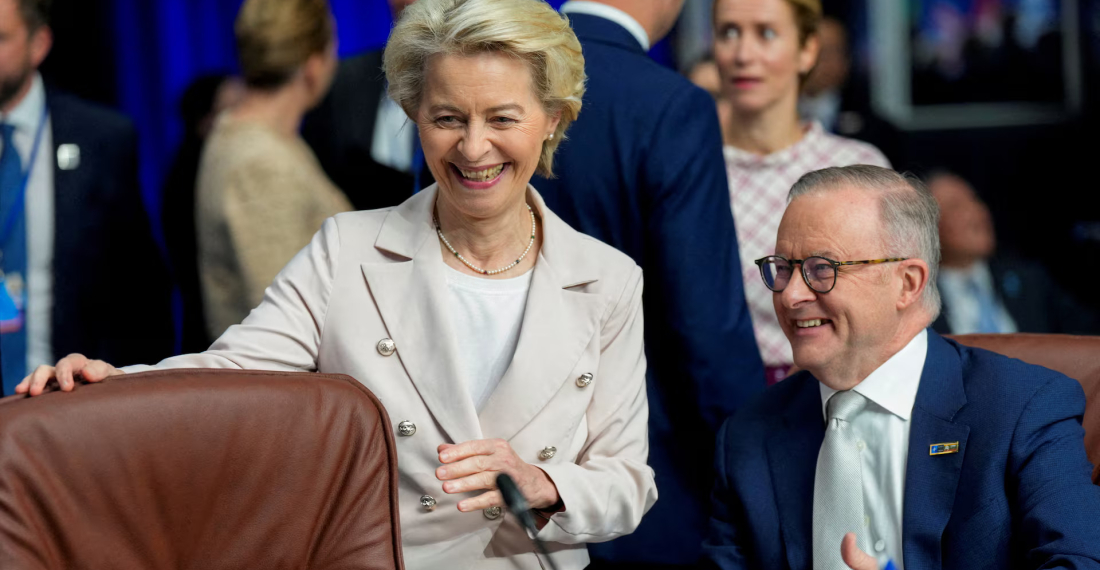
In a statement on Tuesday (24 March), European Commission President Ursula von der Leyen stated:
“The EU and Australia may be geographically far apart but we couldn't be closer in terms of how we see the world.”
"With these dynamic new partnerships on security and defence, as well as trade, we are moving even closer together."
The trade agreement will cut 99% of tariffs on EU goods exports to Australia, saving the EU 1 billion euros per year in duties. Exports to Australia are now projected to grow up to 33% over the next decade.
According to a statement by Australian Prime Minister Anthony Albanese, the agreement is expected to contribute approximately A$10 billion to the Australian economy. Albanese added that slashing nearly all tariffs on Australian critical minerals to the EU will stabilise international supply chains.
"For both Europe and Australia, getting China right is a strategic imperative, and this is why bringing to life our critical minerals partnership will be crucial to our success," von der Leyen said in an address to the Australian parliament on Tuesday (24 March).
"We cannot be over-dependent on any supplier for such crucial ingredients, and that is precisely why we need each other."
The deal reflects the European bloc’s expanded economic interests in the Indo-Pacific, having sealed agreements with Indonesia in September and India in January.
Source: commonspace.eu with Reuters