


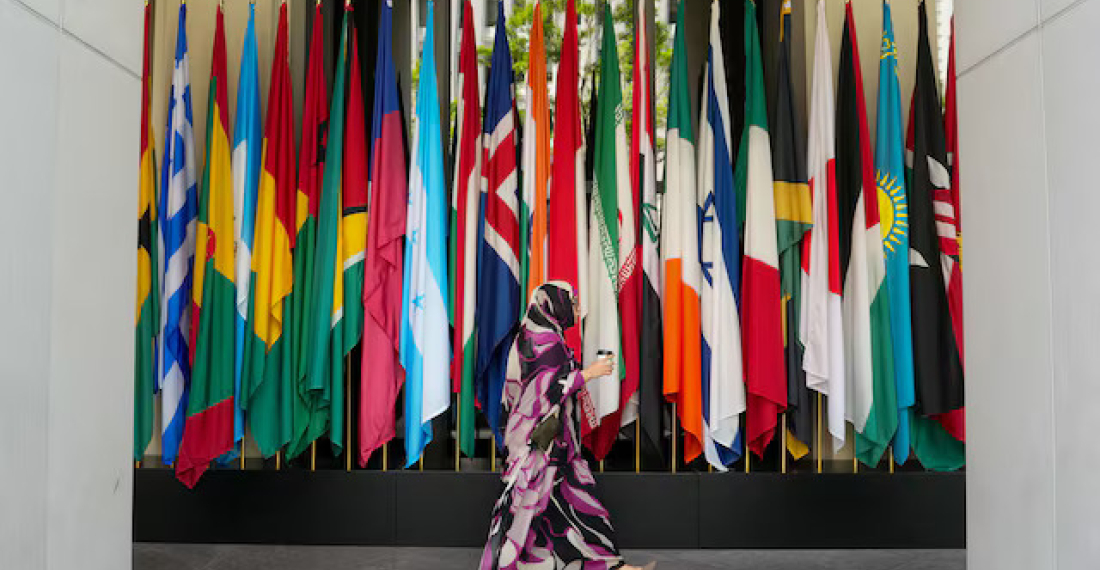
Developing countries face unfavourable economic outlook, discuss solutions at IMF-World Bank meetings

The past week’s IMF-World Bank meetings (13-18 April) have left developing-country policymakers frustrated, as repeated external shocks are derailing efforts to tackle debt, reform their economies, and provide affordable food and fuel for millions of citizens.

Some officials and economists say this crisis marks a critical point and may drive countries to embrace more independent and regionally coordinated action.

According to the IMF and the World Bank, the war in Iran and the sharp rise in oil and fertiliser prices will weigh on global growth and drive inflation, even if the war ends soon.

These external shocks threaten the fiscal balances of countries recovering from previous debt defaults, such as Zambia and Sri Lanka. They are also eating into the buffers some countries built after the pandemic, the Russia-Ukraine war, and US trade tariffs upended their economies.

"It's like you got hit in the head many times. Once you got up and then you got hit again," Chayawadee Chai-anant, assistant governor of Thailand's central bank, told Reuters, referring to efforts to recover from repeated crises.

The IMF has lowered its 2026 growth forecast for emerging nations to 3.9 per cent, down from 4.2 per cent in January. These projections could worsen if the war in Iran persists.

“It’s a depressing mood, and it is also a repeated demonstration of the consequences on bystanders, where due to developments not of their own making, they have to deal with a severe economic crunch,” Reza Baqir, head of sovereign advisory services at Alvarez & Marsal, told Reuters.

In response to growing concern, the IMF and World Bank offered few new solutions, instead advising countries to “rebuild fiscal buffers once conditions stabilize and do so without delay”.

The IMF’s new fiscal affairs chief, Rodrigo Valdes, warned countries against using broad fuel subsidies to shield citizens from economic shocks, and instead advocated targeted, temporary cash transfers that do not obscure higher prices and keep demand high. At the same time, top leaders acknowledged that rising energy and food prices could fuel social unrest and outward migration.

Throughout the week, officials from Africa, Asia and Latin America discussed boosting resilience to future energy shocks by shifting resources into renewable energy and making better use of critical minerals to support growth and create jobs.

Even as leaders emphasise long-term resilience, they are under pressure to act quickly.

The World Bank forecasts that a prolonged war could push an additional 50 million people into acute food insecurity, while 10-15 million jobs could be lost in the near term alone.

“The cushion has been quite low, because it's never recovered back all the way, so it's thinner and thinner and thinner…especially for the fragile people,” Thailand’s Chai-anant told Reuters. “That's why this crisis, I think it's going to be more widespread.”

Source: commonspace.eu with Reuters

Related articles

Editor's choice
News
Thousands join Pope on his last day in Cameroon, his second stop on his African tour

Thousands join Pope on his last day in Cameroon, his second stop on his African tour

More than 120,000 people joined Pope Leo XIV in Cameroon for an open-air Mass on Friday (17 April), the biggest crowd so far during his 11-day Africa tour. Arriving in the economic city of Douala on Friday, the Pope reiterated his message of peace after visiting the country's Anglophone region hit by a decade-long rebellion the day before. He later warned of the dangers of artificial intelligence (AI), which he said was leading to the spread of "polarisation, conflict, fear and violence". Jubliant crowds welcomed the Pope as he arrived at the Japoma Stadium. Standing in his vehicle - known as the Popemobile - the pontiff waved at the droves of people waiting for his entrance. Some worshippers camped outside the premises on Thursday night in a bid to get a prime spot for the pontiff's address, with some having been there for more than 24 hours By Friday, tens of thousands of people of all ages, including several from the priesthood, braved the heat to participate in the occasion. “Do not give in to distrust and discouragement,” he said. “Reject every form of abuse or violence, which deceives by promising easy gains but hardens the heart and makes it insensitive. Do not forget that your people are even richer than this land, for your treasure lies in your values: faith, family, hospitality, and work.” Pope Leo invited African youth to follow the vocation that God sets out for them, so that they may be protagonists of their own future. “Do not let yourselves be corrupted by temptations that waste your energies and do not serve the progress of society,” he said.

Popular

Editor's choice
Interview
Thursday Interview: Murad Muradov

Thursday Interview: Murad Muradov

Today, commonspace.eu starts a new regular weekly series. THURSDAY INTERVIEW, conducted by Lauri Nikulainen, will host  persons who are thinkers, opinion shapers, and implementors in their countries and spheres. We start the series with an interview with Murad Muradov, a leading person in Azerbaijan's think tank community. He is also the first co-chair of the Action Committee for a new Armenian-Azerbaijani Dialogue. Last September he made history by being the first Azerbaijani civil society activist to visit Armenia after the 44 day war, and the start of the peace process. Speaking about this visit Murad Muradov said: "My experience was largely positive. My negative expectations luckily didn’t play out. The discussions were respectful, the panel format bringing together experts from Armenia, Azerbaijan, and Turkey was particularly valuable during the NATO Rose-Roth Seminar in Yerevan, and media coverage, while varied in tone, remained largely constructive. Some media outlets though attempted to represent me as more of a government mouthpiece than an independent expert, which was totally misleading.  Overall, I see these initiatives as important steps in rebuilding trust and normalising professional engagement. The fact that soon a larger Azerbaijani civil society visits to Armenia followed, reinforces the sense that this process is moving in the right direction." (click the image to read the interview in full)


