


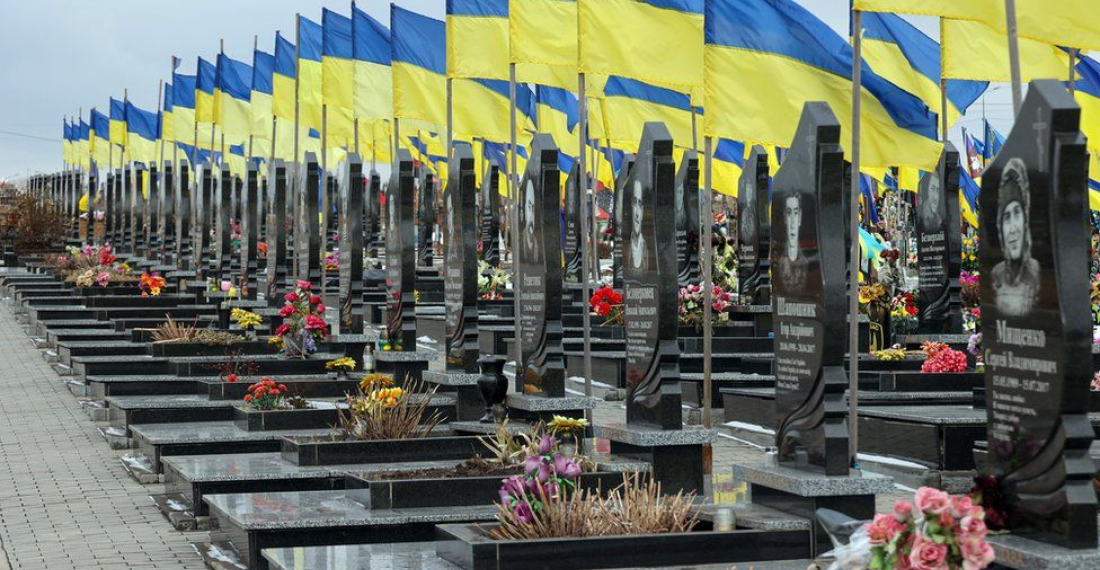
This week marks the fourth anniversary of Russia’s unprovoked attack and invasion of Ukraine, sparking a deadly European war. Despite the fact that only Ukrainian soldiers are fighting the Russian aggression, this war is a European war. Its outcome will have consequences throughout the continent.
This has been a deadly war. Tens of thousands of soldiers on both sides have been killed. Hundreds of thousands of Ukrainians have been displaced. The cost of the war unleashed by Vladimir Putin, in human, social and financial terms have been enormous, and cannot be accurately calculated as long as the fighting continues.
Ukraine
Ukraine and Russia share many common features. They also have a difficult history as Ukrainians have suffered from Russian unpleasantness many times. In February 2022 Putin persuaded himself that if he launched an all-out invasion of Ukraine, including occupying Kyiv, Ukrainians will rush to support him. They didn’t. Instead, from the first day, and to the surprise of all, including Western governments, they resisted, and Russia had to limit itself to the mainly Russian speaking areas of the Donbass. The heroic stand of the Ukrainians inspired the world, and after an embarrassing short pause, Europe threw its weight behind Ukraine.
Four years later, Ukrainians continue to fight heroically for every inch of the country’s territory. But there is no doubt that Ukraine is “damaged”. It needs the fighting to stop so that the process of healing can start.
Europe’s war
So far in this war the Ukrainians have done all the fighting to repel the Russian aggression. There are no body bags going back to Berlin, Paris, Brussels, or other European towns and villages. This has enabled the European public to remain detached, to pretend that this is not their war.
The harsh truth is that Europe was simply not prepared. Only now – and this has nothing to do with Donald Trump’s demands – European countries, and the European Union are rushing to fill the gaps in their defence postures.
Short of engaging in combat, European support for Ukraine -political, moral, social and financial - has been generous and consistent, enabling the Ukrainians to continue the struggle, to safeguard their country, and to safeguard Europe.
The European public has by and large, acquiesced to the resolute decisions of their governments and leaders, particularly when it came to providing funds for Ukraine. But we are warned against “Ukraine fatigue”. The mainstream media that in the beginning supported Europe’s sustaining of Ukraine, is increasingly restless. And Putin apologists, including one or two EU governments, persist in undermining European unity.
Four years after Russia’s unprovoked aggression against Ukraine to need for pan-European support for Kyiv is more important than ever. This support to be sustainable must also be at the level of people. More needs to be done, and fast, to ensure that the European public understands the Ukraine issue, and why its important for them.
Trump’s United States and Russia
Trump’s United States has betrayed Ukraine, and has betrayed Europe. Trump’s ambivalence towards Ukraine has empowered Putin, making him believe that victory was possible.
The war has had a huge cost to Russia. It has lost hundreds of thousands of soldiers; it has cost the Russian economy billions, and it has cut Russia off from Europe in no uncertain terms.
Russia is a big country, with plenty of resources. The losses it has suffered can be sustained. But its human, financial and other resources are not endless either, and there are indications that finally Putin has to start accepting these limitations.
The war must end; Ukraine must be rebuilt; relations with Russia have to be “reinvented”
The war in Ukraine must end this year! This can only happen if there is enough pressure on Putin’s Russia. Europe must sustain and increase its support for Ukraine. Fortunately leaders of the main European governments: France, Germany, UK and Poland are convinced of the importance of this, but they need to ensure the resolve of others, and of the European public.
The support of the US is essential. Trump can end the war, not by agreeing to Russia’s terms, but by increasing pressure on Russia. There is still widespread support for Ukraine in American body-politic. Now is the time to show it.
Ones the fighting stops the challenging task of rebuilding Ukraine – not just the infrastructure, but also the spirit of the Ukrainian nation – starts. In this Europe must lead, and EU accession is major and essential step that must happen quickly. Ukraine is a big country, damaged by war, and the EU will not digest it easily. For Europe however this is the ultimate test which it must pass honourable.
And finally, once the guns are silent, what to do with Russia? Russia is too big, too important, and too close, to be ignored. However, under Putin Russia will remain a danger for its neighbours, for Europe, and ultimately, for the world.
Relations with Russia will have to be re-invented. Europe must never again deal with Russia from a position of weakness or dependence. The decision of Finland and Sweden to abandon neutrality and join NATO, after the Russian invasion of Ukraine, has shown the way.
A strong Europe can open a new dialogue with Moscow. But after Ukraine, trust will take a long time to build.
source: Monday Commentary is written for commonspace.eu by Dr Dennis Sammut, Director of LINKS Europe, and Managing Editor of commonspace.eu
photo: War graves in Ukraine



