They say that a week is a long time in politics, and the time since the European Political Community (EPC) was established in October 2022, may now seem like an eternity. The war in Ukraine, that triggered the establishment of the EPC, drags on, and continues to define Europe. Everything else has changed.
When the EPC was established, many yawned, and saw it as yet another useless talking shop. But the idea of creating a framework that brings the 27 EU member states with other European countries – 20 at the last meeting – has increasing value. The attendance of the leaders of these 20 countries: Turkiye’s Erdogan, Ukraine’s Zelensky, UK’s Starmer, and others, has made its twice yearly meetings an important occasion.
The stated aims of the European Political Community are:
- strengthening the links between EU member states and non-EU member states who share the same European values,
- increasing cooperation between the member countries on a large scale of topics, such as peace, security, energy, climate, migration and the current economic situation,
- allowing candidate states to start taking part in some European projects, such as student and university exchanges.
Yet it is in one area: defence and security, where the biggest need of Europe currently is, and where the biggest potential of the EPC lays. The war in Ukraine, Russia’s malign intentions, and Trump’s reset of US foreign and security policy, focused minds. Europe had been sleeping! When it woke up it did what the EU does whenever it is faced with a problem, it threw money at it, and started a defence spending spree, that was overdue, but is not by itself enough. The EU27 may be a global economic force, but on their own they lack strategic clout. But if you add with them the other European countries such as Turkiye, UK, Ukraine, and even smaller ones such as Norway and Switzerland, it becomes a completely different preposition. Turkiye has a military of about half a million, is fast modernising its military machine, and is a long-standing NATO member; Ukraine has an army of around 800,000. It is battle-hardened from its war with Russia. When that ends it will become an important front-line state; the UK is a nuclear power; its armed forces are relatively small, around 140,000, but are considered highly professional. It also has a global vista, which EU countries with the exception of France, lack. They are three different countries, with very different perspectives. But all three have in the last days indicated that they understand that their future security strategy must be anchored in Europe.
Perhaps most surprising was hearing this from Turkiye. Turkiye’s able and eloquent foreign minister, Hakan Fidan speaking in an interview on al Jazeera English on Thursday (29 January) which focused mainly on Syria and Iran, spoke about the importance, and inevitability, of building a pan European system, independent of US, China and Russia. Days earlier, Ukraine’s president Zelensky spoke of Ukraine’s army being Europe’s army.
In the UK, Sir Keir Starmer, does not want to re-open the debate on Brexit. But he has carefully detached defence and security from the rest of the debate, putting relations with Europe and the EU on these issues, front and centre. Yesterday London’s Times newspaper reported that the UK will seek to work with SAFE, the European Defence Fund.
Under the surface, these discussions are going on even more intensively. But the European Political Community offers a space for conversations – public and private between the leaders of wider Europe. The value of the Community is therefore significant.
Armenia, 4 May 2026
The next EPC summit will be in Armenia on 4 May 2026. It will be important for a number of reasons: It will be a summit that should contribute to Armenia-Azerbaijan peace; it is not clear at what level will Azerbaijan participate, but for sure this will be a high level delegation. It will be the first EPC summit in Russia’s back yard – Armenia is still a member of the EAEU, and even if only on paper, of CSTO. The summit will take place on the eve of crucial parliamentary elections in Armenia that will determine the fate of the country and the region. But in the background will be the issue of how wider Europe can work together on defence and security. This will take time – probably not less than a decade – but the work has started, and the EPC summit in Armenia will contribute to it.
source: Dr Dennis Sammut is the Director of LINKS Europe, and Managing Editor of commonspace.eu
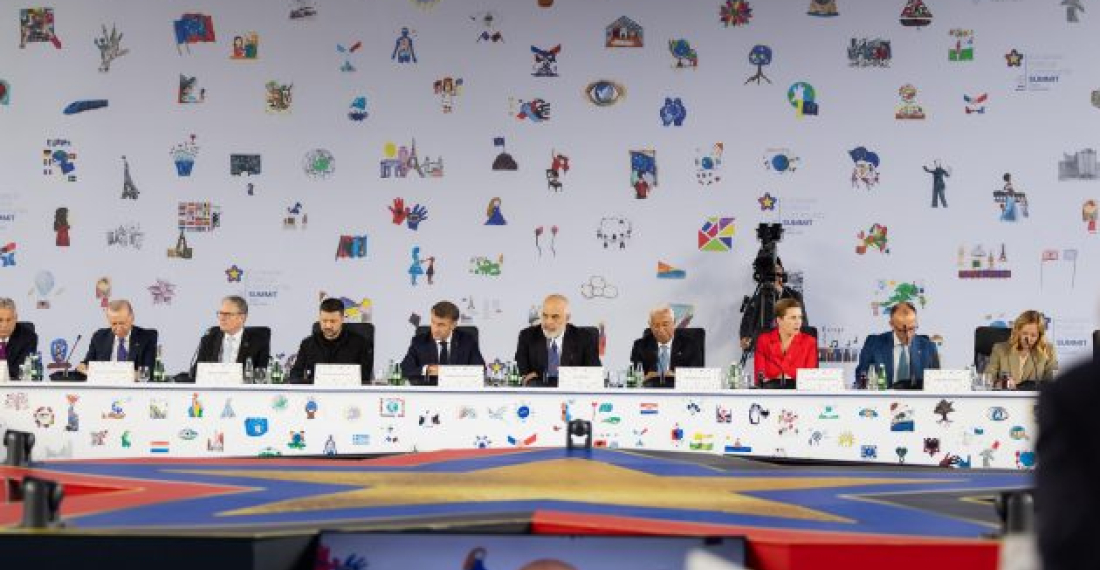
photo: The leaders of Turkiye, Ukraine and UK join EU leaders at the EPC summit in Tirana.