


Two ominous developments over the last days have cast a shadow over an otherwise peaceful election environment. It highlights the need for vigilance as Georgians prepare to go to the polls on 8 October. Caucasus Concise editorial team reflect on developments.
Given recent political history, and the macho culture that still prevails especially among young men, Georgia's election environment has been remarkably calm and peaceful. Anyone who says otherwise clearly has no sense of proportion, nor an understanding of recent Georgian history. There has been one serious incident, just before the start of the elections campaign, in May, in Kortskheli, in western Georgia. That was one incident too many, but fortunately subsequent incidents were small.
But vigilance remains necessary, on the part of the government, on the part of civil society, and on the part of the international community. The gains of the last two decades remain fragile.
Incidents of petty violence in Georgia tend to be sparked off on the smallest of pretexts, and they often quickly spiral into something more serious. The cause may be a family dispute, an argument about a girlfriend, or a business dispute. However, when the incidents have a political nature they have much more serious consequences and have an impact on wider society. For Georgia, therefore, there is no other choice but to adopt a zero tolerance to violence in politics.
As the election campaign started drawing to a close two stories have emerged which cause concern.
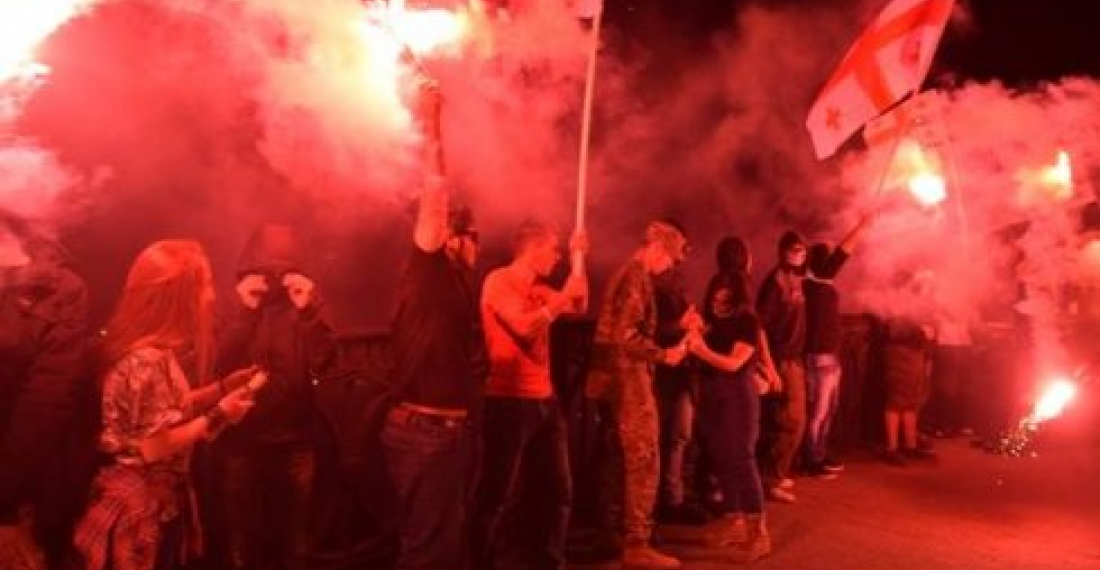
The first is the appearance of a group of young people, portraying themselves as ultra-rightists and under the name "Georgian Power". They had a presence on the internet for some weeks, and their Facebook page has more than 14,000 likes. Their rhetoric is nationalistic, xenophobic, anti Islamic and anti-semetic On Tuesday, they were joined by other small groups, including one calling itself "Eidelweiss", and dozens of their members took to the streets in an area which in recent years has seen a surge of foreign residents, mostly from muslim countries. There were some skirmishes with the police and eleven were arrested. Their appearance so close to the election is a cause of concern, especially since some of their rhetoric is uncomfortably close to election statements from one of the parties that aspires to be in the new parliament, Patriots' Alliance of Georgia. One of the main Georgian TV channels, Rustavi 2, pulled one of their adverts due to potentially xenophobic content.
(A picture on the "Eidelweiss" website (above) identifies the many "enemies" of the group. The site also carries a picture of Adolf Hitler.)
The second occurrence is potentially much more serious. A recording purported to be between former president Mikheil Saakashvili and leaders of the United National Movement was released online. In the conversation a scenario for the overthrow of the government "through revolution" is discussed. The government has taken the tape seriously and has opened an investigation. The UNM has dismissed the tape as a fabricated, and those who were supposedly participating in the conversation and who are still in Georgia have refused to go to be interviewed by the State Security Service, claiming they were too busy campaigning in the election to do so, offering to be interviewed at their party offices' instead. It will take time to ascertain the authenticity of the tape. If the tape is genuine, then both Saakashvili and his UNM partners will have much to answer for; if fabricated, those who have tried to use it against the UNM will have a great deal of egg on their collective faces.
Fringe groups with violent tendencies exist in many European countries. They are shunned by society and severely criticised by all mainstream political parties. The same needs to happen in Georgia. Such groups, no matter if they wrap themselves up in the national flag, support the national football team and play to public emotions have no place in the political arena, an arena that must be free of violence.
The question of the UNM is a different proposition. The UNM is a mainstream political party. It was the largest opposition party in the outgoing parliament. It is fighting the election with the aspiration of winning it and forming a government. Any hint that in parallel it is trying to seize power through any means other than the ballot box would be an act of self-immolation. Critics of the UNM say that it is trying to repeat the same scenario of 2003, when it led the so called "Rose Revolution" that ended the era of Edward Shevardnadze. However, Georgia in 2016 is not the Georgia of 2003. If the UNM has grievances about the conduct of the elections, then it needs to raise them in the courts, not in the streets.
The process of developing the Georgian political process into a mature and peaceful one is not easy but its importance for Georgia's future is huge. The guarantors of a peaceful political environment cannot be outsiders. Indeed, outsiders, be they politicians supporting their local allies, monitoring organisations observing the process, or civil society keen to uphold democratic standards, can help best by remaining measured in what they say. The Georgians themselves - civil society, media, activists and indeed the politicians - are the ones who must be the guarantors of a peaceful political environment by shunning anyone who tries to act otherwise. This is the essence of political maturity.
Speaking at a policy forum in the European parliament earlier this week the Georgian State Minister for European and Euro-Atlantic Integration, David Bakradze declared that the Georgian government will not allow anyone to use the forthcoming parliamentary elections to distabilise the country. (read report on the event here) Bakradze told more than one hundred MEPs, EU officials, diplomats and representatives of civil society and the business community gathered in Brussels, that for Georgia elections were no longer a challenge, but an opportunity. He said that how the election campaign is held, and how the election itself conducted, is just as important as the result of the election itself.
This is commendable. The proof of the pudding will be in the eating, and on 8 October the world will be able to judge that very pudding for itself.
This is a commentary prepared by the editorial team of Caucasus Concise.



