


Will "Sambo Diplomacy" work? Putin's new approach to resolving the Karabakh conflict.

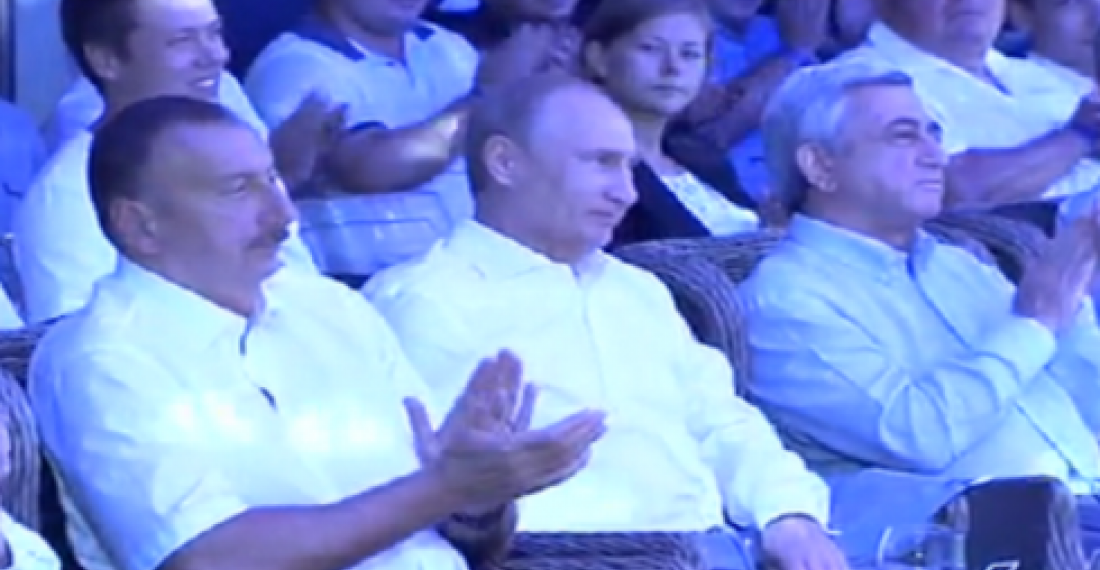
Russia's President Vladimir Putin on Saturday (9 August) hosted his Armenian and Azerbaijani counterparts to a Sambo Judo tournament in the city of Sochi. Earlier Putin held bilateral meetings with the two presidents where high on the agenda was the settlement of the Nagorno-Karabakh conflict.

The Russian president's press secretary, Dmitry Peskov, told journalists that a trilateral meeting between Russian President Vladimir Putin, Armenian President Serzh Sargsyan and Azerbaijani President Ilkham Aliev might take place.
"We are not ruling out that such a meeting may be held," Peskov said. During the meetings on Saturday "all the parties expressed concern with the growing tensions and the recent incidents (in Nagorno-Karabakh) which resulted in loss of life, which can be said to be numerous," Peskov said. He described the situation in Nagorno-Karabakh as unquiet and unstable.

The appearance of the three Presidents at the Sambo Tournament created a stir on social media sites. The word "SAMBO" is an acronym for SAMozashchita Bez Oruzhiya, which literally translates as "self-defense without weapons". Sambo has roots in Japanese judo, but was developed as a sport by the Soviet Army in the 1920s to help soldiers develop hand to hand combat. Some criticised the Presidents for appearing together at what looked like a jovial event so soon after the violence of the last days in the Nagorno-Karabaklh conflict zone, and without having yet made any progress in their talks. Others welcomed the appearance at the Sambo tournament as a positive sign.

If the trilateral meeting scheduled for today takes place, and if it succeeds, this would make it the first example of Sambo diplomacy in history.

source: commonspace.eu

photo: Presidents Aliev, Putin and Sargsyan at a Sambo Tournament event in Sochi on 9 August 2014. (Screen grab from Rossiya 2 TV).

 

Related articles

Editor's choice
News
International Election Observation Mission finds that Armenians were offered a genuine choice against a backdrop of direct foreign pressure and uneven campaign opportunities

International Election Observation Mission finds that Armenians were offered a genuine choice against a backdrop of direct foreign pressure and uneven campaign opportunities

Farah Karimi, Special Co-ordinator and leader of the short-term OSCE observer mission, said that: “The concentration of arrests and criminal prosecutions against opposition figures contributed to perceptions of selective justice, while a polarized media landscape, inflammatory rhetoric, misinformation, and persistent foreign pressure and interference challenged Armenia’s democratic resilience and the integrity of public debate. This underscores the importance of continued efforts to strengthen democratic institutions, safeguard fundamental freedoms, and foster public trust in democratic processes. ” Damien Cottier, Head of the delegation of the Parliamentary Assembly of the Council of Europe, argued that “The Armenian elections took place in a particularly tense geopolitical context, with direct foreign interference. In particular, pressure and threats from Russian authorities reached an unprecedented and worrying level.” Janez Lenarčič, head of the election observation mission from the OSCE Office for Democratic Institutions and Human Rights, stated that “Armenia’s voters were given – and took – the opportunity to make a genuine choice in a professionally managed election process and a vibrant and pluralistic, if often highly polarized campaign. “Unfortunately, they had to make that choice against the backdrop of unprecedented foreign interference and pressure, in the form of punitive trade measures and day-by-day threats of further negative consequences contingent on which choice they made”. == click image to read full report

Popular

Editor's choice
Interview
Thursday Interview: Murad Muradov

Thursday Interview: Murad Muradov

Today, commonspace.eu starts a new regular weekly series. THURSDAY INTERVIEW, conducted by Lauri Nikulainen, will host  persons who are thinkers, opinion shapers, and implementors in their countries and spheres. We start the series with an interview with Murad Muradov, a leading person in Azerbaijan's think tank community. He is also the first co-chair of the Action Committee for a new Armenian-Azerbaijani Dialogue. Last September he made history by being the first Azerbaijani civil society activist to visit Armenia after the 44 day war, and the start of the peace process. Speaking about this visit Murad Muradov said: "My experience was largely positive. My negative expectations luckily didn’t play out. The discussions were respectful, the panel format bringing together experts from Armenia, Azerbaijan, and Turkey was particularly valuable during the NATO Rose-Roth Seminar in Yerevan, and media coverage, while varied in tone, remained largely constructive. Some media outlets though attempted to represent me as more of a government mouthpiece than an independent expert, which was totally misleading.  Overall, I see these initiatives as important steps in rebuilding trust and normalising professional engagement. The fact that soon a larger Azerbaijani civil society visits to Armenia followed, reinforces the sense that this process is moving in the right direction." (click the image to read the interview in full)

