Region

Global

Stories in this section cover various issues and stories from all around the world.

Editor's choice
News
NATO Chief says war is on Europe's doorstep, and warns against complacency

NATO Chief says war is on Europe's doorstep, and warns against complacency

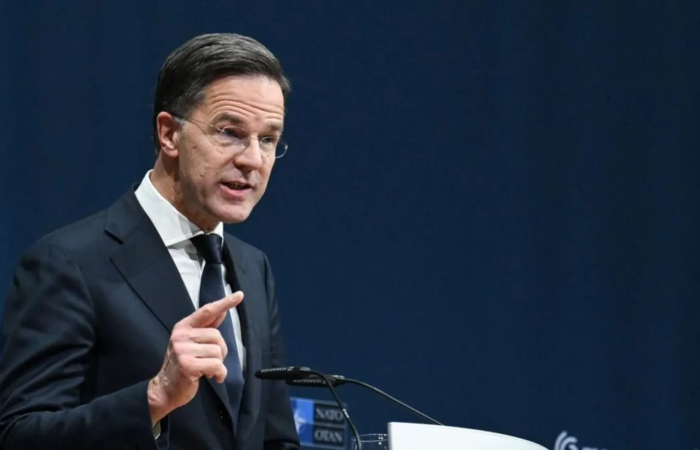
Russia could attack a NATO country within the next five years, the Secretary General of NATO, Mark Rutte, said in a stark new warning. "NATO's own defences can hold for now," Rutte warned in Berlin, but conflict was "next door" to Europe, and he feared "too many are quietly complacent, and too many don't feel the urgency, too many believe that time is on our side. "Russia is already escalating its covert campaign against our societies," Rutte said in a speech in Germany. "We must be prepared for the scale of war our grandparents or great-grandparents endured." Earlier this month, Russia's President Vladimir Putin said his country was not planning to go to war with Europe, but it was ready "right now" if Europe wanted to - or started a war. But similar reassurances were given by Moscow in 2022, just before 200,000 Russian troops crossed the border and invaded Ukraine. Putin has accused European countries of hindering US efforts to bring peace in Ukraine - a reference to the role Ukraine's European allies have recently played in trying to change a US peace plan to end the war, whose initial draft was seen as favouring Russia. But Putin was not sincere, Nato's secretary-general said in the German capital, Berlin. Supporting Ukraine, he added, was a guarantee for European security. "Just imagine if Putin got his way; Ukraine under the boot of Russian occupation, his forces pressing against a longer border with Nato, and the significantly increased risk of an armed attack against us." Russia's economy has been on a war footing for more than three years now - its factories churn out ever more supplies of drones, missiles and artillery shells. According to a recent report by the Kiel Institute for the World Economy, Russia has been producing each month around 150 tanks, 550 infantry fighting vehicles, 120 Lancet drones and more than 50 artillery pieces. The UK, and most of its Western allies, are simply not anywhere near this point. Analysts say it would take years for Western Europe's factories to come close to matching Russia's mass-production of weapons. "Allied defence spending and production must rise rapidly, our armed forces must have what they need to keep us safe," the Nato chief said.
Editor's choice
News
Thai-Cambodia border clashes enter fourth day

Thai-Cambodia border clashes enter fourth day

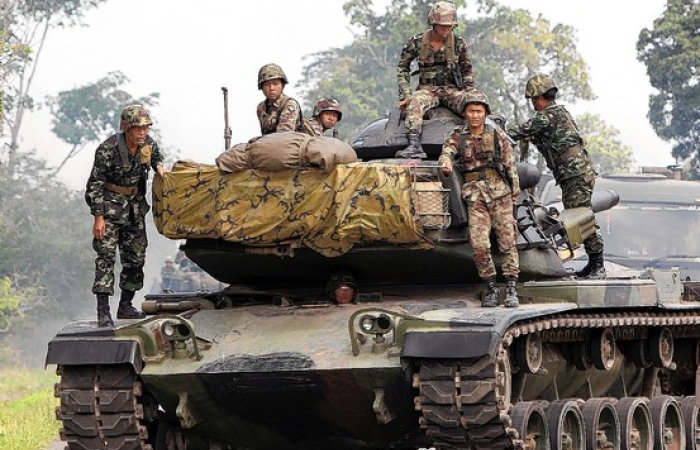
Renewed fighting between Thailand and Cambodia has entered its fourth day, with both sides accusing one another of violating international law, as they await a promised phone call from United States President Donald Trump. Cambodia’s Ministry of Defence accused Thailand’s military of carrying out numerous attacks within the country in the early hours of Thursday morning, including deploying tanks and artillery to strike targets in the country’s Pursat, Banteay Meanchey, and Oddar Meanchey provinces. In one such attack, Cambodia accused Thai soldiers of violating international humanitarian law by firing on civilians in Prey Chan village in Banteay Meanchey province. In another, it accused Thai forces of shelling “into Khnar Temple area”, and said Thai forces had also “fired artillery and support fire into the O’Smach area”. “Cambodia urges that Thailand immediately stop all hostile activities and withdraw its forces from Cambodia’s territorial integrity, and avoid acts of aggression that threaten peace and stability in the region,” the Defence Ministry said. Clashes took place on Wednesday at more than a dozen locations along the contested colonial-era demarcated 817-kilometre (508-mile) Thai-Cambodian border, with some of the most intense fighting being reported since a five-day battle in July, which saw dozens killed on both sides. Cambodia’s Ministry of the Interior said homes, schools, roads, Buddhist pagodas and ancient temples had been damaged by “Thailand’s intensified shelling and F-16 air strikes targeting villages and civilian population centres up to 30km [18.6 miles] inside Cambodian territory”. (click the image to read the full story).

Filter archive

Publication date
Editor's choice
Monday Commentary
Monday Commentary: Let sports unite us

Monday Commentary: Let sports unite us

The 2022 FIFA World Cup opened in Doha on Sunday (20 November) with a lavish half an hour opening ceremony full of music and colour. It will be followed by weeks of football extravaganza that millions are looking forward to watching. It was a proud moment for the small Arab Gulf country which has put a lot of effort and resources towards making the event a success, writes Dennis Sammut in today's Monday Commentary on commonspace.eu. Ever since it was decided to hold the FIFA world cup in Qatar there have been those who questioned the decision. Some said the climate was too hot; others criticised the working conditions of the labour force that built the facilities; others questioned Qatar's human rights record, especially on gay rights. Some of the criticism was justified. The world cup helped put attention to such problems and that is how it should be. But frankly, a lot of the criticism of Qatar went over the top and reeked of racism. Qatar has its shortcomings, but the hundreds of thousands of people who flock there to work, and others who just visit, appreciate it for what it is: a young nation that is trying to play a positive role in the world and to offer opportunity for work and business to whoever wants to work with it. It is ofcourse easy to say that sports and politics do not mix. Since sports is an expression of human talent and human feelings politics cannot be excluded. It needs to be managed. People watching football do not need expressions of political opinions shoved down their throats. Many even find such expressions as an insult to their intelligence. But that does not mean that the occasion of a global sports event cannot be a way of transmitting a dignified message with political connotations. One such example happened yesterday when the captain of the Iranian team sent a message to his compatriots back home.
Editor's choice
News
Divisions over Ukraine haunt the G20 summit in Indonesia

Divisions over Ukraine haunt the G20 summit in Indonesia

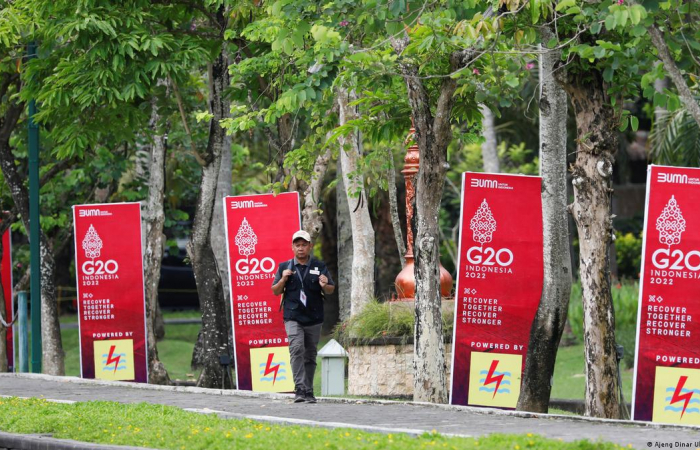
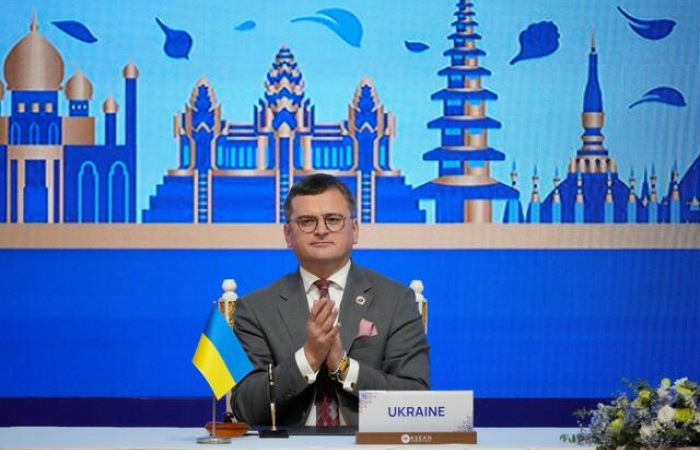
Leaders of the G20 countries are meeting on the Indonesian island of Bali, with the war in Ukraine casting a shadow on the proceedings. Indonesia, the world’s fourth-most populous country and Southeast Asia’s largest economy, is hosting the summit under the theme “Recover together, recover stronger” in the wake of the coronavirus pandemic and its economic consequences. Analysts expect the war in Ukraine to feature prominently in the summit’s final communique, despite calls by the Indonesian hosts for dialogue and collaboration to resolve global economic problems such as inflation, and food and energy security. News agencies reported on Tuesday that leaders of the world’s largest economies appeared ready to convey a strong message condemning Russia’s invasion of Ukraine, though the draft declaration would still need to be approved by all the group’s members. Established in 1999 in the wake of the Asian financial crisis, the G20 was originally intended to foster global economic cooperation. But it has since morphed into a forum addressing urgent world problems. This year’s focus was on health infrastructure and food security. The annual leaders’ summit also serves as an opportunity for informal diplomatic exchanges, as heads of state participate in bilateral talks on the sidelines of the big meeting.
Editor's choice
Monday Commentary
Commentary: American mid-term elections enable continued strong US leadership at a time of global turmoil

Commentary: American mid-term elections enable continued strong US leadership at a time of global turmoil

The US mid-term elections held last week were expected to be a disaster for US president Joe Biden and his Democratic administration. A Republican surge was expected to sweep the party to comfortable majorities in both the Senate and the House of Representatives. In the end none of this happened. The outcome of the election means that the gridlock that some had been predicting between President and Congress on many issues, including foreign and security policy is now not likely to happen, or in any case not on a scale to be a concern. In this Monday Commentary for commonspace.eu Dennis Sammut says that this is important not only for the United States, but also for the world. The current global situation is complicated and challenging, and US leadership is needed more than ever. Leadership is not hegemony. Nobody wants the US to dictate and impose its views on the world. Multipolarity, which some speak so enthusiastically about, should not be about how many nuclear missiles countries can point on each other, but rather on a competition of ideas and models. In this the world needs diversity. Yes, there are universal values, and these are already recognised in a number of documents adopted by nearly all countries, but on many issues there is room, and even need, for diversity.
Editor's choice
News
Did Russia give Iran the technology for a hypersonic ballistic missile?

Did Russia give Iran the technology for a hypersonic ballistic missile?

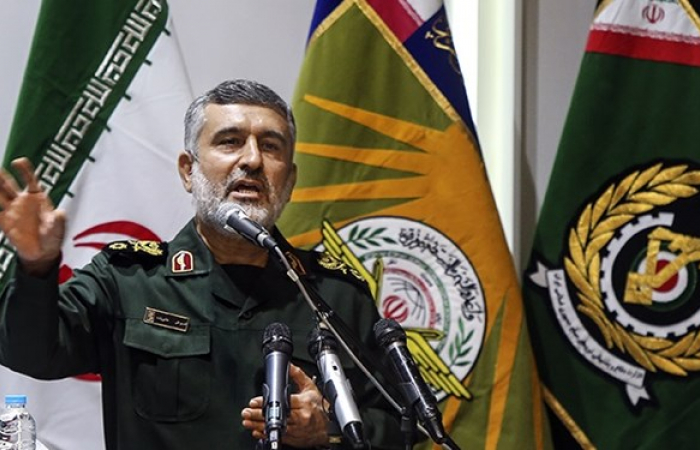
Iran has announced that it has developed a hypersonic ballistic missile Iran’s Fars news agency quoted the Islamic Revolution Guards Corps (IRGC) Aerospace Commander Brigadier General Amir Ali Hajizadeh as saying on Thursday (10 November) that the country has manufactured a hypersonic ballistic missile with advanced technologies that can penetrate all types of advanced air defence systems. Speaking to reporters Brig. Gen. Hajizadeh said “The missile can target the enemy’s anti-missile systems and is a great generational leap in the missile field”. “I don’t think any technology would be found for tens of years capable of countering it,” the IRGC commander declared. The announcement appears to have taken defence analysts by surprise, and concern has been expressed in different quarters Hypersonic missiles can deliver nuclear weapons in the same way as traditional ballistic missiles, but they can fly at more than five times the speed of sound and are highly maneuverable, making them impossible to track and defend against. Unlike ballistic missiles, hypersonic missiles fly on a low trajectory in the atmosphere, and are able to reach targets more quickly. Several countries have developed systems designed to defend against cruise and ballistic missiles, but the ability to track and take down a hypersonic missile remains elusive. Iran’s claim to have developed such a missile raises the question of where Tehran obtained the technology.
Editor's choice
News
Blinken hosts Armenian and Azerbaijan counterparts for talks about peace

Blinken hosts Armenian and Azerbaijan counterparts for talks about peace

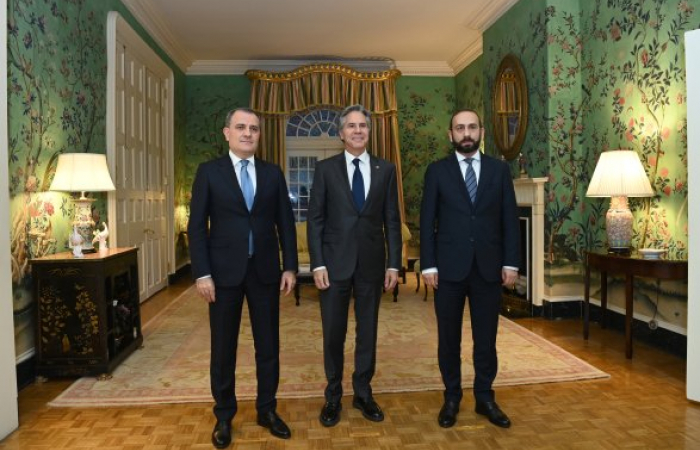
US Secretary of State, Antony Blinken, on Monday hosted at Blair House in Washington DC, talks with his Armenian and Azerbaijani counterparts, foreign minister Ararat Mirzoyan and foreign minister Bayramov. The ministers exchanged views on the elements of a possible peace agreement, noting that there were a number of outstanding issues. Both sides reaffirmed the commitments made by the leaders of Azerbaijan and Armenia at the meetings held on October 6 in Prague and October 31 in Sochi. Bayramov and Mirzoyan also agreed to speed up negotiations and hold another meeting in the coming weeks. Both ministers thanked the American side for hosting the peace talks between Azerbaijan and Armenia.