


Commentary: American mid-term elections enable continued strong US leadership at a time of global turmoil

The US mid-term elections held last week were expected to be a disaster for US president Joe Biden and his Democratic administration. A Republican surge was expected to sweep the party to comfortable majorities in both the Senate and the House of Representatives. In the end none of this happened. The outcome of the election means that the gridlock that some had been predicting between President and Congress on many issues, including foreign and security policy is now not likely to happen, or in any case not on a scale to be a concern. In this Monday Commentary for commonspace.eu Dennis Sammut says that this is important not only for the United States, but also for the world. The current global situation is complicated and challenging, and US leadership is needed more than ever. Leadership is not hegemony. Nobody wants the US to dictate and impose its views on the world. Multipolarity, which some speak so enthusiastically about, should not be about how many nuclear missiles countries can point on each other, but rather on a competition of ideas and models. In this the world needs diversity. Yes, there are universal values, and these are already recognised in a number of documents adopted by nearly all countries, but on many issues there is room, and even need, for diversity.

The US mid-term elections held last week were expected to be a disaster for US president Joe Biden and his Democratic administration. A Republican surge was expected to sweep the party to comfortable majorities in both the Senate and the House of Representatives. In the end none of this happened. The Democrats maintained control of the Senate, and although they may have lost their majority in the House, it is likely to be by the narrowest of margins, which would still allow many deals to be made on a bi-partisan level.

The reasons for this have been analysed in detail by many experts and observers: the Trump factor, the threat to the right of choice on abortion; mixed economic realities, etc.

But whatever the reasons, the outcome of the election means that the gridlock that some had been predicting between President and Congress on many issues, including foreign and security policy is now not likely to happen, or in any case not on a scale to be a concern.

This is important not only for the United States, but also for the world. The current global situation is complicated and challenging, and US leadership is needed more than ever. Yes, Europe can and should in the future share in both the leadership role, and the responsibilities that go with it, but the EU is not ready for this yet, so that role for some time yet needs to be continued to be played by the United States.

Leadership is not hegemony. Nobody wants the US to dictate and impose its views on the world. Multipolarity, which some speak so enthusiastically about, should not be about how many nuclear missiles countries can point on each other, but rather on a competition of ideas and models. In this the world needs diversity. Yes, there are universal values, and these are already recognised in a number of documents adopted by nearly all countries, but on many issues there is room, and even need, for diversity.

If leadership is not hegemony, what is it?

It is first about the willingness and ability to galvanise and mobilise the international community at a time of crisis. The US, and the EU, have been doing that on Ukraine this year. It meant standing up to Russia.

Leadership is also about leading from the front, by example, by policies, and by resources, on key global issues such as climate change.

Leadership is about being on the forefront in promoting and supporting a rules-based international system.

The Biden administration has shown it can do this. Even taking into account the doubtful decision to withdraw, many say prematurely, from Afghanistan, its track record to date has been overall positive.

Joe Biden can sometimes look like a confused president, confusing Cambodia with Colombia and other slips of the tongue. But in fact he has a grip on his foreign policy brief, and even more importantly, he has a dynamic and effective foreign policy team not seen in the US for some time. This team has projected an image of a US foreign policy that is coherent, co-ordinated and effective. It has built bridges with allies, that had been all but destroyed during the Trump years. In short, it has provided leadership at a crucial time in world history.

The new Congress will not change that very much. There may be a nuance here or there, but overall we expect the next two years of Biden to be continuity of the last two. For many world leaders who have come to depend on US leadership, that is a relief. But the US can be neither complacent nor arrogant. The current situation demands hard work and a humility in engaging with the international community which would allow for broad consensus on key global issues to emerge, and for spoilers in the international system, for example Russia, to be challenged.
 

Source: Dr Dennis Sammut is Managing Editor of commonspace.eu and Director of LINKS Europe based in The Hague. He writes regularly on European and international security issues, the EU’s policy and strategy towards its neighbourhood and Gulf affairs. (director@links-europe.eu)
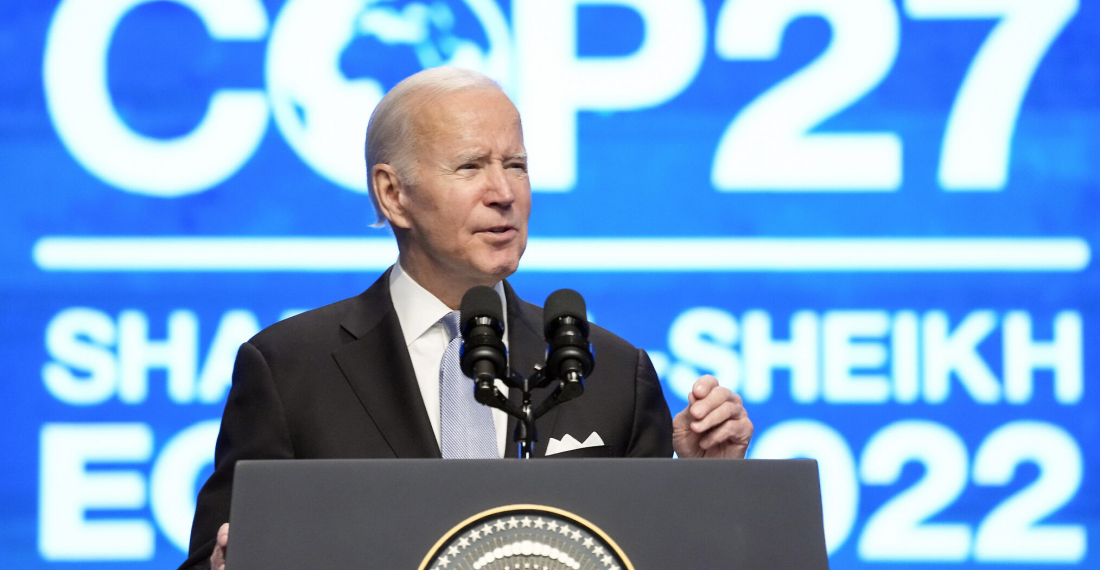
Photo: US president Joe Biden, emboldened by the results of the mid-term elections travelled to Sharm El Sheikh in Egypt last week to address the COP27 conference on climate change.
Monday Commentary is a personal opinion, and does not necessarily reflect the views of commonspace.eu or its partners and supporters

Related articles

Editor's choice
News
Council of Europe launches new International Claims Commission for Ukraine

Council of Europe launches new International Claims Commission for Ukraine

Thirty-four countries and the European Union have signed a new convention establishing an International Claims Commission for Ukraine at a diplomatic conference co-hosted by the 46-nation Council of Europe and the Netherlands in the Hague. The diplomatic conference was attended by leaders and high-level representatives from over 50 states, including the President of Ukraine, Volodymyr Zelenskyy, the President of the Republic of Moldova, Maia Sandu, and the Prime Minister of the Netherlands, Dick Schoof.  “Today marks a major step forward in ensuring accountability for Ukraine. The International Claims Commission represents justice and hope for tens of thousands of victims—our determination that those who have suffered will not be forgotten. I call for quick ratifications so we can get the commission rapidly up and running for the people of Ukraine,” said Council of Europe Secretary General Alain Berset. Ukrainian President Volodymyr Zelenskyy said: “We expect that every mechanism for compensation from the Register of Damage and Claims Commission to the actual payments – will start working and receive strong and sufficient international support, so that people can truly feel that any kind of damage caused by the war can be compensated. This war, and Russia’s responsibility for it, MUST become a clear example – so that others learn not to choose aggression.” “Accountability is about creating the conditions for peace that endures. And therefore, accountability is a condition of security – today and for the future. But accountability is not only about Ukraine. And it is not only about one aggressor and one victim. Accountability is about Europe. About every country in Europe. It is about whether Europe, as a whole, is willing to defend its peace,” said Maia Sandu, President of the Republic of Moldova, which currently holds the Presidency of the Council of Europe’s Committee of Ministers. The Prime Minister of the Netherlands, Dick Schoof, said: “Every day Russia is deliberately bombarding homes, destroying businesses and damaging infrastructure in Ukraine. Russia must compensate Ukraine for the damage caused. That is why we have launched the International Claims Commission for Ukraine and we are honoured to host it.” The International Claims Commission will be the second part of a comprehensive compensation mechanism related to Russia’s war of aggression, building on the existing Register of Damage for Ukraine. The claims commission will be established within the framework of the Council of Europe and will also be open to other countries. The Register of Damage for Ukraine, created in 2023, collects and records compensation claims submitted by individuals, organisations and public bodies in Ukraine. Forty-four states and the European Union have so far joined the Register, which has already received 86,000 claims. The International Claims Commission will review, assess and decide upon claims submitted to the Register of Damage for Ukraine and determine the amount of compensation, if any, which is due in each case. The convention establishing the commission will enter into force once it has been ratified by 25 signatories, as long as sufficient funds have been secured to support its initial work.

Popular

Editor's choice
News
Council of Europe launches new International Claims Commission for Ukraine

Council of Europe launches new International Claims Commission for Ukraine

Thirty-four countries and the European Union have signed a new convention establishing an International Claims Commission for Ukraine at a diplomatic conference co-hosted by the 46-nation Council of Europe and the Netherlands in the Hague. The diplomatic conference was attended by leaders and high-level representatives from over 50 states, including the President of Ukraine, Volodymyr Zelenskyy, the President of the Republic of Moldova, Maia Sandu, and the Prime Minister of the Netherlands, Dick Schoof.  “Today marks a major step forward in ensuring accountability for Ukraine. The International Claims Commission represents justice and hope for tens of thousands of victims—our determination that those who have suffered will not be forgotten. I call for quick ratifications so we can get the commission rapidly up and running for the people of Ukraine,” said Council of Europe Secretary General Alain Berset. Ukrainian President Volodymyr Zelenskyy said: “We expect that every mechanism for compensation from the Register of Damage and Claims Commission to the actual payments – will start working and receive strong and sufficient international support, so that people can truly feel that any kind of damage caused by the war can be compensated. This war, and Russia’s responsibility for it, MUST become a clear example – so that others learn not to choose aggression.” “Accountability is about creating the conditions for peace that endures. And therefore, accountability is a condition of security – today and for the future. But accountability is not only about Ukraine. And it is not only about one aggressor and one victim. Accountability is about Europe. About every country in Europe. It is about whether Europe, as a whole, is willing to defend its peace,” said Maia Sandu, President of the Republic of Moldova, which currently holds the Presidency of the Council of Europe’s Committee of Ministers. The Prime Minister of the Netherlands, Dick Schoof, said: “Every day Russia is deliberately bombarding homes, destroying businesses and damaging infrastructure in Ukraine. Russia must compensate Ukraine for the damage caused. That is why we have launched the International Claims Commission for Ukraine and we are honoured to host it.” The International Claims Commission will be the second part of a comprehensive compensation mechanism related to Russia’s war of aggression, building on the existing Register of Damage for Ukraine. The claims commission will be established within the framework of the Council of Europe and will also be open to other countries. The Register of Damage for Ukraine, created in 2023, collects and records compensation claims submitted by individuals, organisations and public bodies in Ukraine. Forty-four states and the European Union have so far joined the Register, which has already received 86,000 claims. The International Claims Commission will review, assess and decide upon claims submitted to the Register of Damage for Ukraine and determine the amount of compensation, if any, which is due in each case. The convention establishing the commission will enter into force once it has been ratified by 25 signatories, as long as sufficient funds have been secured to support its initial work.

