Divisions over Ukraine haunt the G20 summit in Indonesia

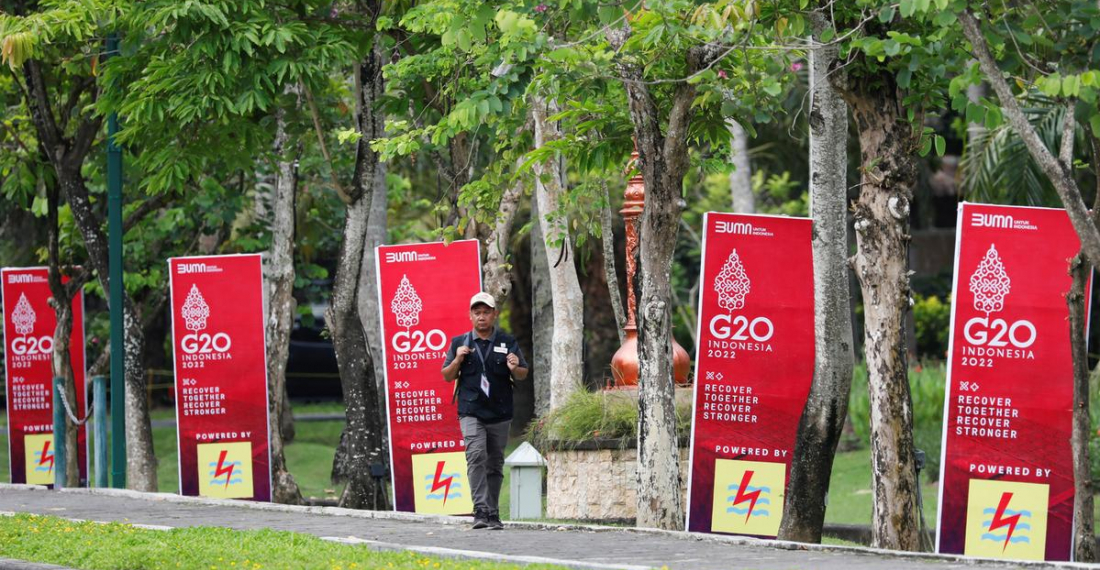
Leaders of the G20 countries are meeting on the Indonesian island of Bali, with the war in Ukraine casting a shadow on the proceedings.

Indonesia, the world’s fourth-most populous country and Southeast Asia’s largest economy, is hosting the summit under the theme “Recover together, recover stronger” in the wake of the coronavirus pandemic and its economic consequences.

Although the summit’s official focus is on financial stability, health, sustainable energy, and digital transformation, host Indonesia faces another layer of complexity as it tries to bridge rifts within the G20 over the war in Ukraine. Joko Widodo, the Indonesian president, acknowledged the mood during his opening remarks on Tuesday, just before the closed-door discussions began. “I understand we need huge efforts to be able to sit together in this room,” he said, while calling for collaboration among countries. He pointed out that the world could not afford to fall into “another Cold War,” adding that nations must work to “end the war.” He said: “Today, the eyes of the world are on our meeting. Will we score success? Or will we add one more to the list of failures? For us, G20 must succeed and cannot fail.”

Seventeen G20 leaders are attending this week’s summit, including US President Joe Biden, Chinese President Xi Jinping, French President, Emanuel Macron, German Chancellor Olaf Sholz, Turkish president Recip Tayip Erdogan and Saudi Crown Prince Mohammed bin Salman. Conspicuous by his absence is Russian president Vladimir Putin, who stayed away according to reports, because of fear he may be snubbed by other world leaders.

Indonesia also invited other nations and international organizations to take part, adding to a long list of world leaders that includes Dutch prime minister, Mark Rutte, UAE President Mohammed bin Zayed Al-Nahyan and Singaporean Prime Minister Lee Hsien Loong.

Volodymyr Zelensky, the president of Ukraine, addressed G20 leaders via video link on the summit’s first day, in which he shared his optimism that the conflict’s end could be in sight.

Analysts expect the war to feature prominently in the summit’s final communique, despite calls by the Indonesian hosts for dialogue and collaboration to resolve global economic problems such as inflation, and food and energy security.

News agencies reported on Tuesday that leaders of the world’s largest economies appeared ready to convey a strong message condemning Russia’s invasion of Ukraine, though the draft declaration would still need to be approved by all the group’s members.

Established in 1999 in the wake of the Asian financial crisis, the G20 was originally intended to foster global economic cooperation. But it has since morphed into a forum addressing urgent world problems. This year’s focus was on health infrastructure and food security.

The annual leaders’ summit also serves as an opportunity for informal diplomatic exchanges, as heads of state participate in bilateral talks on the sidelines of the big meeting.

source: commonspace.eu with agencies


Related articles

Editor's choice
News
Germany accuses Russia of cyberattacks and disinformation campaign

Germany accuses Russia of cyberattacks and disinformation campaign

The German government holds Russia responsible for a cyberattack on German air traffic control, and for targeted disinformation campaigns before the last federal election. According to the German Foreign Office in Berlin, the incidents could be clearly attributed to the Russian military intelligence service, the GRU. In response, the Russian ambassador to Berlin was summoned to the Foreign Ministry. "We have been observing a massive increase in threatening hybrid activities by Russia for some time now," a spokesperson for the Foreign Ministry stated. These range from disinformation campaigns and espionage to cyberattacks and sabotage attempts. The aim is to divide society, sow distrust, and undermine confidence in democratic institutions. The spokesperson added that with these actions, Russia is "very concretely threatening our security, not only through its war of aggression against Ukraine, but also here in Germany."  The Foreign Ministry spokesperson explained that the cyberattack on air traffic control in August 2024 was clearly attributed to the hacker collective "APT28," known as "Fancy Bear," and to the responsibility of the Russian military intelligence service, the GRU. Furthermore, it could now be "conclusively stated" that Russia had attempted "to influence and destabilize both the last Federal election and the ongoing internal affairs of the Federal Republic of Germany." There was "absolutely irrefutable evidence" for this". The so-called "Storm 1516" campaign, which has been running since 2024, is allegedly backed by "reliable information" that the Moscow-based think tank "Center for Geopolitical Expertise" is behind it. The Center is also said to be supported by Russian military intelligence. Its primary aim is to influence democratic elections in the West. (Click the image to read more).
Editor's choice
News
NATO Chief says war is on Europe's doorstep, and warns against complacency

NATO Chief says war is on Europe's doorstep, and warns against complacency

Russia could attack a NATO country within the next five years, the Secretary General of NATO, Mark Rutte, said in a stark new warning. "NATO's own defences can hold for now," Rutte warned in Berlin, but conflict was "next door" to Europe, and he feared "too many are quietly complacent, and too many don't feel the urgency, too many believe that time is on our side. "Russia is already escalating its covert campaign against our societies," Rutte said in a speech in Germany. "We must be prepared for the scale of war our grandparents or great-grandparents endured." Earlier this month, Russia's President Vladimir Putin said his country was not planning to go to war with Europe, but it was ready "right now" if Europe wanted to - or started a war. But similar reassurances were given by Moscow in 2022, just before 200,000 Russian troops crossed the border and invaded Ukraine. Putin has accused European countries of hindering US efforts to bring peace in Ukraine - a reference to the role Ukraine's European allies have recently played in trying to change a US peace plan to end the war, whose initial draft was seen as favouring Russia. But Putin was not sincere, Nato's secretary-general said in the German capital, Berlin. Supporting Ukraine, he added, was a guarantee for European security. "Just imagine if Putin got his way; Ukraine under the boot of Russian occupation, his forces pressing against a longer border with Nato, and the significantly increased risk of an armed attack against us." Russia's economy has been on a war footing for more than three years now - its factories churn out ever more supplies of drones, missiles and artillery shells. According to a recent report by the Kiel Institute for the World Economy, Russia has been producing each month around 150 tanks, 550 infantry fighting vehicles, 120 Lancet drones and more than 50 artillery pieces. The UK, and most of its Western allies, are simply not anywhere near this point. Analysts say it would take years for Western Europe's factories to come close to matching Russia's mass-production of weapons. "Allied defence spending and production must rise rapidly, our armed forces must have what they need to keep us safe," the Nato chief said.

Popular

Editor's choice
News
Germany accuses Russia of cyberattacks and disinformation campaign

Germany accuses Russia of cyberattacks and disinformation campaign

The German government holds Russia responsible for a cyberattack on German air traffic control, and for targeted disinformation campaigns before the last federal election. According to the German Foreign Office in Berlin, the incidents could be clearly attributed to the Russian military intelligence service, the GRU. In response, the Russian ambassador to Berlin was summoned to the Foreign Ministry. "We have been observing a massive increase in threatening hybrid activities by Russia for some time now," a spokesperson for the Foreign Ministry stated. These range from disinformation campaigns and espionage to cyberattacks and sabotage attempts. The aim is to divide society, sow distrust, and undermine confidence in democratic institutions. The spokesperson added that with these actions, Russia is "very concretely threatening our security, not only through its war of aggression against Ukraine, but also here in Germany."  The Foreign Ministry spokesperson explained that the cyberattack on air traffic control in August 2024 was clearly attributed to the hacker collective "APT28," known as "Fancy Bear," and to the responsibility of the Russian military intelligence service, the GRU. Furthermore, it could now be "conclusively stated" that Russia had attempted "to influence and destabilize both the last Federal election and the ongoing internal affairs of the Federal Republic of Germany." There was "absolutely irrefutable evidence" for this". The so-called "Storm 1516" campaign, which has been running since 2024, is allegedly backed by "reliable information" that the Moscow-based think tank "Center for Geopolitical Expertise" is behind it. The Center is also said to be supported by Russian military intelligence. Its primary aim is to influence democratic elections in the West. (Click the image to read more).