


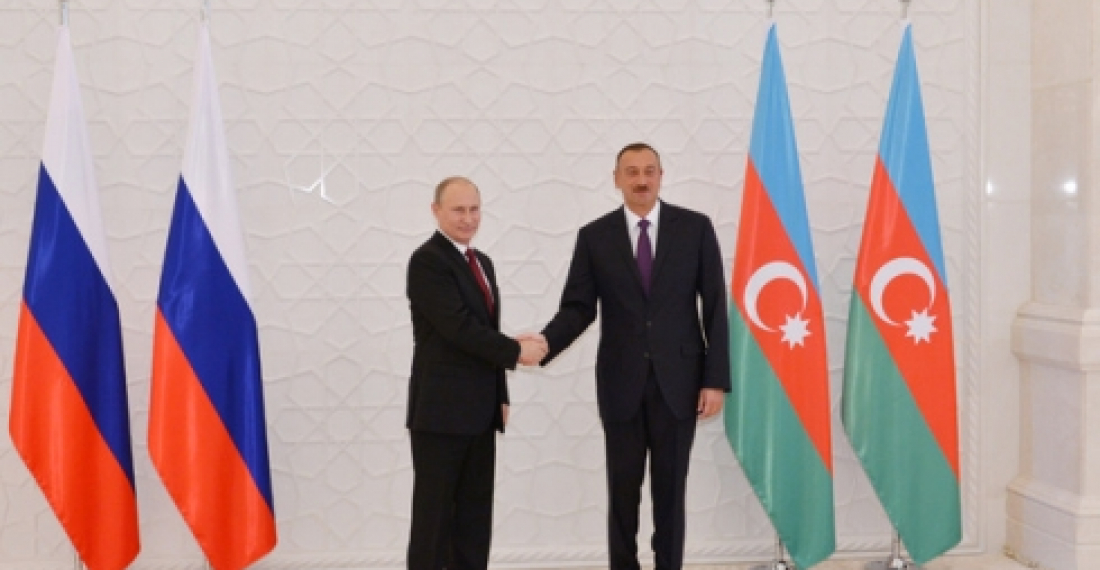
Putin says Karabakh conflict should be solved through political means.

The Russian President Vladimir Putin arrived in Baku on Tuesday at the head of a powerful delegation of Ministers and State officials for talks with President Ilham Aliev and members of the Azerbaijani Government. This  visit is seen as one of the most important efforts by Russia in recent years to reach out towards Azerbaijan. Relations with the two countries have often been strained because of perceived Russian support for Armenia.

Coinciding with the visit of the Russian leader, ships of the Caspian Flotilla of the Russian Navy also anchored in the Port of Baku on what has been described as a friendship visit.

Speaking to journalists after their meeting the two Presidents emphasised the closeness of Russian-Azerbaijani relations. President Aliev said that in the discussions Russian and Azerbaijani positions coincided on all issues. On his part President Putin praised the level of relations between the two countries and said there was potential to do more in many spheres.

President Putin also spoke about the Nagorno-Karabakh conflict and said that Russia was helping to find a solution to this conflict, and that the only way to solve the conflict was through political means. The Russian leader also expressed hope that progress will be made in discussions on the delineation of boundaries in the Caspian Sea and other issues related to environmental challenges in the Caspian.

source: Commonspace.eu with agencies.

photo: President Putin and President Aliev at the start of their talks in Baku on 13 August 2013. (picture courtesy of the Press Office of the President of Azerbaijan.)

Related articles

Editor's choice
News
Despite crisis, Lebanon takes the lead to become first country in the Middle East to abolish the death penalty

Despite crisis, Lebanon takes the lead to become first country in the Middle East to abolish the death penalty

Lebanon's parliament has voted to abolish the death penalty, a move that would make it the first country in the Middle East to formally end capital punishment. A majority of MPs in the 128-seat parliament backed the measure on Tuesday (11 August), while Hezbollah's parliamentary bloc voted against it. The legislation will now go to the cabinet before being passed to President Joseph Aoun for signing. The government has already expressed its support for the measure. Lebanon has not carried out an execution since January 2004, although courts have continued to hand down death sentences. Rights groups estimate that more than 78 people remain on death row. Under the new legislation, capital punishment will be replaced with life imprisonment with hard labour. However, the legislation does not yet set out in detail how the new sentence would be enforced. Hard labour is already written into Lebanese law but has rarely been implemented in recent years. The country's financial crisis and overcrowded prisons have limited the authorities' resources and capacity. The latest legislation follows years of campaigning by civil society groups and lawyers for the removal of capital punishment from Lebanese law. (click image to read more)

Popular

Editor's choice
Interview
Thursday Interview: Murad Muradov

Thursday Interview: Murad Muradov

Today, commonspace.eu starts a new regular weekly series. THURSDAY INTERVIEW, conducted by Lauri Nikulainen, will host  persons who are thinkers, opinion shapers, and implementors in their countries and spheres. We start the series with an interview with Murad Muradov, a leading person in Azerbaijan's think tank community. He is also the first co-chair of the Action Committee for a new Armenian-Azerbaijani Dialogue. Last September he made history by being the first Azerbaijani civil society activist to visit Armenia after the 44 day war, and the start of the peace process. Speaking about this visit Murad Muradov said: "My experience was largely positive. My negative expectations luckily didn’t play out. The discussions were respectful, the panel format bringing together experts from Armenia, Azerbaijan, and Turkey was particularly valuable during the NATO Rose-Roth Seminar in Yerevan, and media coverage, while varied in tone, remained largely constructive. Some media outlets though attempted to represent me as more of a government mouthpiece than an independent expert, which was totally misleading.  Overall, I see these initiatives as important steps in rebuilding trust and normalising professional engagement. The fact that soon a larger Azerbaijani civil society visits to Armenia followed, reinforces the sense that this process is moving in the right direction." (click the image to read the interview in full)

