A raft of issues are complicating relations between long time allies Turkey and the United States. But both sides continue using diplomatic back-channels to get as many concessions as possible from each other without fatally harming bilateral relations, argues Benyamin Poghosyan in this op-ed
US - Turkey relations are probably at their lowest point since the start of the cold war in late 1940s. The bilateral partnership was mainly based on a common Soviet threat. Turkey, as a NATO member, played a key role in fortifying the alliance's southern flank. The collapse of the Soviet Union created new geo-strategic conditions, and both the US and Turkey were in quest of new rationale for fostering their relationship. In 1990s Turkey was perceived in the US as a potential model on how to develop democratic institutions in Muslim majority countries for the newly independent Muslim republics of the Caucasus and Central Asia.
After the AKP ascendance to power in late 2002 US Turkey relations passed through the first severe crisis, when Turkey in 2003 rejected the US offer to use its territory to attack Iraq. Nevertheless, during the first years of the Obama administration the US made efforts to improve bilateral relations in its bid to positively enhance America's posture in the Muslim World. The Arab spring once again put into spotlight the possible role of Turkey as a model for Muslim democracy for such states as Egypt, Tunisia, Libya and Yemen. However, the growing authoritarian tendencies in Turkish domestic politics essentially diminish the attractiveness of Turkey as being such a model Turkey's active involvement in the Syrian conflict, with its unequivocal support to both moderate and radical Islamist groups challenging Syrian President Bashar al Assad, raised anxiety in Washington. In its turn, the US decision to support and arm Syrian Kurdish PYD party and its military units YPG as the main force against "Islamic State" was perceived as an overtly hostile action in Turkey. Turkey believes that PYD is a Syrian branch of the Kurdistan Workers' Party (PKK), and its growing influence in Syria is perceived as an existential threat in Turkey. Ankara is demanding from the US to cease its assistance to PYD as it is unacceptable to use "terrorists as a tool to fight other terrorists". Nevertheless, despite Turkish complaints, the US played an instrumental role in the creation of the Syrian democratic forces, a multi-ethnic umbrella organization, mostly composed of YPG, which pushed hard against ISIS and just recently liberated its capital Raqqa.
During the last year three events resulted in further deterioration in bilateral relations. The July 2016 failed military coup in Turkey created another point of irritation between Turkey and the US. Turkish authorities are accusing the Pennsylvania based cleric Fetullah Gulen of organizing the coup, and demanding his extradition. The lack of progress in this process is explained in some Turkish circles as a sign of tacit US support for Gulen. The May 2017 incident in Washington with Erdogan bodyguards who were involved in a scuffle with Armenian and Kurdish protesters gathered in front of Turkey's ambassador residence only added additional strain in bilateral relations. As a result of the incident the U.S. authorities issued detention warrants for 13 Erdogan's bodyguards infuriating the Turkish President. On October 21 Erdogan stated that due to this incident he cannot call the US a civilized country. Erdogan claimed that the protest was organized by members of the outlawed PKK and a network led by Fetullah Gulen.
But probably the biggest danger for bilateral relations is the charges brought against former Turkish economy minister and Erdogan's close ally Zafer Caglayan in September 2017. He is accused of conspiring to violate Iran sanctions by illegally moving hundreds of millions of dollars through the U.S. financial system on Tehran's behalf. The charges stem from the case against Reza Zarrab, a wealthy Turkish-Iranian gold trader who was arrested in the United States over sanctions evasion in March 2016. The charges against Caglayan may potentially result in the involvement of Erdogan in a criminal case which may seriously harm his image abroad and complicate his bid to a second Presidential term in the upcoming 2019 elections.
In a possible act of retaliation Turkish authorities on October 4 arrested a Turkish citizen who was working in the US general consulate in Istanbul, accusing him of having ties with the Gulen movement. This move sparked a diplomatic crisis with the US, and then both the US and Turkey suspended issuance of non-immigrant visas for their citizen
As an escalation move Turkish authorities have issued a warrant of arrest for another US consulate worker. A US delegation led by Deputy Assistant Secretary for European and Eurasian Affairs Jonathan Cohen and senior U.S. diplomats arrived in Ankara on October 16 in an attempt to resolve the visa crisis, but negotiations have not brought about tangible results yet.
In this strained atmosphere Turkey's decision to buy the S-400 Russian missile defense systems, and its growing cooperation with Iran and Russia in Syria, raised serious concerns in the US on long term perspectives of the US - Turkey alliance. Obviously, Turkey recently has pursued a more independent foreign policy which not always takes into account US concerns and interests. However, Turkey is too important to simply ignore or alienate. him. Turkey has the 13th largest economy in the world and a growing population, currently of about 80 million. It also has the second-largest army in NATO, and hosts the headquarters of all alliance land forces. Most likely Ankara will play a key role in future settlements in Syria and Iraq. Given its strong ties with the Iraqi Kurdistan region, it may also be a valuable partner in any efforts to calm tensions raised as a result of September 25 independence referendum. Turkey's strong military position in the Black Sea makes it a key asset for NATO in its efforts to counter growing Russian influence in the Black Sea and secure the Alliance South eastern borders.
President Erdogan is well aware of these advantages and may feel he can afford a more assertive posture in his relations with the US. However, it is not in Turkey's core national interests to break with the US or NATO, as membership into North Atlantic Alliance provides it with its necessary security guarantees and enhances its posture in dealing with both Russia and Iran. Thus, at least in short term, both US and Turkey will continue to publicly criticize each other whilst simultaneously using diplomatic back-channels to get as many concessions as possible from each other without fatally harming bilateral relations.
Source: Dr. Benyamin Poghosyan is the Executive Director of the Political Science Association of Armenia. He contributed this op-ed to commonspace.eu
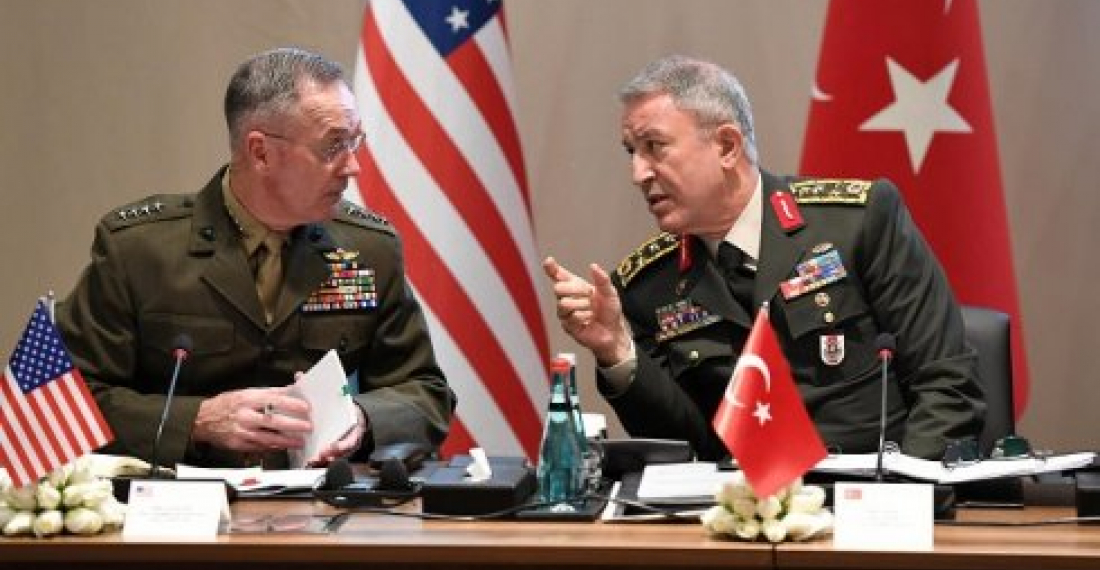
Photo: Turkey's Chief of Staff General Hulusi Akar chats with U.S. Chairman of the Joint Chiefs of Staff Joseph Dunford during a meeting in Antalya, Turkey March 7, 2017. (Picture courtesy of the turksih Armed Forces press Service)