


Opinion: Germany must help EU diplomacy succeed in the South Caucasus

"It is urgent for Germany to add its weight as an active participant and co-facilitator" in EU diplomacy in the South Caucasus, write Lara Setrakian and Benyamin Poghosyan in this op-ed for commonspace.eu. "Germany is a key architect and leader in the long-term thinking that is the basis for effective foreign policy. To be a peacemaker requires firm resolve and solid nerves. Germany has both and it can use them in the service of this EU project," they add.

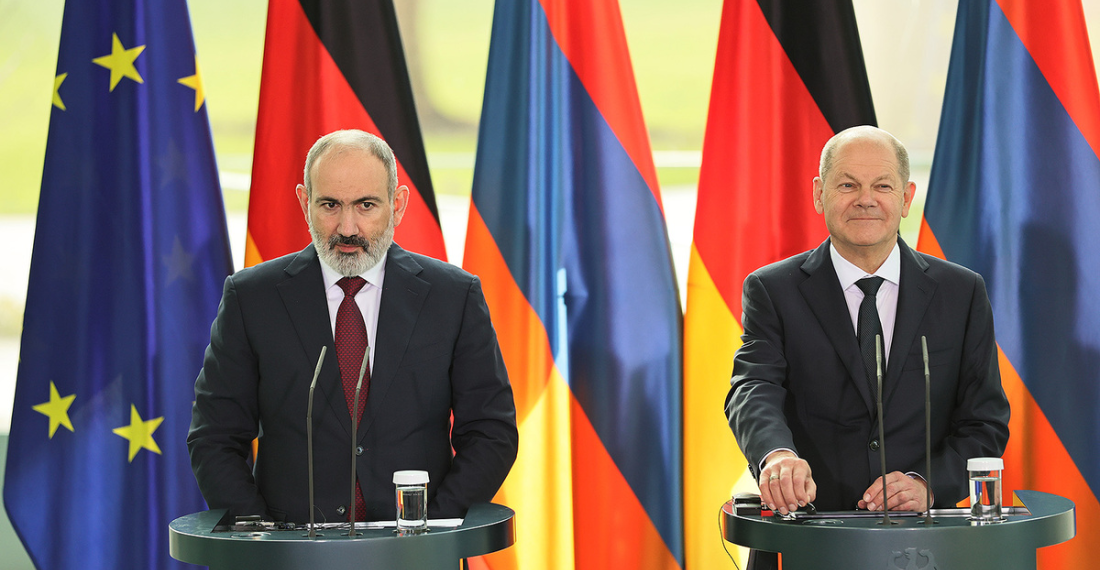
In March, German Chancellor Olaf Scholz hosted visits from Azerbaijan's President Ilham Aliyev and Armenian Prime Minister Nikol Pashinyan. Since the brutal war between Armenia and Azerbaijan in 2020, both countries have called for Berlin to play a larger role in resolving the long-standing conflict between them. Germany’s economic and political capital with both parties, as well as its generally balanced position on the issue, made it an appealing candidate to co-lead the peace process. But it hasn’t heeded those calls to date. Now, as Azerbaijan and Armenia walk a thin line between war and peace, it is urgent for Germany to add its weight as an active participant and co-facilitator in the diplomatic process. 

The meetings in Berlin were the highest-level signals to date that Germany might raise its level of engagement in the South Caucasus. Doing so would be of great benefit to the cause of regional peace, helping to save lives, prevent humanitarian upheaval and stem mass abuses of human rights. It would also boost the EU’s efficacy and credibility in its extended neighborhood. In the wake of the conflict in Ukraine, Europe’s influence and its diplomatic footprint in the South Caucasus has been expanding. A peace process led by Brussels is now one of the two main negotiating tracks – the other one led by Moscow. In February 2023, after a preliminary two-month deployment in the fall, an extended EU civilian observer mission was established to monitor the border between the two countries from the Armenian side.

Germany has much to offer EU diplomacy in the South Caucasus

There is ample reason for Germany to invest in this process; above all, it wants to see geo-economic stability and support the success of major EU projects. It may be the case that what Europe is trying to achieve in its foreign policy – solving problems and maintaining stability at the edge of Europe – simply cannot be done without the weight of Berlin.

Paired with the longtime engagement of France in the South Caucasus, Germany can offer a range of highly effective interventions, from hosting track 2/track 1.5 diplomacy forums to confidence-building economic initiatives. Berlin can become a platform for regular contact between officials, experts and civil society stakeholders at various levels. So far, such platforms have been far too sporadic and lacking in coherent vision; different actors have funded disparate and uncoordinated programs that did not make a lasting impact. 

There are real areas for potential cooperation between Armenia and Azerbaijan, as distant as they may seem at the moment. Both countries have economic development imperatives and need to provide for the long-term welfare of their citizens; the success of both their governments depends on it. Both countries strive for greater economic ties with the block. Armenia’s government, since its Velvet Revolution in 2018, has also accelerated a set of reforms aligned with the EU democratization and anti-corruption agenda. In particular Armenia has followed the blueprint of the Armenia-EU Comprehensive and Enhanced Partnership Agreement (CEPA), which entered into force in 2021. Azerbaijan, for its part, signed a Memorandum of Understanding with the EU in 2022 on Strategic Partnership in the Field of Energy.

Germany can also be a significant part of the post-conflict reconstruction and rehabilitation process

A sustained platform for dialogue and peacebuilding will help surface more opportunities for economic cooperation with Europe and, eventually, with each other. As the EU’s economic heavyweight, Germany can provide incentives in trade and sustainable development that entice both countries to move forward, rather than looking back on their past grievances. Germany also has the moral credibility and capacity for stricture to serve as a no-nonsense referee in what has become a messy human rights imbroglio. Pulling the region back from the brink and preventing the risk of ethnic cleansing in Nagorno-Karabakh would be a huge achievement.

Berlin can also be a significant part of the post-conflict reconstruction and rehabilitation process, which will lay the foundation for long-term sustainable development in the region. The potential for the South Caucasus is rich and robust in opportunities, starting with transit and transport corridors that connect Europe to China and India, without the added expense and congestion of the Suez Canal. Clean energy and traditional fossil fuels, as well as goods and technology can be readily supplied to European markets. Moving Armenia and Azerbaijan forward, through this rocky period, ensures that they will be stable, long-term partners for the EU. That will also provide a stronger foothold in the South Caucasus for EU relations with Georgia and, in the long run, potentially Iran. 

Europe must not repeat mistakes of the past – namely, letting short-term energy deals prevent it from building a better long-term strategy that meets all of its goals and needs. Germany is a key architect and leader in the long-term thinking that is the basis for effective foreign policy. To be a peacemaker requires firm resolve and solid nerves. Germany has both and it can use them in the service of this EU project. It is urgent from a humanitarian perspective and for EU geostrategic interests that this conflict be solved. The problems in Europe’s extended neighborhood will always penetrate back into the core of the continent; a new war in the South Caucasus will likely draw in Turkey and Iran, while potentially opening a window for confrontation between Iran and Israel. It is far less costly to enable peace and stability today than to pay the cost of instability tomorrow, with another major war in the European arena.

source: Lara Setrakian is the President of APRI Armenia. Benyamin Poghosyan is a Senior research fellow, APRI Armenia, and the founder and Chairman of the Centre for Political and Economic Strategic Studies in Yerevan.
photo: Prime Minister of Armenia
The views expressed in opinion pieces and commentaries do not necessarily reflect the position of commonspace.eu or its partners



Related articles

Editor's choice
News
Key European countries back Denmark in the face of Trump's continuing insistence on taking over Greenland

Key European countries back Denmark in the face of Trump's continuing insistence on taking over Greenland

 Six major European countries have declared their support to Denmark following renewed insistence by the US that it must have control over Greenland. "Greenland belongs to its people, and only Denmark and Greenland can decide on matters concerning their relations," said the leaders of the UK, France, Germany, Italy, Poland, and Spain, in a joint statement, issued on Tuesday (6 January), together with Denmark. On Sunday, Donald Trump said the US "needed" Greenland - a semi-autonomous region of fellow Nato member Denmark - for security reasons. He has refused to rule out the use of force to take control of the territory, and Danish Prime Minister Mette Frederiksen warned on Monday that an attack by the US would spell the end of Nato. The issue of Greenland's future resurfaced in the wake of the US military intervention in Venezuela, during which elite troops went in to seize the country's President Nicolás Maduro and take him to face drugs and weapons charges in New York. Following the raid, Trump said the US would "run" Venezuela for an unspecified period of time. He also said the US was returning to an 1823 policy of US supremacy in its sphere of influence in the Western hemisphere - and he warned a number of countries the US could turn its attention to them. The US military raid in Venezuela has reignited fears that the US may consider using force to secure control of Greenland. A day after the raid, Katie Miller - the wife of one of Trump's senior aides - posted on social media a map of Greenland in the colours of the American flag, alongside the word "SOON". On Monday, her husband Stephen Miller said it was "the formal position of the US government that Greenland should be part of the US". In an interview with CNN, he also said the US "is the power of Nato. For the US to secure the Arctic region, to protect and defend Nato and Nato interests, obviously Greenland should be part of the US." Asked repeatedly whether the US would rule out using force to annex it, Miller responded: "Nobody's going to fight the US over the future of Greenland." Stressing they were as keen as the US in Arctic security, the seven European signatories of Tuesday's joint statement said this must be achieved by Nato allies, including the US "collectively" - whilst "upholding the principles of the UN Charter, including sovereignty, territorial integrity and the inviolability of borders". Greenland's Prime Minister Jens-Frederik Nielsen welcomed the statement and called for "respectful dialogue". "The dialogue must take place with respect for the fact that Greenland's status is rooted in international law and the principle of territorial integrity," Nielsen said. Trump has claimed that making Greenland part of the US would serve American security interests due to its strategic location and its abundance of minerals critical to high-tech sectors. Greenland, which has a population of 57,000 people, has had extensive self-government since 1979, though defence and foreign policy remain in Danish hands. While most Greenlanders favour eventual independence from Denmark, opinion polls show overwhelming opposition to becoming part of the US.
Editor's choice
News
Donald Tusk: "One for all, and all for one! Otherwise we are finished."

Donald Tusk: "One for all, and all for one! Otherwise we are finished."

Europe is rattled by events in Venezuela, and there are serious concerns that US disregard for international law may have consequences close to home.  The BBC diplomatic correspondent, James Landale, said, the question is how Europe may respond in the longer term to America's military operation in Venezuela. Will it provide a catalyst for the continent to take greater responsibility for its own security in the face of so much instability from what many see as an unreliable ally? Polish prime minister, Donald Tusk, appears to have answered the question, saying on social media: "No-one will take seriously a weak and divided Europe: neither enemy nor ally. It is already clear now. "We must finally believe in our own strength, we must continue to arm ourselves, we must stay united like never before. One for all, and all for one. Otherwise, we are finished." The US seizing of Venezuela's leader has faced strong criticism from both America's friends and foes at an emergency meeting of the United Nations Security Council, held on Monday, 5 January. Many member states agreed with the US that Nicolás Maduro had been an illegitimate and repressive leader. But many also condemned the US military action as a breach of international law and the UN Charter, and they demanded a democratic transition that reflected the will of the Venezuelan people. (click the image to read the full article).

Popular

Editor's choice
News
Key European countries back Denmark in the face of Trump's continuing insistence on taking over Greenland

Key European countries back Denmark in the face of Trump's continuing insistence on taking over Greenland

 Six major European countries have declared their support to Denmark following renewed insistence by the US that it must have control over Greenland. "Greenland belongs to its people, and only Denmark and Greenland can decide on matters concerning their relations," said the leaders of the UK, France, Germany, Italy, Poland, and Spain, in a joint statement, issued on Tuesday (6 January), together with Denmark. On Sunday, Donald Trump said the US "needed" Greenland - a semi-autonomous region of fellow Nato member Denmark - for security reasons. He has refused to rule out the use of force to take control of the territory, and Danish Prime Minister Mette Frederiksen warned on Monday that an attack by the US would spell the end of Nato. The issue of Greenland's future resurfaced in the wake of the US military intervention in Venezuela, during which elite troops went in to seize the country's President Nicolás Maduro and take him to face drugs and weapons charges in New York. Following the raid, Trump said the US would "run" Venezuela for an unspecified period of time. He also said the US was returning to an 1823 policy of US supremacy in its sphere of influence in the Western hemisphere - and he warned a number of countries the US could turn its attention to them. The US military raid in Venezuela has reignited fears that the US may consider using force to secure control of Greenland. A day after the raid, Katie Miller - the wife of one of Trump's senior aides - posted on social media a map of Greenland in the colours of the American flag, alongside the word "SOON". On Monday, her husband Stephen Miller said it was "the formal position of the US government that Greenland should be part of the US". In an interview with CNN, he also said the US "is the power of Nato. For the US to secure the Arctic region, to protect and defend Nato and Nato interests, obviously Greenland should be part of the US." Asked repeatedly whether the US would rule out using force to annex it, Miller responded: "Nobody's going to fight the US over the future of Greenland." Stressing they were as keen as the US in Arctic security, the seven European signatories of Tuesday's joint statement said this must be achieved by Nato allies, including the US "collectively" - whilst "upholding the principles of the UN Charter, including sovereignty, territorial integrity and the inviolability of borders". Greenland's Prime Minister Jens-Frederik Nielsen welcomed the statement and called for "respectful dialogue". "The dialogue must take place with respect for the fact that Greenland's status is rooted in international law and the principle of territorial integrity," Nielsen said. Trump has claimed that making Greenland part of the US would serve American security interests due to its strategic location and its abundance of minerals critical to high-tech sectors. Greenland, which has a population of 57,000 people, has had extensive self-government since 1979, though defence and foreign policy remain in Danish hands. While most Greenlanders favour eventual independence from Denmark, opinion polls show overwhelming opposition to becoming part of the US.


