Turkish pressure to bring about the closure of the International Black Sea University in Tbilisi exposes once more Georgia's vulnerability to pressure from strong neighbours, argues George Mchedishvili in this op-ed
On 20 August, the National Center for Education Quality Enhancement's "Authorization Board", which operates under the auspices of the Georgia's Ministry of Education and Science, annulled the enrolment of first-year students to the International Black Sea University (IBSU), one of Georgia's most highly-regarded tertiary education institutions. This year, nearly 800 students listed IBSU as their first choice, i.e. the most desirable place to study at. The decision of the Board, made only three weeks before the commencement of the academic year, has denied 800 young people the right to study where they wanted.
The decision at first may seem only to affect new incoming students since upper-grade undergrads and graduate students may continue the studies, and the authorisation (licensing) of the University is confirmed for another six years. However, the ruling is also a body blow to the entire University, which stands to lose close to 3 million Lari (approx. 1 million Euros) from tuition fees from the new intake - a significant fraction of its revenues. The decision of the Board is all the more surprising given that it comes on the heels of the conclusion by the reputed international panel of authorisation experts, which visited IBSU on 24-27 April to study compliance with authorization standards. The report issued by the group found no fault in the academic or administration processes.
Although the Board assured that it will facilitate a smooth transfer of the students denied entry to IBSU to other universities, its decision still disrupts the plans of many students. IBSU is one of very few universities that delivers instruction in both Georgian and English languages at the BA level (MA and PhD are entirely in English), with some programs, like English-language American studies BA program, not being taught anywhere else in the country.
The formal basis for this ruling is the University's alleged "financial debts to the state, which was levied upon it for avoiding taxes". But this justification is substantively very thin, since the case is still in the Court, with the outcome unknown. Even if the verdict obliges IBSU to pay 715,000 Georgian Lari (about 240,000 Euro) debt, the latter has ample financial capabilities to pay it. Apart from assets that are in excess of 10 million Lari (about 3.5 million Euros), the University had a special account set-up, containing the sum, just for the contingency in case the court ruling went against it. On August 27 the University unilaterally payed the sum demanded to the state just to eliminate the "official reason" on which the enrollment suspension was based But even this move did not appease the National Center for Education Quality Enhancement, and the decision of 20 August remains in force. Many think that the Ministry, and entire Georgian Government for that matter, is under powerful external pressure to act in such a punitive and discriminatory way.
Many view the latest crisis around IBSU as another step in a larger campaign being conducted by the Turkish government against Gulen-affiliated educational institutions around the globe. The Turkish government accuses the Gulenist Movement of involvement in the July 2016 violent military coup, and over the last two years it has purged the army, civil service and other state-institutions of hundreds of thousands of people which it accused of being in the service of the Gulenist Movement. The Turkish government's attempt to extradite the founder of the Movement, Fettulah Gulen, from the United States, have so far failed. In parallel the Turkish government has pushed for the closure of Gulen affiliated institutions abroad, alleging, that they belong to the extended and elaborate terrorist network by the name FETO (acronym, in Turkish, for "Fethullah' Terrorist Organization"). Some countries, like Azerbaijan and Turkmenistan, which enjoy close ties with Turkey and are not "burdened" by civil society or the desire to westernize politically, were eager to comply and either nationalized or closed those institutions altogether. Some other countries, most notably Kazakhstan and Kyrgyzstan, where dependence on Turkey is less pronounced, would not budge.
The International Black Sea University was launched with great fanfare by the then Georgian President Shevardnadze and Turkish Prime Minister Tansu Chiller during the latter's state visit to Georgia. Although a private educational institution, the university was supported financially and logistically by the Government of Georgia, and in the first years of its operation by the Gulen-affiliated Caglar foundation. However, even from a purely legal point of view, naming the University as a "Gulenist" school is certainly a generalization, and the assertion that the IBSU is somehow a part of a terrorist network is absurd. A few days before the controversial Authorization Council decision, the Turkish Ambassador to Georgia said in an interview: "FETO still has its University in Georgia", hoping that the Georgian government becomes more active in rooting out "terrorists". The timing of these words suggests that this might be the case of diplomatic pressure.
Turkey has a number of potent leverages over Georgia. Tbilisi has almost a billion-dollar trade deficit with Ankara, whose economy is almost 60 times larger than that of Georgia. Therefore, any potential disruption of trade - export or import alike - would affect Georgia in a far more grave and consequential way. To top it off, tens of thousands of Georgian citizens work in Turkey and support the rest of their families in Georgia by remittances, amounting to 75-80 million Euro per annum. Despite this, the likelihood that Turkey resorts to tougher policies against Georgia is not very high, given extensive bilateral and trilateral (with Azerbaijan) cooperation in economy, energy, transportation and defense. Furthermore, Ankara and Tbilisi enjoy strategic relations, which were even enhanced in July 2016, a few days after the failed coup attempt, through the establishment of the Strategic Cooperation Council. Nevertheless, no scenario can be excluded entirely.
Georgia's Conundrum
The current row around IBSU also brings to the fore bigger questions: how a democratic or democratizing country can retain its credentials in a non-democratic neighborhood? Until a few years ago Turkey was a fairly democratic secular state - a loyal NATO member and an EU-aspiring country. For Georgia, which has been enjoying very good relations with Ankara, this state of the play was extremely favorable. Turkey was virtually a getaway to the West - geographically and economically connecting Georgia, and even in terms of political development - since Turkey was ahead of Georgia in all rankings pertaining to democracy and freedoms.
But over the past several years, given Turkey's swift slide towards what in many European circles is perceived as authoritarianism, these very intense ties between the two states risk quickly changing from a major asset into a serious liability and headache. This is particularly pertinent for Georgia, which sees its future exclusively in integration with Europe, and has already achieved some progress in this quest. One thing Tbilisi cannot afford is casting doubts upon its commitment to democracy - and acting at Turkey's behest does precisely that.
One can of course speculate that Georgia had to be more rigorous in defense of its interests and there should be "red lines" even in close relations between strategic partners, relative strength notwithstanding. Whether or not this critique is valid, the reality is that Georgia today finds itself in a dilemma and will have to walk a tightrope between increasingly closer ties with EU, which are contingent on the level of democracy in the country, and increasingly anti-western and erratic Turkey, keen on eliminating political opposition inside and outside the country, and likely to mount new, even more outlandish demands from Georgia.
The international community, EU and leading member states in the first place, might play a role in the ongoing dispute and more generally, by sending two clear messages. First ('the stick') is that caving in to Turkey's demands is not conducive to Georgia's European integration, and second ('the carrot'), Europe should guarantee economic and political support in case Georgia stands firm, does not comply, and incurs a backlash from Ankara.
source: George Mchedlishvili is Associate Professor in the School of Social Sciences at the International Black Sea University in Tbilisi. He contributed this op-ed to commonspace.eu
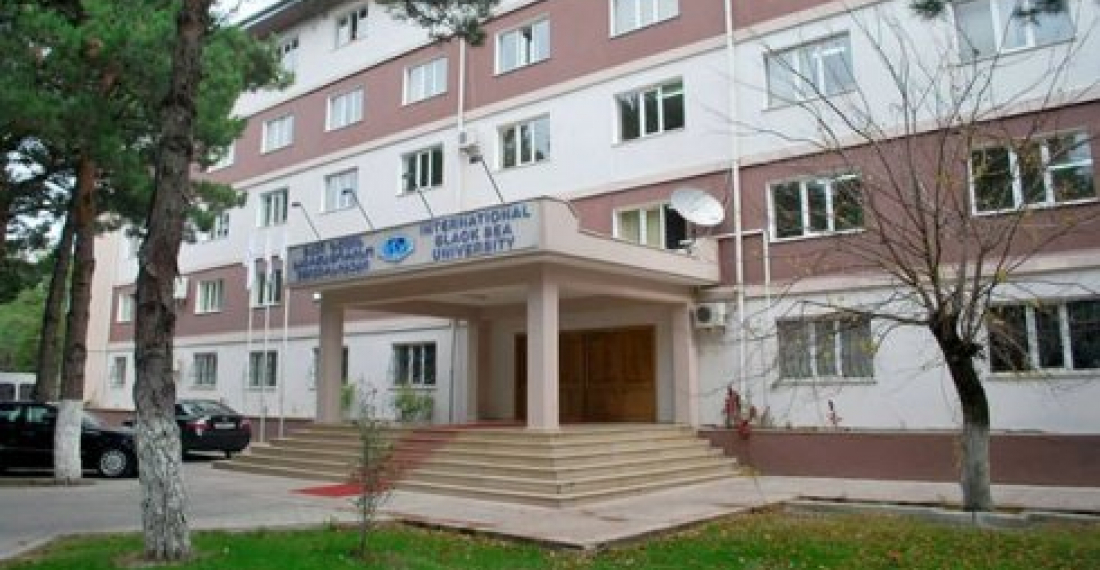
photo: The campus of the International Black Sea University in Tbilisi
The views expressed in opinion pieces and commentaries do not necessarily reflect the position of commonspace.eu or its partners