As tensions in US-Russia relations increase there are signs that America is adding pressure on Russia through increased support for Ukraine and Georgia, writes Emil Avdaliani in this op-ed for commonspace.eu
Confrontation between Russia and the US across the former Soviet space seems to have reached new heights over the past few weeks. This is primarily reflected in the military affairs, pointing to a much-widened rift between the two powers.
The US made the Russian RT television channel (Russia Today) register as an agent, while similar legislature was passed by the Russian State Duma to target foreign media operating in Russia. However, the timing of this legislature suggests the Kremlin did this in response to the US actions and to confront US media outlets.
The media legislature could be regarded as a sideshow to those bigger processes which are unfolding in the ever-deteriorating Russia-US relations. The US increases its pressure on Russia on two fronts where the Russians are most vulnerable: in Ukraine and Georgia.
On November 13 US special envoy Kurt Volker met the Kremlin aide Vladislav Surkov in Belgrade, Serbia, to discuss the possibility of stationing peacekeeping forces in east Ukraine.
After the talks, the US and Russian envoys also said that their countries have, "different concepts for how to make peace" but will work further to achieve results. Moreover, the differences were so extensive that after the meeting, Surkov said that the US side presented 29 paragraphs and that "only three of them were acceptable".
This is important as it again stresses those irreconcilable differences between US and Russia that have existed over Ukraine for a long time. Washington insisted on Moscow giving up its control of the eastern Ukraine-Russia border, while Moscow argued to the contrary. From a purely geopolitical standpoint, Russia acceptance of the US offer would mean losing control over the processes in east Ukraine. Russians would be unable to send military hardware into east Ukraine when necessary.
Moving from the diplomatic to the military realm, the recent reports that the US is now considering increasing its military support for Ukraine could prove an important development for US policy across the former Soviet space. On November 18, ABC News reported, quoting a State Department source, that senior aides will present US President Donald Trump with a $47 million plan to finance and sell high-tech defensive weapons to Ukraine to bolster its efforts to repel Russian aggression in east Ukraine.
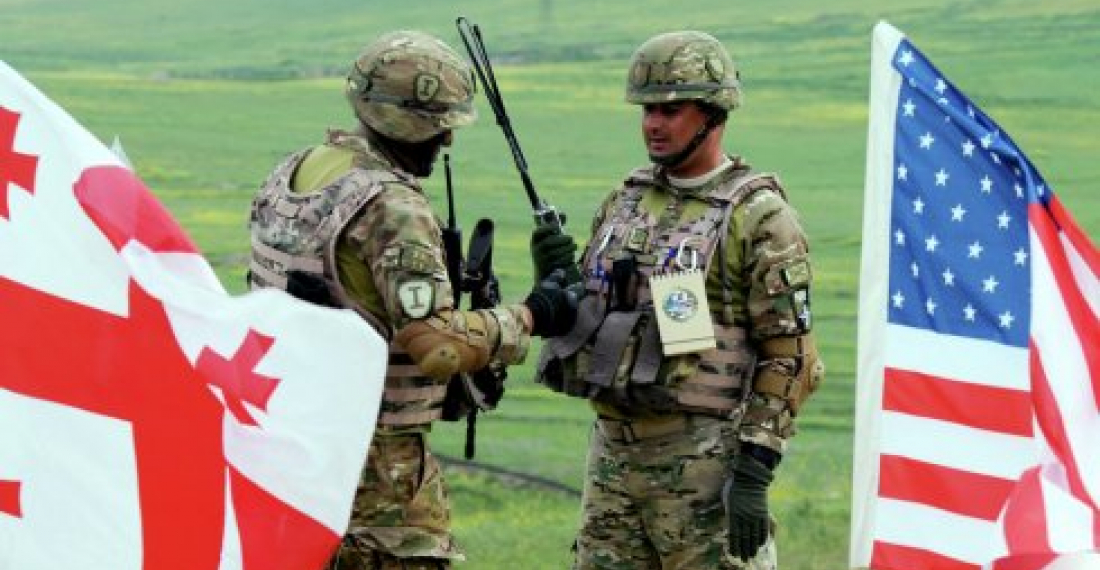
Some could take this with a pinch of salt, of course, as the US government was making similar statement earlier, ever since Trump became president. However, this time round there are additional arguments indicating that the US is considering to slowly change its military policy across the former Soviet space. In a related development, it was announced that the US will be increasing its military support to Georgia. From spring 2018, US Army officers will train Georgian soldiers on defensive tactics. The new Georgia Defense Readiness Program differs from previous US military aid initiatives. Previously, the US was training Georgian troops for participation in foreign missions, in particular, the coalition operation in Afghanistan. However, with the new program, the focus will be the defense of Georgia's own territory against a potential invasion. This is what Georgia has lacked for decades, and what was well reflected in the 2008 Russo-Georgian war.
The Georgian defense minister Levan Izoria said before his recent visit to Washington in early November: "US-Georgia defense relations are advancing to a new level. The US side will allocate more than $100 million for defense reforms in Georgia, which will further strengthen Georgia's defense capabilities and will deepen the existing strategic cooperation between our countries".
More importantly, on November 20, the US State Department approved the sale of Javelin anti-tank missiles to Georgia. Tbilisi plans to buy from the Pentagon 410 of the missiles and 72 launch units. The total amount of the proposed deal is $75 million.
The provision of this kind of weapons will be a landmark development as it will go against the standard US approach to the conflicts across the former Soviet Union: no supplies of lethal weapons to Ukraine, Georgia or Moldova, so as not to cause further escalation with Russia. Surely, the plan in the White House might not materialize, but it nevertheless reflects a slowly changing thinking in the American political establishment. At the same time the proposed sales would not drastically change the military balance of power in the region against Russia. But it is nevertheless a development important enough to cause an immediate Russian reaction. On November 29 the Russian foreign affairs ministry emphasized that Georgia's deepening of military cooperation with NATO countries, especially with the United States, is dangerous, and that Moscow believes that the military support is directly encouraging Tbilisi to "new dangerous adventures in the region".
On a much wider level these military developments around Ukraine and Georgia fit into what NATO/US are doing in east Europe - namely increasing their military capabilities. Somewhat related to that is the recently-announced initiative by NATO to create two additional command centers in east Europe to better protect sea lanes and improve the movement of troops and equipment within Europe overall.
Thus there has been a substantial ratcheting up of tensions in US-Russia relations over recent weeks. The US is increasing its pressure on Russia through various means available, among them through increased support for Ukraine and Georgia, as a centerpiece of the US strategy of containment of Russia in the former Soviet space.
Emil Avdaliani contributed this op-ed to commonspace.eu