The G7 and Shanghai Co-operation Organisation summits last week highlighted the decline of western dominated post-cold war order, and a growing role for regional powers in their respective zones of influence says Benyamin Poghosyan in this op-ed
Last week world attention was focused on two key international summits - the G7 in Canada and the Shanghai Cooperation Organization (SCO) meeting in China. The first was a gathering of advanced economies, with established democratic institutions and traditions, the second a summit of the "rising others", including two giants - China and India - as well as Russia, desperately vying for a seat at the table of global powers. Traditionally the G7 members unanimously support the liberal world order, the spread of democracy and international trade rules, while many in the SCO, including China, Russia, and the Central Asian Republics, chastise the unfair international security and economic architecture. However, the 2018 summits were marked by sharp deviations from the business as usual scenario, especially within the camp of the world's advanced democratic nations. The star role was played by US President Trump, who accused his counterparts of unfair trade practices, surprised everyone by his suggestion to re-include Russia into the elite club, and after leaving the summit, whilst on board "Airforce One" on his way to Singapore, cancelled the US signature of final joint communiqué. His insults against his counterparts, including the Canadian Prime Minister and the German Chancellor exposed yet again disagreements within the elite club.
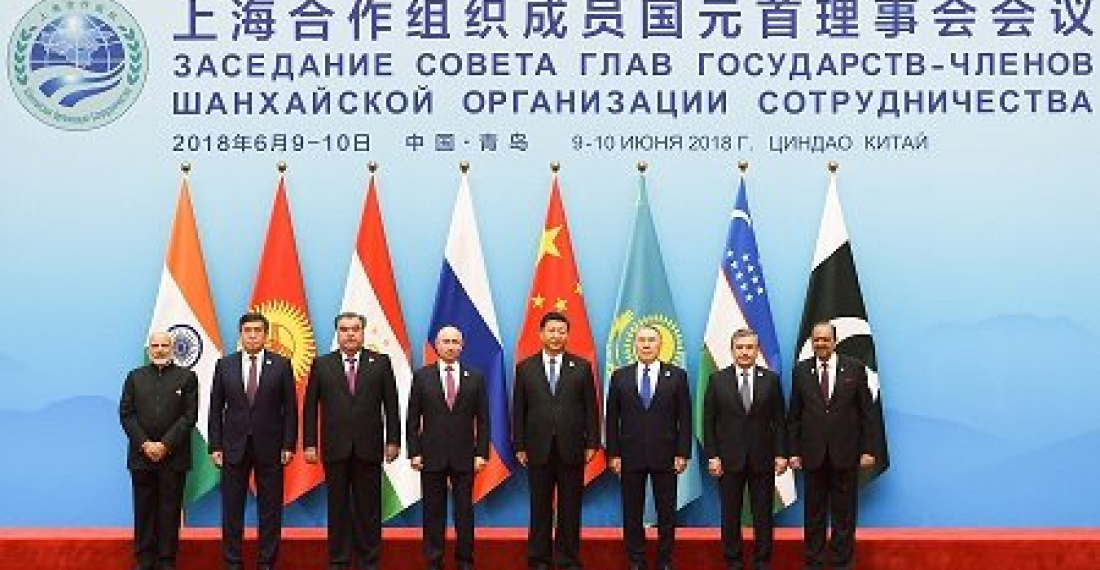
Meanwhile, the SCO summit passed without any big surprises. Russia and China reiterated their willingness to further develop strategic partnership, simultaneously urging for more balanced and multi-polar world. The inclusion of India and Pakistan as SCO full members has essentially expanded the scope of the organization. Iran, Mongolia, Turkey and some other states are also increasing their involvement in the organization, potentially making SCO a new center of gravity in the world politics. Russia and China are planning to foster cooperation between SCO, CSTO, CIS, and EAEU, creating a web of different layered connections. India is a bit more cautious - official Delhi abstained from endorsing the Chinese flagship "Belt and Road" initiative in the final summit statement. However, despite growing US - India strategic ties, and some hopes in Washington that India can be a leverage to balance growing Chinese influence in Asia, Delhi is smart enough not to alienate Russia or China, seeking to keep a balance whilst promoting its own interests.
A key question arises after these two summits as to the future of the international security system. Currently, the US firmly holds the number one position in terms of size of GDP and military spending. However, the "the rise of others" among them China, as well as India, Brazil etc., is putting pressure on Washington. Till the November 2016 Presidential elections the US strategy was clear - to use its alliance with Europe, Canada, Japan, South Korea, Australia and others to create an effective deterrence of China, and to a lesser extent Russia, and promote democracy as a key tool in the protection of the post-cold war order . Multilateral organizations such as NATO and the EU, as well as trade pacts (NAFTA, efforts to sign TPP and TTIP) were key instruments of US policy. However, the current US administration is sending mixed signals about its intentions. While emphasizing the significance of NATO, and putting aside "NATO is an obsolete organization" rhetoric, Washington makes more and more demands on its allies, calling for fair burden sharing. The US administration is imposing new sanctions on Russia and simultaneously President Trump continues to make friendly gestures towards President Putin. Trade rules are becoming another key point of disagreement between the US and its Western allies. Washington has pulled itself out from the TPP; the fate of NAFTA is in limbo; and the decision to put tariffs on the import of steel and aluminum from Canada and some European countries makes the situation even more complicated For sure, the harsh rhetoric on trade is not targeted only allies. The threats to put some 150 billion USD tariffs on China are a clear sign of US desire to significantly overview the current world trade architecture. These days the US behaves more as a "change seeker" than a "status quo" power.
Meanwhile, Russia and China are making efforts to consolidate power within their neighborhood. China is assertive in the South China Sea. The "One belt, one Road" initiative is a geostrategic tool to expand Beijing influence far beyond its own borders. Russia concentrates its efforts to regain control over the former Soviet space, whilst Moscow is more and more active in the Middle East and the Balkans. Efforts to use their own currencies for bilateral trade, the launch of new international financial institutions such as AIIB and BRICS New Development Bank are clear signs of the desire of the "rising powers" to challenge the Western dominated international financial structure.
Given that the leading western power - the US - is itself fighting against some elements of the post-cold war security and economic architecture, the most probably scenario in short and mid-term is the decline of western dominated post-cold war order, and a growing role for regional powers in their respective zones of influences. This will bring more instability, and raises the possibilities of regional conflicts and turmoil.
source: Dr. Benyamin Poghosyan is the Executive Director of the Political Science Association of Armenia. He contributed this op-ed to commonspace.eu
The views expressed in opinion pieces and commentaries do not necessarily reflect the position of commonspace.eu or its partners.
photo: Leaders of the Shanghai Co-operation Organisation states at their meeting in Beijing 9-10 June 2018.