Opinion: Committing to doing what it takes for Ukraine to achieve victory

2024 started with an unprecedented number of Russian drones and ballistic missiles raining down on Ukraine. In this op-ed published this week on various media outlets, the European Union's High Representative for Foreign and Security Policy, Josep Borrell, argues that Ukraine prevailing against the Russian aggression is the best security guarantee for Europe and that a paradigm shift is needed from supporting Ukraine for 'as long as it takes' to committing to 'what it takes' for Ukraine to achieve victory.

2024 started with an unprecedented number of Russian drones and ballistic missiles raining down on Ukraine. Two years ago, in the early days of 2022, I visited the Donbas and Kyiv. The drums of war were already sounding clearly, as Russia amassed over 100,000 troops on Ukraine's borders.

In those days, Putin bet that Ukraine could not withstand a Russian attack and that internal division and energy dependency would prevent the EU from coming to Ukraine’s help. He prepared for a war that would last merely a few days. Many Europeans harboured similar expectations. However, things turned out very differently. Putin could not have imagined that two years later, Ukraine would still be resisting.

The Ukrainian armed forces won the Battle of Kyiv, they won the Battle of Kherson, they liberated more than half of the territory Russia had captured, broke the blockade of Black Sea ports and forced Russia to withdraw the bulk of its fleet from occupied Crimea. However, last year’s Ukrainian counteroffensive did not achieve the desired results and the Russian aggressors are keeping up the pressure on Ukraine, continuing with intense bombings. Russia has achieved virtually no progress on the battlefield in 2023, but Putin is still prepared to let hundreds of thousands more young Russians die to conquer Kyiv. His army and his people are suffering, but he does not know the meaning of reversing gear.

As a result, we once again hear claims that Ukraine cannot win, and that Western support will not hold. And once again, whispers of appeasement resurface. Those claims were wrong in 2022, and they remain so today. We must not let them shape our policy on Ukraine.

As Sam Greene, a Russia expert at King’s College London, put it: 'Putin may want negotiations, but he does not want to negotiate'. Putin himself declared, 'We want to end this conflict as soon as possible, but only on our terms.' His terms? Denazification, demilitarization, and dismantling. Three words that mean one thing: surrender. He has repeatedly shown that he does not negotiate in good faith and has consistently failed to honour agreements. And now, less than a year before the US elections, which he believes may favour his imperialist ambitions, who can seriously expect Putin to seek compromise?

Putin was wrong two years ago. He was wrong about the capabilities of his army. He was wrong about the resistance of the Ukrainians. He was wrong about European unity. He was wrong about the strength of the transatlantic link. We must prove him wrong again. Instead of eying appeasement, we should remember the lessons we have learnt since 2022, avoid repeating mistakes and double down in areas where we saw success.

The EU and its Member States have provided unprecedented economic, humanitarian, and military support to Ukraine, delivering almost €30 billion in ammunition and weapons, and training nearly 40,000 Ukrainian soldiers on EU soil. The war has also bolstered transatlantic unity and our sanctions, which we progressively tightened to counter circumvention, have weakened Russia’s war machine.

However, we have frequently been too slow to provide Ukraine with essential weapons, often only acting when Russia threatened to gain the upper hand. This hesitancy has cost lives. Going forward, we need a paradigm shift from supporting Ukraine for 'as long as it takes' to committing to 'what it takes' for Ukraine to achieve victory.

We need to equip Ukraine with the necessary tools to liberate its territory, including long-range missiles and other advanced weapons systems. We also need to bolster Ukraine's air defence capabilities. With Russia intensifying its campaign against civilian targets and infrastructure, anti-air missiles have become crucial to saving lives and preventing attacks, such as the recent bombing of a children's clinic in Kharkiv.

This needs to go hand in hand with a renaissance of the European Defence industry. The war in Ukraine has revealed that this industry is nowhere near adequately prepared to meet the challenges we face. Much of the EU’s substantial military support to Ukraine came from existing stockpiles. Replenishing those stocks while at the same time providing Ukraine with more weapons and ammunition is a serious challenge for a defence industry shrunk to peacetime production. Even though defence expenditure is already 40% up compared to the all-time low in 2014, this reversal of trends is not yet rapid enough. We must intensify our efforts to win this race against time with Putin’s Russia.

We cannot allow him to prevail. Our own security is at stake. Should Putin’s strategy prove successful, it would embolden Russia and other autocracies to pursue their imperialist agendas. We must at any cost prevent a world where might makes right, where powerful countries change borders at will, and the weak fall prey to the strong. Allowing such a scenario would cast a long shadow over our future for decades to come.

Ukraine prevailing against the Russian aggression is the best security guarantee for Europe. A Russia that learnt to stay within its borders will lessen pressure on its neighbours, ease Ukraine’s path to EU membership and allow Europe and the world to shift attention to the many other challenges that need solving. With our assistance, Ukraine can consign Russia’s imperial ambitions to the pages of history. This must guide our actions and thinking.

source: Josep Borrell is the European Union's High Representative for Foreign and Security Policy. This op-ed was published this week on various media outlets, and on the website of the EEAS (Brussels)
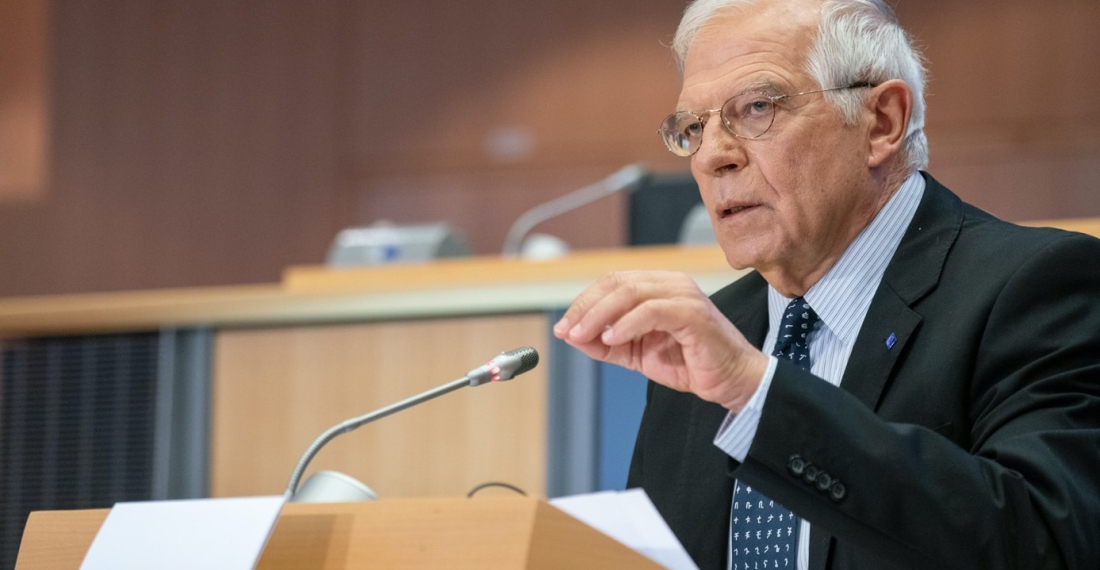
photo: Josep Borrell (archive picture)

Related articles

Editor's choice
News
Council of Europe launches new International Claims Commission for Ukraine

Council of Europe launches new International Claims Commission for Ukraine

Thirty-four countries and the European Union have signed a new convention establishing an International Claims Commission for Ukraine at a diplomatic conference co-hosted by the 46-nation Council of Europe and the Netherlands in the Hague. The diplomatic conference was attended by leaders and high-level representatives from over 50 states, including the President of Ukraine, Volodymyr Zelenskyy, the President of the Republic of Moldova, Maia Sandu, and the Prime Minister of the Netherlands, Dick Schoof.  “Today marks a major step forward in ensuring accountability for Ukraine. The International Claims Commission represents justice and hope for tens of thousands of victims—our determination that those who have suffered will not be forgotten. I call for quick ratifications so we can get the commission rapidly up and running for the people of Ukraine,” said Council of Europe Secretary General Alain Berset. Ukrainian President Volodymyr Zelenskyy said: “We expect that every mechanism for compensation from the Register of Damage and Claims Commission to the actual payments – will start working and receive strong and sufficient international support, so that people can truly feel that any kind of damage caused by the war can be compensated. This war, and Russia’s responsibility for it, MUST become a clear example – so that others learn not to choose aggression.” “Accountability is about creating the conditions for peace that endures. And therefore, accountability is a condition of security – today and for the future. But accountability is not only about Ukraine. And it is not only about one aggressor and one victim. Accountability is about Europe. About every country in Europe. It is about whether Europe, as a whole, is willing to defend its peace,” said Maia Sandu, President of the Republic of Moldova, which currently holds the Presidency of the Council of Europe’s Committee of Ministers. The Prime Minister of the Netherlands, Dick Schoof, said: “Every day Russia is deliberately bombarding homes, destroying businesses and damaging infrastructure in Ukraine. Russia must compensate Ukraine for the damage caused. That is why we have launched the International Claims Commission for Ukraine and we are honoured to host it.” The International Claims Commission will be the second part of a comprehensive compensation mechanism related to Russia’s war of aggression, building on the existing Register of Damage for Ukraine. The claims commission will be established within the framework of the Council of Europe and will also be open to other countries. The Register of Damage for Ukraine, created in 2023, collects and records compensation claims submitted by individuals, organisations and public bodies in Ukraine. Forty-four states and the European Union have so far joined the Register, which has already received 86,000 claims. The International Claims Commission will review, assess and decide upon claims submitted to the Register of Damage for Ukraine and determine the amount of compensation, if any, which is due in each case. The convention establishing the commission will enter into force once it has been ratified by 25 signatories, as long as sufficient funds have been secured to support its initial work.

Popular

Editor's choice
News
Council of Europe launches new International Claims Commission for Ukraine

Council of Europe launches new International Claims Commission for Ukraine

Thirty-four countries and the European Union have signed a new convention establishing an International Claims Commission for Ukraine at a diplomatic conference co-hosted by the 46-nation Council of Europe and the Netherlands in the Hague. The diplomatic conference was attended by leaders and high-level representatives from over 50 states, including the President of Ukraine, Volodymyr Zelenskyy, the President of the Republic of Moldova, Maia Sandu, and the Prime Minister of the Netherlands, Dick Schoof.  “Today marks a major step forward in ensuring accountability for Ukraine. The International Claims Commission represents justice and hope for tens of thousands of victims—our determination that those who have suffered will not be forgotten. I call for quick ratifications so we can get the commission rapidly up and running for the people of Ukraine,” said Council of Europe Secretary General Alain Berset. Ukrainian President Volodymyr Zelenskyy said: “We expect that every mechanism for compensation from the Register of Damage and Claims Commission to the actual payments – will start working and receive strong and sufficient international support, so that people can truly feel that any kind of damage caused by the war can be compensated. This war, and Russia’s responsibility for it, MUST become a clear example – so that others learn not to choose aggression.” “Accountability is about creating the conditions for peace that endures. And therefore, accountability is a condition of security – today and for the future. But accountability is not only about Ukraine. And it is not only about one aggressor and one victim. Accountability is about Europe. About every country in Europe. It is about whether Europe, as a whole, is willing to defend its peace,” said Maia Sandu, President of the Republic of Moldova, which currently holds the Presidency of the Council of Europe’s Committee of Ministers. The Prime Minister of the Netherlands, Dick Schoof, said: “Every day Russia is deliberately bombarding homes, destroying businesses and damaging infrastructure in Ukraine. Russia must compensate Ukraine for the damage caused. That is why we have launched the International Claims Commission for Ukraine and we are honoured to host it.” The International Claims Commission will be the second part of a comprehensive compensation mechanism related to Russia’s war of aggression, building on the existing Register of Damage for Ukraine. The claims commission will be established within the framework of the Council of Europe and will also be open to other countries. The Register of Damage for Ukraine, created in 2023, collects and records compensation claims submitted by individuals, organisations and public bodies in Ukraine. Forty-four states and the European Union have so far joined the Register, which has already received 86,000 claims. The International Claims Commission will review, assess and decide upon claims submitted to the Register of Damage for Ukraine and determine the amount of compensation, if any, which is due in each case. The convention establishing the commission will enter into force once it has been ratified by 25 signatories, as long as sufficient funds have been secured to support its initial work.