Events in neighbouring Georgia are being closely watched in Yerevan, writes Benyamin Poghosyan in this op-ed
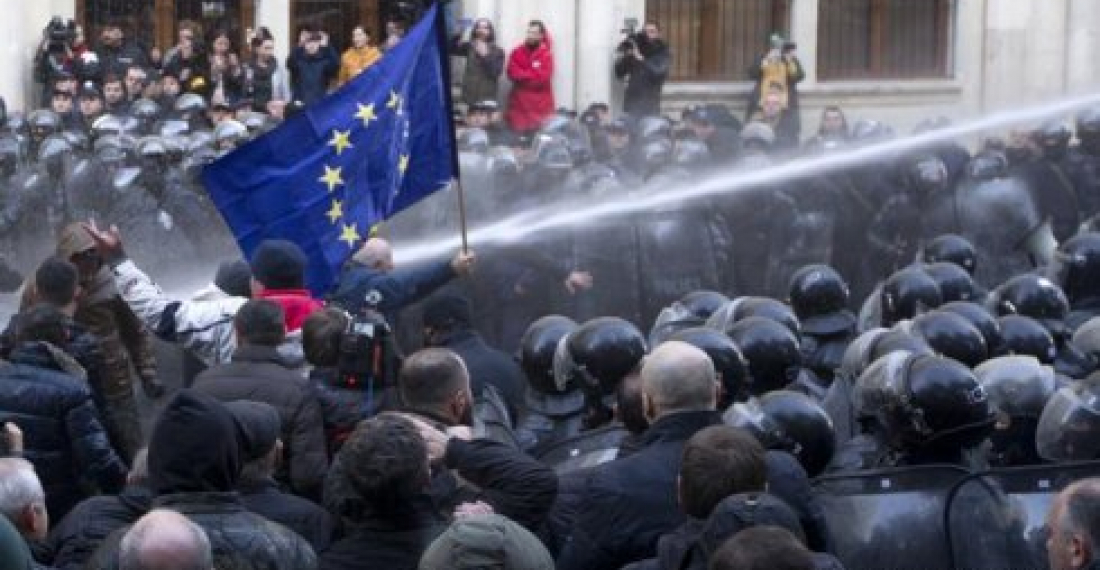
Since mid November a new wave of protests has covered Georgia. This time the trigger was Parliament’s failure to make necessary amendments in the Georgian constitution to introduce a fully proportional system with no threshold in upcoming 2020 Parliamentary elections. This reform was promised by the leader of the ruling party Bidzina Ivanishvili during the summer 2019 protests. However, the Majoritarian MPs from the ruling party have played key role in undermining this reform. Despite the statements of Mr. Ivanishvili and Georgian Prime Minister Giorgi Gakharia that they regret this outcome, main opposition parties as well as most part of the civil society stated that the negative vote in Parliament was orchestrated by Mr. Ivanishvili as he was not sure that ruling Georgian Dream party could keep its leading positions in case of fully proportional parliamentary elections.
The Parliamentary vote was the trigger but not the key reason for protests. The active part of Georgian society has been in a protest mode for a while. In 2018 Presidential elections pro-government candidate Salome Zurabishvili was elected only after a run-off. In June 2019 another wave of protests swept Tbilisi resulting in violent clashes between rally participants and riot police.
There are two main reasons behind the growing resentment and disappointment in Georgia. The first is the deterioration of the social-economic situation. Despite some economic growth, no significant improvements of life standards for average citizens have been achieved in recent years. The depreciation of Georgian currency resulted in a price hike of imported goods. No economic breakthrough is visible, which means that the best case scenario for Georgia is keeping the current average life standards.
The second issue is the growing concern among active part of the Georgian society regarding the rising Russian influence in Georgia. In the summer, millions of Russian tourists transform downtown Tbilisi into an essentially Russian speaking district. Simultaneously, Russian big business feels comfortable in Georgia, including such Kremlin related companies as Rosneft. The speculations that Mr. Ivanishvili is being supported by the Kremlin and has some hidden agenda to bring Georgia back to the Russian sphere of influence are popular with opposition circles in Georgia, and for them the rising Russian influence is therefore even more alarming.
Society is becoming more and more polarized. After seven years since the transition of power from former President Saakahsvili to Mr. Ivanishvili these two figures continue to dominate the Georgian political scene without even a slight chance that they will come to terms with each other. Other political forces such as European Georgia, Labor party, Alliance of Patriots, Civil Movement, Girchi, United Georgia as well as newly formed Lelo whose inaugural session is scheduled on December 22, as for now have not been able to compete as equals with the leading two forces.
Another source of concern for Georgians is the de facto deadlock in their Euro-integration aspirations. The Association Agreement with EU, Visa liberalization, NATO – Georgia commission and substantial NATO – Georgia package are the maximum which EU and NATO are able to offer Georgia. All actors (EU, NATO, Russia, the US as well Georgian political circles) clearly understand that Georgia will be neither EU nor NATO member for at least coming 15 years. The growing signs of possible launch of the EU/US – Russia normalization process make Georgians insecure and as pawns in bigger geopolitical games.
If recently Georgia was the battlefield of the US – Russia confrontation, now it has been actively transformed into the US – China battlefield in the South Caucasus too. Americans quite openly banned Georgia from accepting any Chinese investments in Anaklia Deep sea port project. Meanwhile, Georgia wants to be included in the Chinese “Belt and Road” initiative through cultivating China – Kazakhstan – Caspian Sea – Azerbaijan - Georgia – Turkey – Europe, or Georgia – Black Sea - Europe, routes. Georgians are interested in having China as a balance for both the US and Russia and not surprisingly signed free trade agreement with Beijing in May 2017.
Thus, Georgia enters 2020 with an unstable political and economic situation. Georgia faces strategic ambiguity in its domestic and foreign policy which will contribute to the rise of the protest movements.
Growing instability in Georgia is a source of concern for its neighbors including Armenia. Georgia is the key route connecting Armenia with the world and increasing instability there may create additional problems for Armenian businesses.
The frequent changes of Prime Ministers in Georgia also create practical problems for Armenia. Armenian Prime Minister Pashinyan made one of his first foreign visits to Georgia and met with then Prime Minister Kvirikashvili on May 30, 2018. However, only two weeks later Kvirikashvili resigned and was replaced by Mamuka Bakhtadze. Pashinyan and Bakhtadze started to cultivate personal warm relations. On September 10, 2018 Bakhtadze paid an official visit to Armenia and two unofficial summits were held in 2019 - one on January 15 in Bolnisi, Georgia and second on March 24 in Enokavan, Armenia. However, Bakhtadze resigned in early September and Mr. Gakharia is the third Georgian Prime Minister to meet with Mr. Pashinyan, making an official visit to Armenia on October 15. Of course, all three represent Georgian Dream party which means previous arrangements continue to be in place. However, every time the Armenian leadership has to get acquainted to the personal style of the new Georgian Prime Ministers.
Meanwhile, the political and economic instability in Georgia may have other impact on Armenia too. After the “Velvet Revolution” part of the society and the new Armenian political elite was looking to Georgia (especially to the period of 2004-2006) as a key example on how quickly vital reforms could be implemented, especially in the field of the fight against corruption, and justice system improvements. Several meetings and workshops with participation of Armenian MPs, representatives of Government and civil society have been held in Tbilisi in mid February, mid March and April 2019 to share the Georgian experience.
However, after the change of power in 2012-2013 many representatives of Mr. Saakashvili governments were accused of large scale corruption, human rights violations and establishing an authoritarian, police state. The current political turmoil in Georgia may cast doubts on the effectiveness of Georgian reform model as 16 years after the ‘Rose revolution” large part of Georgian society still fights against authoritarianism, high level corruption and lack of democracy. This situation may complicate the efforts of the Armenian authorities to justify their actions referring to the successful Georgian model.
source: This op-ed was prepared for commonspace.eu by Dr. Benyamin Poghosyan, the Chairman and Founder of the Center for Political and Economic Strategic Studies in Yerevan.
photo: Police disperse demonstrators in front of the Georgian parliament during a recent protest (picture courtesy of Deutche Welle, Cologne)
The views expressed in opinion pieces and commentaries do not necessarily reflect the position of commonspace.eu or its partners