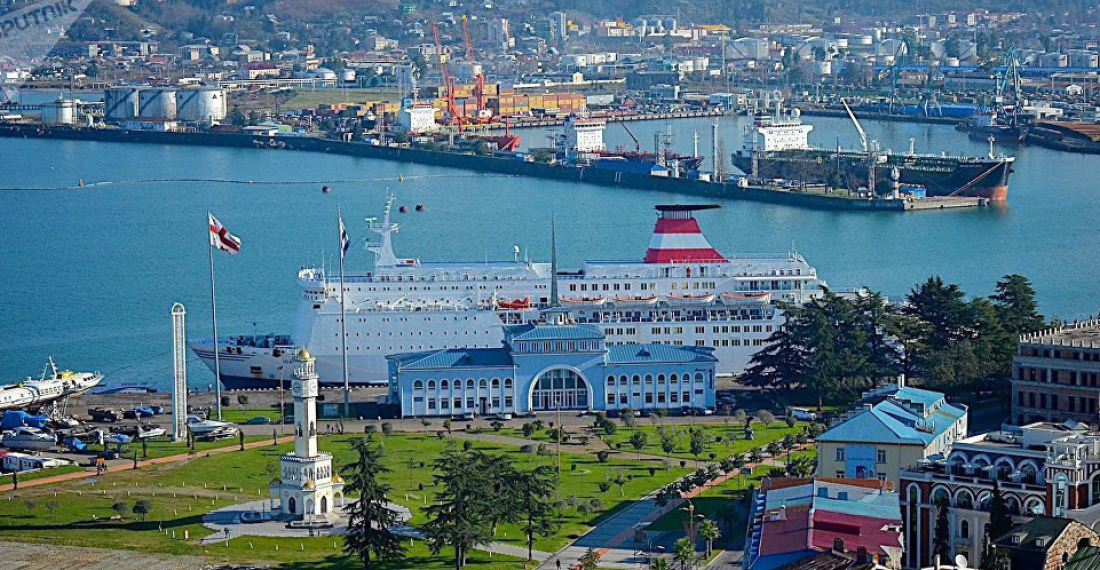
According to recent reports, Armenia based entities are using the sea route Batumi-Novorossiysk to re-export sanctioned goods to Russia. Through the Armenian Shipping Company, 600 containers with a total weight of 6 tons are transported to Russia weekly via Georgian ports.
This sophisticated Russo-Armenian scheme involves a variety of goods, such as clothing, cars, and spare parts, as well as medical equipment produced by Western companies. Among the most re-exported commodities are vehicles, especially American: they are usually delivered, through the Georgian ports, to Armenia, where they are registered and stored in the city of Gyumri. This is from where most of the cars are re-exported to Russia, again via Georgia. This scheme has been very well portrayed on Financial Times back in summer.
Such operations usually involve several stakeholders, such as C&M International LLC, the operator of transportation along the sea route Batumi-Novorossiysk, the Armenian Shipping Company, the customer company from Armenia, and Black Sea Forwarding LLC, a Russian-based recipient firm.
This also underlines the fact that Georgian entities are also complicit in the sanctions evasion practice via Armenia, though they may not be aware of where the goods originated from, which makes it difficult for state authorities to enforce the sanctions regime.
Claims that Armenia has been serving as Putin’s main logistics hub in the war against Ukraine are not new, and have been written about quite intensively.
According to the U.S. Bureau of Industry and Security, between 2021 and 2022, Armenia's imports of microprocessors and chips from the U.S. increased by approximately 500%, while shipments from the EU increased by approximately 200%. According to the bureau, up to 97 percent of these parts were subsequently re-exported to Russia. Russia and Armenia's trade volume topped $5 billion in 2022, which is a substantial increase in terms of the trade growth percentage. Russia and Armenia's commercial turnover reached $2.6 billion in 2021.
Unsurprisingly, U.S. State Department also addressed this issue and the Department`s Sanctions Coordinator, Jim O’Brien stated back in June 2023, that Russia's purchases of essential microchips and electronics have returned to pre-invasion stages, as Moscow found other nations to re-export the high-tech parts purchased from European corporations.
In September 2022, U.S. Treasury designated TACO LLC as a third-country supplier for “Radioavtomatika”, a major Russian defense procurement firm that specializes in procuring foreign items for Russia’s defense industry. The department consequently added it to the sanctions list for aiding Russia’s war effort in Ukraine. Similarly, Gazprom’s Armenia branch also faced sanctions due to it carrying out money transfers related to the purchase of Russian gas in roubles.
Armenia, a self-proclaimed democracy, and a nation that has been playing by Russian rules for quite some time has started acting rebellious vis-à-vis their strategic partner, Russia, and in Armenia there is talk of shifting the geopolitical orientation away from Russia. However, on the ground, the business is being run as usual as Armenia-based companies are not only collaborating with Russian firms, but also providing them a window to trade with the West.
The surge of the Armenian economy in the last two years further underlines the fact that it is institutionally attached to Russia and cannot prosper without the latter; this fact was somehow re-affirmed by former Armenian Minister of Finance, Vardan Aramyan, who said that Armenia is not able to endure possible Russian sanctions and that the lion's share of 12.6% growth posted by Armenia in 2022 was contributed by Russia. Aramyan also said that today Armenia's integration in the Russian market is quite high. For example, of the $980 million FDI in 2022, $585 million were reinvested profit, mostly from companies with Russian capital. The bulk of individual remittances sent to Armenia come from Russia and 50-60% of re-exports, which increased significantly in 2022 and 2023, go to Russia.
Even though this Armenian-Russian economic axis has been addressed by Western political circles and expert communities multiple times, and several Armenian organizations have been sanctioned, the West`s relaxed reaction seems surprising. Particularly nowadays when euphoria prevails in many Western capitals regarding Armenia`s alleged Westward drift. While Armenia`s Prime Minister Nikol Pashinyan in his October speech claimed that his country was ready to integrate with the European Union to the extent that the EU deems it possible, the Caucasus nation does not abandon its pro-Russian economic policies. In this situation, surprising is also the quick decision by France, a NATO member, to supply Armenia, a Russian ally, with weapons and air defense systems: no one gives a guarantee that the said Western military equipment and technology would not end up in the hands of Russia.